Compton Scattering
Compton scattering is the inelastic scattering of X-rays by electrons, producing a wavelength shift that depends on scattering angle. Historically, it strengthened the light-quantum idea by showing that radiation quanta behave as if they carry not only energy but also momentum .
The result did not replace wave optics. It added a new constraint: any adequate theory of light had to account for photon-like energy-momentum exchange in scattering as well as interference and diffraction.
X-Ray Scattering Setup
Section titled “X-Ray Scattering Setup”In the elementary Compton experiment, incident X-rays of wavelength strike a target containing electrons. The scattered radiation is observed at angle relative to the incident beam. The measured spectrum contains radiation with a shifted wavelength .
The defining result is
where is the electron mass. The length
is the electron Compton wavelength in the non-reduced convention.
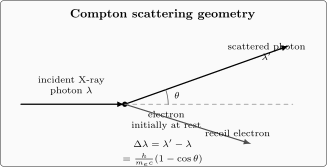
In the elementary free-electron model, the scattered photon leaves at angle with a longer wavelength . The shift is fixed by relativistic energy-momentum conservation.
The shift is zero for forward scattering and largest for backscattering:
Classical Wave Expectation
Section titled “Classical Wave Expectation”Classical electromagnetic theory already described scattering of radiation by charges. In the simplest free-electron Thomson picture, an incident wave drives electron oscillation, and the accelerated charge reradiates at the same frequency as the incident wave. That gives an angular distribution of scattered intensity, but not an angle-dependent wavelength increase of the Compton form.
This matters historically because Compton’s result was not merely another intensity anomaly. It was a kinematic statement. The wavelength shift behaved as if the radiation transferred a definite amount of momentum to an electron, with the recoil energy carried away by the electron.
Classical wave theory was not globally discarded. It remained essential for interference, diffraction, polarization, and the low-energy scattering limit. The new point was that continuous wave scattering alone did not account for the observed shifted X-ray component.
Photon Energy-Momentum Explanation
Section titled “Photon Energy-Momentum Explanation”For a photon,
If an incident photon scatters from an electron initially at rest, the outgoing photon has lower energy when . The missing energy appears as electron recoil energy, and the vector momentum change determines the scattering-angle dependence.
The physical picture is:
- the incident photon carries energy and momentum magnitude ;
- the scattered photon carries energy and momentum magnitude ;
- the electron recoils so total energy and total momentum are conserved;
- the angle fixes how much momentum must be transferred to the electron.
This is the momentum-side complement to the Photoelectric Effect, where the central evidence concerned energy transfer.
Relativistic Kinematics
Section titled “Relativistic Kinematics”The clean derivation uses special relativity. Use four-momentum convention and metric signature . Let and be the initial and final photon four-momenta, and let and be the initial and final electron four-momenta.
Conservation gives
Equivalently,
Squaring both sides and using and gives
In the electron rest frame before the collision,
Therefore
while
Equating these expressions and multiplying by gives
The derivation is kinematic. It does not require a detailed microscopic model of the target material, but the clean formula assumes scattering from an electron that can be treated as free and initially at rest.
Why It Strengthened the Photon Concept
Section titled “Why It Strengthened the Photon Concept”Einstein’s light quantum explained the photoelectric energy relation. Millikan’s measurements confirmed that relation with high precision. Compton scattering added a different piece: light quanta also participate in relativistic momentum conservation.
That was a major step because a purely energy-based quantum hypothesis could still seem like a rule for emission and absorption. Compton scattering made the light quantum behave as a scattering participant with four-momentum.
The evidence chain is therefore cumulative:
| Evidence | Main photon-like feature |
|---|---|
| Blackbody radiation | Universal quantum scale in radiation equilibrium |
| Photoelectric effect | Energy transfer in packets |
| Millikan’s measurements | Precision confirmation of the energy-frequency slope |
| Compton scattering | Momentum transfer with |
The modern photon still belongs to a later theory. In quantum electrodynamics, photons are quanta of the electromagnetic field, and scattering probabilities are computed from amplitudes. Compton’s result is one of the historical bridges to that field-theoretic picture.
Limits of the Elementary Formula
Section titled “Limits of the Elementary Formula”The elementary Compton formula is not a complete scattering theory. Real targets contain bound electrons, and spectra can include both shifted and unshifted components. At low photon energies the Thomson limit is recovered. At higher energies, spin, polarization, recoil, and quantum electrodynamic corrections matter.
For the historical argument, the central point is narrower and stronger: the observed wavelength shift has the angular dependence predicted by photon energy-momentum conservation.
Common Mistakes
Section titled “Common Mistakes”- Saying Compton scattering proved light is a tiny classical particle. It supported photon-like four-momentum, not classical corpuscles.
- Forgetting the angle dependence. The shift is proportional to , not just to photon energy.
- Confusing the Compton wavelength with the reduced Compton wavelength .
- Applying the free-electron formula without checking whether binding effects matter.
- Treating Compton scattering as a replacement for wave optics rather than as additional evidence that light requires quantum theory.
Cross-Links
Section titled “Cross-Links”- Light Quanta and Photon Evidence
- Photoelectric Effect
- Einstein’s Light Quantum Hypothesis
- Millikan’s Photoelectric Measurements
- Special Relativity Checklist
- Momentum-Space Representation
- Compton Scattering Reference
- Constants
- Natural Units
- Bridge to QFT Scattering
References
Section titled “References”- A. H. Compton, “A Quantum Theory of the Scattering of X-rays by Light Elements,” Physical Review 21, 483-502 (1923), DOI: 10.1103/PhysRev.21.483.
- A. H. Compton, “The Spectrum of Scattered X-Rays,” Physical Review 22, 409-413 (1923), DOI: 10.1103/PhysRev.22.409.
- Nobel Prize Outreach, The Nobel Prize in Physics 1927.
- J. J. Sakurai and J. Napolitano, Modern Quantum Mechanics, 3rd ed., Cambridge University Press, 2020.
- M. Jammer, The Conceptual Development of Quantum Mechanics, 2nd ed., American Institute of Physics, 1989.
Exercises
Section titled “Exercises”- Show that the Compton shift vanishes for forward scattering and equals for backscattering.
Solution
The shift is
For , , so . For , , so
- Using , compute the shift at .
Solution
At , . Therefore
- Why is Compton scattering stronger evidence for photon momentum than the photoelectric effect alone?
Solution
The photoelectric effect mainly constrains energy transfer: the maximum electron kinetic energy depends on . Compton scattering constrains both energy and vector momentum through the angle-dependent wavelength shift. The formula follows from treating the photon as carrying momentum and conserving relativistic four-momentum with the recoiling electron.