Photoelectric Effect
The photoelectric effect is the emission of electrons from a material surface when light of suitable frequency illuminates it. Its historical force came from a simple pattern: electron emission depends sharply on frequency, and the maximum electron kinetic energy grows linearly with frequency rather than with light intensity.
Experimental Phenomenon
Section titled “Experimental Phenomenon”In a basic photoelectric experiment, light strikes a metal surface and emitted electrons are collected by an electrode. By applying a retarding voltage, one can find the stopping potential needed to prevent even the fastest emitted electrons from reaching the collector.
The key observations are:
- below a threshold frequency, no electrons are emitted regardless of ordinary intensity changes;
- above threshold, increasing intensity increases the photoelectric current but not the maximum electron kinetic energy;
- the maximum kinetic energy grows approximately linearly with frequency.
Classical Expectation
Section titled “Classical Expectation”In a purely classical wave picture, the light’s energy is spread over the wave. It is then natural to expect intensity to control the energy transferred to electrons, with sufficiently intense light eventually ejecting electrons even at low frequency.
That expectation misses the observed threshold and the frequency dependence of the stopping potential. The failure is not that classical waves cannot carry energy; they can. The failure is that a continuous-wave energy-transfer picture does not match the observed emission law.
Einstein’s Energy Relation
Section titled “Einstein’s Energy Relation”Einstein’s 1905 light-quantum hypothesis explained the effect by assigning energy to a quantum of light. If is the work function of the surface, the maximum kinetic energy is
The stopping potential satisfies
so the measurable relation is
The threshold frequency is therefore
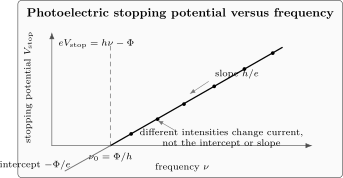
In the simplest single-photon photoelectric relation, the stopping potential is linear in frequency. The slope determines , while the threshold frequency records the work function of the material.
Millikan’s Measurements
Section titled “Millikan’s Measurements”Millikan’s precision measurements confirmed the linear frequency relation and gave a determination of Planck’s constant, even though Millikan was historically cautious about Einstein’s light-quantum interpretation. This is one reason the photoelectric effect is such a useful historical case: experimental confirmation and conceptual acceptance did not proceed at the same pace.
The relation was not merely a qualitative story. Stopping-potential data made the slope measurable:
Modern Formulation
Section titled “Modern Formulation”The simple Einstein relation is a clean maximum-energy law for single-photon photoemission from a material with work function . Real photoemission can involve band structure, surface conditions, temperature, multiphoton processes, and many-body effects. Those refinements do not erase the historical lesson: frequency, not intensity alone, controls the maximum energy in the basic regime.
Modern quantum mechanics treats light-matter interaction through transition amplitudes, energy conservation, and quantum states. The fully field-theoretic photon belongs to quantum electrodynamics, but the photoelectric effect is one of the decisive entrance points to light quanta.
What the Effect Did and Did Not Prove
Section titled “What the Effect Did and Did Not Prove”The photoelectric effect supported the light-quantum idea because it made energy transfer appear localized in packets of size . It did not by itself establish every modern feature of photons, nor did it abolish wave behavior of light. Interference and diffraction remained real; the challenge was to build a theory in which wave-like propagation and quantized detection both have a place.
Common Misconceptions
Section titled “Common Misconceptions”- Brighter light should always make more energetic electrons: in the basic single-photon regime, intensity changes current, while frequency controls maximum kinetic energy.
- The threshold means electrons need time to store enough energy: the observed threshold is a frequency condition in the simple relation.
- The photoelectric effect alone proves the whole photon concept: it supports light quanta, while later evidence such as Compton scattering strengthens the momentum side.
- The work function is universal: depends on the material and surface conditions.
Cross-Links
Section titled “Cross-Links”- Light Quanta and Photon Evidence
- Blackbody Radiation
- Common Historical Misconceptions
- Energy Eigenstates
- Planck Constant Symbol
- QFT Bridge Index
References
Section titled “References”- A. Einstein, “Über einen die Erzeugung und Verwandlung des Lichtes betreffenden heuristischen Gesichtspunkt,” Annalen der Physik 322, 132-148 (1905), DOI: 10.1002/andp.19053220607.
- R. A. Millikan, “A Direct Photoelectric Determination of Planck’s h,” Physical Review 7, 355-388 (1916), DOI: 10.1103/PhysRev.7.355.
- Nobel Prize Outreach, Albert Einstein Facts.
- M. Jammer, The Conceptual Development of Quantum Mechanics, 2nd ed., American Institute of Physics, 1989.
Exercises
Section titled “Exercises”- A material has work function . What threshold frequency is predicted by the Einstein relation?
Solution
The threshold is . Using gives