Blackbody Radiation
Blackbody radiation is the universal spectrum emitted by an ideal absorber-emitter in thermal equilibrium. Historically, it became a crisis because classical electromagnetic mode counting and thermal equipartition predicted the wrong high-frequency behavior.
What Is a Blackbody?
Section titled “What Is a Blackbody?”A blackbody is an idealized body that absorbs all incident radiation and emits a thermal spectrum determined only by its temperature. A cavity with a small aperture is the standard physical model: radiation entering the aperture is very likely to be absorbed after multiple internal reflections, and radiation escaping the aperture samples the equilibrium field inside.
The importance of the blackbody ideal is universality. The detailed material of the cavity walls should not determine the final equilibrium spectrum. That made blackbody radiation a sharp test of thermodynamics, electromagnetism, and statistical mechanics.
The Empirical Spectrum
Section titled “The Empirical Spectrum”The measured spectrum has three essential features:
- it rises from low frequency,
- it has a temperature-dependent peak,
- it falls rapidly at high frequency.
As temperature increases, the total emitted energy grows and the peak shifts toward higher frequency.
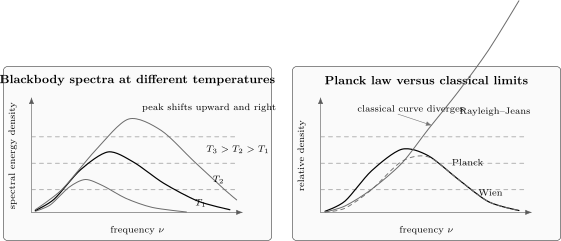
Blackbody spectra are universal functions of temperature. The left panel shows the qualitative temperature shift of the peak. The right panel shows why the Rayleigh–Jeans classical form fails at high frequency while Planck’s law has the observed falloff.
Classical Mode Counting
Section titled “Classical Mode Counting”Inside a cavity, classical electromagnetism allows standing-wave modes. Counting modes in a frequency interval gives a density proportional to . Classical equipartition then assigns an average energy to each mode, giving the Rayleigh–Jeans form
This formula agrees with the low-frequency limit but grows without bound as increases. Integrating over all frequencies gives an infinite energy density. That is the ultraviolet catastrophe.
Planck’s Resolution
Section titled “Planck’s Resolution”Planck’s successful law can be written as
At low frequency, where , this reduces to the Rayleigh–Jeans form. At high frequency, the exponential denominator suppresses the spectrum and gives the observed falloff.
The new element is not merely a better fitting curve. The factor enters as an energy quantum for oscillators exchanging energy with the radiation field. This was a decisive break from unrestricted continuous classical energy exchange.
What the Episode Did Not Immediately Prove
Section titled “What the Episode Did Not Immediately Prove”Historical caution: Planck’s work did not instantly establish the modern photon. Planck introduced quantization in a radiation-equilibrium calculation involving oscillators. Einstein’s 1905 light-quantum hypothesis, the photoelectric effect, Compton scattering, and later quantum field theory all contributed to the modern photon concept.
It is therefore more accurate to say:
blackbody radiation forced energy quantization into radiation theory,but the full photon concept emerged through later evidence and theory.Why It Matters for Quantum Mechanics
Section titled “Why It Matters for Quantum Mechanics”Blackbody radiation matters because it reveals a failure of classical state counting and energy exchange. The later formal theory generalizes the lesson:
- energies of bound systems can form discrete spectra,
- thermal occupation is not classical equipartition over all modes,
- Planck’s constant sets a scale for quantum effects,
- identical-particle and oscillator statistics become central in radiation theory.
The blackbody problem is therefore both a historical origin and a warning. A formula can be empirically excellent and still require careful interpretation about what has actually been established.
Common Mistakes
Section titled “Common Mistakes”- Saying that Planck discovered photons.
- Treating the ultraviolet catastrophe as merely a bad extrapolation rather than a structural failure of classical equipartition.
- Forgetting that Rayleigh–Jeans works at low frequency.
- Presenting Planck’s law as pure curve fitting without the oscillator-energy assumption.
- Treating blackbody radiation as the only route into quantum mechanics.
Cross-Links
Section titled “Cross-Links”- Thermal Light for the mode-state, photon-statistics, and correlation structure behind the equilibrium spectrum.
- Where Classical Physics Failed
- Evidence Map
- Common Historical Misconceptions
- Constants, Units, and Conventions
- Bose-Einstein Distribution
References
Section titled “References”- T. S. Kuhn, Black-Body Theory and the Quantum Discontinuity, 1894-1912, University of Chicago Press, 1978.
- M. Planck, “Ueber das Gesetz der Energieverteilung im Normalspectrum,” Annalen der Physik 309, 553-563 (1901), DOI: 10.1002/andp.19013090310.
- Nobel Prize Outreach, Max Planck Facts.
- M. Jammer, The Conceptual Development of Quantum Mechanics, 2nd ed., American Institute of Physics, 1989.
Exercises
Section titled “Exercises”- Show that Planck’s law reduces to the Rayleigh–Jeans form when .
Solution
For , . Substituting this into Planck’s law gives
which is the Rayleigh–Jeans expression.