The Ultraviolet Catastrophe
The ultraviolet catastrophe is the high-frequency divergence produced when classical electromagnetic mode counting is combined with classical equipartition. It is one of the cleanest ways to see why blackbody radiation forced a change in microscopic state counting.
The phrase is a later pedagogical label, so it should be used with care. Historically, blackbody radiation developed through Kirchhoff’s universality, Wien’s scaling laws, measurements over broader frequency ranges, Rayleigh and Jeans’s classical limit, and Planck’s radiation law. The “catastrophe” is the sharp mathematical diagnosis of the classical high-frequency failure.
Classical Mode Density
Section titled “Classical Mode Density”Consider electromagnetic radiation in a large cavity. Classical Maxwell theory allows standing-wave modes. Counting the allowed wave vectors and including two transverse polarizations gives the number of modes per unit volume between frequency and :
The factor is the important part. In three dimensions, the number of modes grows like the surface area of a sphere in wave-vector space. Higher frequencies therefore have more available modes.
This mode count is not the part that fails. The same density appears in the successful Planck law. The failure comes from how classical statistical mechanics assigns energy to those modes.
Equipartition Intuition
Section titled “Equipartition Intuition”Each classical electromagnetic normal mode behaves like a harmonic oscillator. For a classical harmonic oscillator at temperature , equipartition assigns an average energy
Multiplying the mode density by this average energy gives the Rayleigh–Jeans spectral energy density:
At low frequency this is right. The problem is that classical equipartition assigns the same average energy to every mode, no matter how high the frequency.
High-Frequency Divergence
Section titled “High-Frequency Divergence”The total radiation energy density predicted by Rayleigh–Jeans is obtained by integrating over all frequencies:
With a finite high-frequency cutoff , the integral is
As , this diverges:
That is the ultraviolet catastrophe. The word “ultraviolet” refers to the high-frequency, short-wavelength side of the spectrum. The word “catastrophe” refers to the fact that the theory predicts infinite energy density in a finite-temperature cavity.
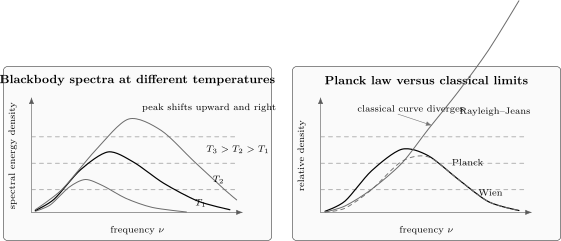
The Rayleigh–Jeans expression matches the low-frequency limit but grows without bound at high frequency. Planck’s law preserves the low-frequency behavior and suppresses high-frequency modes.
Why Experiment Disagrees
Section titled “Why Experiment Disagrees”Real blackbody spectra do not grow without bound. They rise at low frequency, reach a temperature-dependent peak, and then fall rapidly at high frequency. The total energy density is finite and scales as a power of temperature rather than becoming infinite.
The disagreement is structural:
| Feature | Rayleigh–Jeans prediction | Observed spectrum |
|---|---|---|
| Low frequency | Correct limiting behavior | |
| Peak | No finite peak | Has a finite peak |
| High frequency | Grows without bound | Falls rapidly |
| Total energy | Infinite | Finite |
This is why the blackbody problem was not a small correction to a nearly right curve. The low-frequency success and high-frequency failure had to be reconciled in one formula.
Why Quantum Suppression Solves It
Section titled “Why Quantum Suppression Solves It”Planck’s law replaces the classical average mode energy with
At low frequency, , this becomes approximately , so Rayleigh–Jeans is recovered. At high frequency, , it behaves like
Thus the high-frequency spectrum behaves like a power of multiplied by an exponential suppression:
The exponential wins over the polynomial growth in the mode density, so the total energy remains finite.
The physical interpretation is simple but profound: high-frequency modes are not easily thermally excited because their energy spacing is large compared with .
Historical Caution
Section titled “Historical Caution”The ultraviolet catastrophe is a useful derivation for students, but it can make the history sound too linear. The phrase became a compact retrospective label for the classical failure. Around 1900, the problem was embedded in a broader web of empirical spectra, thermodynamic arguments, and competing formulas.
Use the term to name the divergence. Do not use it to imply that the entire quantum revolution followed from one dramatic plot of a wrong curve. Blackbody radiation was one route into quantization, alongside the photoelectric effect, atomic spectra, heat capacities, matter waves, and spin evidence.
Common Mistakes
Section titled “Common Mistakes”- Blaming Maxwell’s equations alone; the divergence comes from Maxwell mode density plus classical equipartition.
- Forgetting that Rayleigh–Jeans is correct at low frequency.
- Treating the ultraviolet catastrophe as the same thing as all of blackbody radiation history.
- Assuming a finite experimental cutoff would solve the theoretical problem; the theory itself has no natural high-frequency cutoff.
- Saying Planck simply “cut off” the modes; Planck changed the thermal occupation of high-frequency modes.
- Thinking the exponential suppression is arbitrary rather than tied to the energy scale .
Cross-Links
Section titled “Cross-Links”- Blackbody Radiation
- Kirchhoff, Wien, Rayleigh, and Jeans
- Planck’s Radiation Law
- Quantized Oscillators
- Classical Electromagnetism Before Quantum Theory
- Thermodynamics and Statistical Mechanics Before Quantum Theory
- Bose-Einstein Distribution
References
Section titled “References”- Lord Rayleigh, “Remarks upon the Law of Complete Radiation,” Philosophical Magazine 49, 539-540 (1900).
- J. H. Jeans, “On the Partition of Energy between Matter and Aether,” Philosophical Magazine 10, 91-98 (1905).
- M. Planck, “Ueber das Gesetz der Energieverteilung im Normalspectrum,” Annalen der Physik 309, 553-563 (1901), DOI: 10.1002/andp.19013090310.
- T. S. Kuhn, Black-Body Theory and the Quantum Discontinuity, 1894-1912, University of Chicago Press, 1978.
- R. K. Pathria and P. D. Beale, Statistical Mechanics, 3rd ed., Academic Press, 2011.
- D. J. Griffiths, Introduction to Electrodynamics, 4th ed., Cambridge University Press, 2017.
Exercises
Section titled “Exercises”- Derive the cutoff form of the Rayleigh–Jeans energy density.
Solution
Start from
Integrating up to gives
The cubic growth with cutoff shows why the limit diverges.
- Why does Planck’s high-frequency form remain integrable?
Solution
At high frequency, Planck’s spectrum behaves like
An exponential decay dominates any finite power of , so the integral over high frequencies converges. This is the mathematical reason quantum suppression removes the ultraviolet divergence.
- Explain why the ultraviolet catastrophe is not simply “Maxwell was wrong.”
Solution
The electromagnetic mode density from Maxwell theory is still used in Planck’s law. The failure comes from combining that mode density with classical equipartition, which assigns average energy to every mode. Quantum theory changes the thermal occupation of high-frequency modes while preserving the classical mode density in the appropriate cavity setting.