Millikan’s Photoelectric Measurements
Millikan’s photoelectric measurements turned Einstein’s photoelectric equation from a striking explanation into a precision experimental test. The result was historically delicate: the linear stopping-potential law was confirmed with high accuracy, and the slope gave Planck’s constant, but the light-quantum interpretation was still debated.
The experiment is therefore a useful warning against compressed histories. A formula can become experimentally secure before its interpretation is universally accepted.
Experimental Goal
Section titled “Experimental Goal”The goal was to measure the maximum kinetic energy of photoelectrons as a function of incident light frequency. In the simple Einstein relation,
the work function depends on the emitting surface, while the slope with respect to frequency should be the universal constant .
Experimentally, one does not usually measure by tracking individual emitted electrons. Instead, one applies a retarding voltage and asks how large it must be to stop even the fastest photoelectrons from reaching the collector. That stopping potential gives
where is the positive elementary charge magnitude. The predicted observable law is
Millikan’s task was to test whether this relation was genuinely linear and whether its slope agreed with the value of inferred from other quantum phenomena.
Stopping Potential Measurements
Section titled “Stopping Potential Measurements”A photoelectric measurement illuminates a carefully prepared metal surface, collects the emitted electrons, and records the current as a function of applied voltage. A retarding voltage reduces the current because lower-energy electrons can no longer reach the collector. The stopping potential is the voltage at which the fastest emitted electrons are just stopped.
In an idealized diagram, each frequency gives a current-voltage curve. The endpoint of that curve determines . Repeating the procedure for several frequencies produces a plot of stopping potential versus frequency.
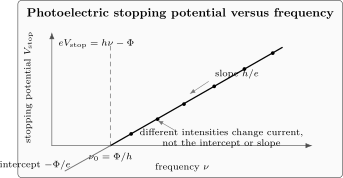
Millikan-type stopping-potential measurements test the linear relation between frequency and maximum photoelectron energy. The slope gives , while the intercept depends on the work function.
The practical difficulty is that real surfaces are not abstract work-function machines. Surface contamination, oxidation, contact potentials, temperature, and residual gas can shift the apparent intercept or blur the endpoint. Millikan’s precision work mattered because it treated those experimental details as central, not as small nuisances to be hand-waved away.
The conceptual separation is important:
| Measured feature | Physical inference |
|---|---|
| Threshold frequency | The surface has a minimum removal energy |
| Slope of versus | The ratio |
| Change in current with intensity | Change in emission rate, in the simple regime |
| Lack of stopping-potential change with intensity | Maximum energy is frequency-controlled |
Extraction of Planck’s Constant
Section titled “Extraction of Planck’s Constant”The most robust part of the measurement is the slope. From
one obtains
Thus
The intercept determines the material-dependent work function:
if the fitted line is extrapolated to zero frequency. Equivalently, the threshold frequency satisfies
In practice, the slope is the universal test, while the intercept is where surface physics and apparatus details enter most visibly. A successful experiment must not merely produce a straight line; it must produce the correct universal slope across surface preparations and frequencies within the experimental uncertainties.
Historical Irony
Section titled “Historical Irony”Millikan’s 1916 result is famous partly because it confirmed the equation associated with Einstein’s light quantum while Millikan himself remained cautious about accepting the light quantum as a literal description of radiation. That caution was not irrational. Classical electromagnetic waves explained interference, diffraction, polarization, and many optical measurements with extraordinary success.
The historical point is sharper than “Millikan proved Einstein right.” Millikan confirmed the empirical relation
and obtained a value of consistent with the broader quantum scale. But accepting the relation did not immediately answer the deeper theoretical question: how should wave propagation and localized energy exchange coexist in one coherent theory?
This is why the page on Einstein’s Light Quantum Hypothesis treats the hypothesis as historically radical rather than as an obvious consequence of Planck’s blackbody calculation.
Role in Establishing Light Quanta
Section titled “Role in Establishing Light Quanta”Millikan’s measurements strengthened the case for light quanta in three ways.
First, they showed that the maximum photoelectron energy is controlled by frequency through a linear law. That behavior is hard to reconcile with a naive continuous-wave energy reservoir in which intensity alone sets the transferred energy.
Second, they connected photoelectric data to the same Planck constant that appeared in blackbody radiation. The constant was no longer a parameter isolated inside a thermal radiation formula; it appeared in a separate light-matter experiment.
Third, the measurements clarified what remained unsettled. They supported quantized energy exchange but did not by themselves establish every modern feature of photons, especially photon momentum. That role was strengthened later by Compton Scattering, where the wavelength shift follows from photon energy-momentum conservation.
What Was and Was Not Confirmed
Section titled “What Was and Was Not Confirmed”Millikan’s measurements confirmed the stopping-potential law in the regime tested:
They also confirmed that the slope is universal in the way Einstein’s formula requires. This is the experimentally durable content students should retain.
The measurements did not show that light is a beam of tiny classical particles. They did not explain interference. They did not provide a full quantum theory of radiation. They did not eliminate the need for wave optics. The modern photon concept is a quantum-field concept, and the early photoelectric data are one part of the evidence chain leading toward it.
Common Mistakes
Section titled “Common Mistakes”- Treating Millikan’s experiment as a measurement of the work function alone. The historically important universal result is the slope .
- Saying intensity has no effect at all. Intensity can change the emitted current; in the simple single-photon regime it does not change at fixed frequency.
- Confusing a confirmed equation with immediate acceptance of a complete interpretation.
- Forgetting that real photoelectric surfaces are sensitive to preparation and contamination.
- Reading the early light quantum as the fully modern quantum electrodynamic photon.
Cross-Links
Section titled “Cross-Links”- Light Quanta and Photon Evidence
- Photoelectric Effect
- Einstein’s Light Quantum Hypothesis
- Planck’s Constant
- Historical Cautions About Planck
- Constants
- Planck Constant Symbol
- Photoelectric Effect Reference
- Compton Scattering
- Energy Eigenstates
References
Section titled “References”- R. A. Millikan, “A Direct Photoelectric Determination of Planck’s h,” Physical Review 7, 355-388 (1916), DOI: 10.1103/PhysRev.7.355.
- A. Einstein, “Über einen die Erzeugung und Verwandlung des Lichtes betreffenden heuristischen Gesichtspunkt,” Annalen der Physik 322, 132-148 (1905), DOI: 10.1002/andp.19053220607.
- Nobel Prize Outreach, The Nobel Prize in Physics 1923.
- T. S. Kuhn, Black-Body Theory and the Quantum Discontinuity, 1894-1912, University of Chicago Press, 1978.
- M. Jammer, The Conceptual Development of Quantum Mechanics, 2nd ed., American Institute of Physics, 1989.
Exercises
Section titled “Exercises”- A stopping-potential fit gives slope . Use to estimate .
Solution
Since the slope is ,
Using gives
- A metal has threshold frequency . Estimate its work function in electronvolts using .
Solution
At threshold,
Therefore
- Explain why Millikan’s confirmation of the photoelectric equation did not instantly settle the interpretation of light.
Solution
The experiment confirmed a relation between stopping potential and frequency, including the universal slope . But wave optics still had overwhelming empirical support, and the experiment did not explain interference, diffraction, or the full dynamics of radiation. It showed that light-matter energy exchange is quantized in the photoelectric regime; it did not by itself provide the complete modern photon theory.