From Matter Waves to Schrödinger Equation
Matter waves made a new mechanics plausible. If material particles carry phase and wavelength, then a theory of particles should look partly like a wave theory. Schrödinger’s equation was the decisive step: it turned the de Broglie relations into a differential equation that could calculate spectra, scattering, wave packets, and tunneling.
This page is a bridge, not a derivation from first principles. The modern equation belongs to Time-Dependent Schrödinger Equation and Schrödinger Equation. The historical page is Schrödinger’s Wave Mechanics.
Momentum-Wavelength Relation
Section titled “Momentum-Wavelength Relation”The de Broglie relation assigns a wavelength to a particle of momentum :
Equivalently, using ,
This relation made electron diffraction intelligible. A beam of electrons accelerated through a voltage has a calculable momentum, and hence a calculable wavelength. Crystal scattering then tests whether that wavelength appears in diffraction. See de Broglie Matter Waves and Electron Diffraction.
The modern interpretation is sharper: plane waves are momentum eigenstate idealizations, and localized particles require wave packets. The wavelength is not a literal water-wave ripple attached to a tiny object.
Energy-Frequency Relation
Section titled “Energy-Frequency Relation”Quantum theory also used the relation
For a nonrelativistic free particle,
Combining these with gives the free-particle dispersion relation
This relation is already different from a classical nondispersive wave such as an ideal string wave with . Matter-wave packets spread because different components move with different group velocities. The canonical treatment is Free Particle and Group Velocity and Phase Velocity.
Wave Equation Logic
Section titled “Wave Equation Logic”Consider a plane wave
It satisfies
and
The two sides agree when
Thus the free Schrödinger equation
has exactly the de Broglie free-particle dispersion relation.
This is a powerful heuristic. It is not a complete derivation of quantum mechanics. It does not by itself justify the Born rule, boundary conditions, Hilbert-space domains, spin, identical particles, or measurement theory. It explains why the form of the equation was natural once matter waves were taken seriously.
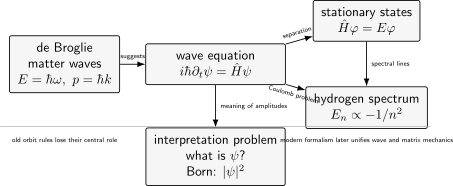
Matter-wave relations suggested a wave equation for particles. Schrödinger’s equation then made stationary states, hydrogen spectra, wave packets, and the probability interpretation part of one calculational framework.
Schrödinger Equation
Section titled “Schrödinger Equation”For a single spinless nonrelativistic particle in a scalar potential, the coordinate-space equation is
The free-particle part encodes the matter-wave dispersion. The potential term imports the classical energy function into the wave equation in a way that works for many nonrelativistic systems.
In modern language, this is a representation of the abstract state equation
The Hamiltonian is the generator of time evolution. In coordinate representation for a particle with scalar potential, it becomes a differential operator. This representation-level distinction matters: the Schrödinger equation is not only a rule for waves in ordinary space; it is the time-evolution law for quantum states represented in a chosen basis.
Stationary States and Spectra
Section titled “Stationary States and Spectra”When the Hamiltonian is time independent, one looks for stationary states:
The time dependence is then
This is the bridge from wave mechanics to spectra. Bound-state boundary conditions can make only certain energies possible. Hydrogen is the historical example: solving the Coulomb problem gives the Rydberg pattern without classical electron orbits.
The same equation also allows continuum states, scattering states, and wave packets. Therefore the lesson is not “Schrödinger’s equation makes every energy discrete.” The lesson is that spectra follow from the Hamiltonian, boundary conditions, and domain.
Modern State Evolution
Section titled “Modern State Evolution”Modern quantum mechanics keeps the wave-equation successes but places them in a broader structure:
- states live in Hilbert space;
- wavefunctions are representations of states;
- Hamiltonians generate time evolution;
- observables are operators;
- probabilities come from the Born rule;
- composite systems use tensor products;
- spin and identical particles require additional structure.
The bridge from matter waves to Schrödinger’s equation is therefore one part of the path, not the whole formalism. It explains why wave mechanics worked, while the full theory explains how wave mechanics, matrix mechanics, measurement, and composition fit together.
Common Mistakes
Section titled “Common Mistakes”- Treating the plane-wave heuristic as a rigorous derivation of all quantum mechanics.
- Forgetting that plane waves are not normalizable localized states.
- Saying Schrödinger’s equation was simply guessed without physical motivation.
- Treating as a classical material wave in ordinary space for every system.
- Assuming the nonrelativistic equation applies to photon states or relativistic particle creation.
- Forgetting that potentials, boundary conditions, and domains are part of the problem.
Cross-Links
Section titled “Cross-Links”- From Old Quantum Theory to Hilbert Space
- de Broglie Matter Waves
- Electron Diffraction
- Wave Packets
- Schrödinger’s Wave Mechanics
- Time-Dependent Schrödinger Equation
- Time-Independent Schrödinger Equation
- Free Particle
- Group Velocity and Phase Velocity
- Wavefunctions as Representations
- Schrödinger Equation
References
Section titled “References”- L. de Broglie, Recherches sur la théorie des quanta, doctoral thesis, Paris, 1924.
- E. Schrödinger, “Quantisierung als Eigenwertproblem,” Annalen der Physik 79, 361-376, 1926.
- E. Schrödinger, “An Undulatory Theory of the Mechanics of Atoms and Molecules,” Physical Review 28, 1049-1070, 1926, DOI: 10.1103/PhysRev.28.1049.
- M. Jammer, The Conceptual Development of Quantum Mechanics, 2nd ed., American Institute of Physics, 1989.
- O. Darrigol, From c-Numbers to q-Numbers: The Classical Analogy in the History of Quantum Theory, University of California Press, 1992.
- R. Shankar, Principles of Quantum Mechanics, 2nd ed., Springer, 1994.
Exercises
Section titled “Exercises”- Show that the free plane wave satisfies the free Schrödinger equation only if .
Solution
For the plane wave,
and
The equation holds when the coefficients match:
so
- Use to compute the group velocity.
Solution
The group velocity is
Since , this is
the classical nonrelativistic velocity.
- Why does adding to the Hamiltonian not follow from the free plane-wave argument alone?
Solution
The plane-wave argument uses the free-particle relation . A potential changes the energy function and may introduce position dependence, boundary conditions, and domain issues. Writing and replacing by is a successful quantization rule in many nonrelativistic settings, but it is an additional structural step, not a consequence of one free plane wave.
- Why is the Schrödinger equation not the whole quantum formalism?
Solution
It gives time evolution for a state under a Hamiltonian. The full formalism also needs a state space, observables, probability rules, measurement modeling, composition rules for multiple systems, spin degrees of freedom, and treatment of identical particles and mixed states.