From Quantum Statistics to Fock Space
Quantum statistics changed what it means to count many-particle states. Classical statistical mechanics begins with labeled particles and then divides by a factorial to repair overcounting. Quantum mechanics goes deeper: for identical particles, the labels themselves are not physical degrees of freedom. The modern language is exchange symmetry, bosons, fermions, occupation numbers, and Fock space.
This page is a bridge. The historical counting pages are Bose’s Counting Argument, Bose–Einstein Statistics, and Fermi–Dirac Statistics. The canonical many-particle formalism begins at Indistinguishability and Occupation-Number Basis.
Counting Indistinguishable States
Section titled “Counting Indistinguishable States”The historical clue was counting. Bose’s treatment of radiation did not count photons as individually labeled objects distributed among cells. Einstein extended the idea to material particles, leading to Bose–Einstein statistics and the prediction of condensation in an ideal gas. Fermi and Dirac then developed the corresponding exclusion-based statistics for particles later called fermions.
The modern lesson is not merely that one must divide by . For genuinely identical quantum particles, a state does not contain particle labels as observable tags. If two identical particles occupy one-particle modes and , the labels “particle 1” and “particle 2” are bookkeeping devices, not physical identities.
The formal problem is therefore not
as two distinct physical alternatives. Instead, the physical state must live in a symmetric or antisymmetric sector, depending on the particle species.
Bosons and Fermions
Section titled “Bosons and Fermions”For two identical particles, the exchange operator swaps the slots:
Bosonic states are symmetric:
Fermionic states are antisymmetric:
This sign is not a convention that can be changed for a given particle species. In nonrelativistic quantum mechanics it is imposed as the symmetrization postulate. In relativistic quantum field theory, the spin-statistics theorem explains why integer-spin particles are bosons and half-integer-spin particles are fermions under standard assumptions.
Historically, bosons entered through radiation and Bose–Einstein counting, while fermions entered through atomic structure, Pauli exclusion, and electron-gas physics. The modern pages Bosons and Fermions own the detailed formalism.
Symmetric and Antisymmetric States
Section titled “Symmetric and Antisymmetric States”For distinct one-particle states and , the normalized two-boson state is
The corresponding two-fermion state is
If , the antisymmetric expression vanishes:
This is the elementary wavefunction version of Pauli exclusion: two identical fermions cannot occupy the same complete one-particle state. For bosons, the same-mode case is allowed and is central to phenomena such as stimulated emission, coherent light, and Bose–Einstein condensation.
The canonical construction is Symmetric and Antisymmetric Wavefunctions. Slater determinants and permanents are the scalable wavefunction expressions for fermions and bosons, but they become cumbersome as particle number grows. That is where occupation numbers become natural.
Occupation Numbers
Section titled “Occupation Numbers”Instead of asking “which particle is in which state,” occupation-number language asks “how many particles occupy each mode.” A basis state is written
For bosons,
For fermions,
This notation is not just shorter. It encodes indistinguishability from the start. The labels refer to modes, not to named particles. For example, the state means two particles in mode , none in mode , one in mode , and so on, subject to the bosonic or fermionic rules.
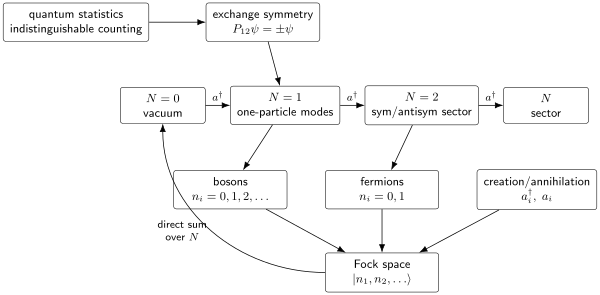
Quantum statistics replaces particle labels with exchange symmetry and mode occupations. Fock space organizes the vacuum, one-particle, two-particle, and higher-particle sectors in a single Hilbert-space structure.
The detailed construction belongs to Occupation-Number Basis, Number States, and Mode Occupations.
Creation and Annihilation Operators
Section titled “Creation and Annihilation Operators”Fock space is the direct sum of particle-number sectors. If is a one-particle Hilbert space, then the bosonic and fermionic Fock spaces are
and
The sector is the vacuum state. Creation operators move from one sector to the next; annihilation operators move in the opposite direction. For a mode , a bosonic creation operator acts schematically as
For fermions, the action is constrained by and by sign conventions tied to mode ordering. Algebraically, this is expressed by anticommutation relations such as
Bosonic operators instead satisfy commutation relations such as
The full operator calculus belongs to Creation and Annihilation Operators, Bosonic Commutation Relations, Fermionic Anticommutation Relations, and Number Operators.
Bridge to Field Theory
Section titled “Bridge to Field Theory”Fock space is already useful in nonrelativistic many-body quantum mechanics: electron gases, phonons, photons in quantum optics, ultracold atoms, lattice models, and quantum chemistry all use occupation-number thinking.
Field theory changes the status of the language. In a free field, modes behave like harmonic oscillators and particles are excitations created from a vacuum. In interacting relativistic theories, particle number may not be conserved, and the vacuum is not merely an empty box. Still, the Fock-space vocabulary supplies the first bridge from many-particle quantum mechanics to fields:
- particle states become mode excitations;
- one-body and two-body operators become field-operator expressions;
- bosonic commutators and fermionic anticommutators encode statistics;
- variable particle number becomes natural rather than exceptional;
- scattering theory uses asymptotic particle states even when interactions are present.
The nonrelativistic bridge is Second Quantization: Bridge to QFT, and the reference bridge is Fock Space. This page only explains why the historical statistics problem points toward that structure.
Common Mistakes
Section titled “Common Mistakes”- Treating indistinguishability as ignorance about which labeled particle is which.
- Thinking Bose–Einstein or Fermi–Dirac statistics are only thermal distribution formulas.
- Saying Pauli exclusion means two electrons cannot be in the same place. The precise statement concerns the same complete one-particle state.
- Confusing symmetrization with ordinary spatial reflection. Exchange swaps particle slots or labels, not necessarily spatial coordinates alone.
- Treating Fock space as a separate physical assumption rather than a Hilbert-space organization of variable particle-number sectors.
- Assuming particle number is always conserved because Fock basis vectors have definite particle number.
Cross-Links
Section titled “Cross-Links”- Identical Particles and Quantum Statistics
- Bose’s Counting Argument
- Bose–Einstein Statistics
- Fermi–Dirac Statistics
- Symmetrization and Antisymmetrization in Historical Context
- Indistinguishability
- Symmetrization Postulate
- Symmetric and Antisymmetric Wavefunctions
- Bosonic Fock Space
- Fermionic Fock Space
- Occupation-Number Basis
- Creation and Annihilation Operators
References
Section titled “References”- S. N. Bose, “Plancks Gesetz und Lichtquantenhypothese,” Zeitschrift für Physik 26, 178-181, 1924.
- A. Einstein, “Quantentheorie des einatomigen idealen Gases,” Sitzungsberichte der Preussischen Akademie der Wissenschaften, 261-267, 1924.
- W. Pauli, “Über den Zusammenhang des Abschlusses der Elektronengruppen im Atom mit der Komplexstruktur der Spektren,” Zeitschrift für Physik 31, 765-783, 1925.
- E. Fermi, “Sulla quantizzazione del gas perfetto monoatomico,” Rendiconti Lincei 3, 145-149, 1926.
- P. A. M. Dirac, “On the Theory of Quantum Mechanics,” Proceedings of the Royal Society A 112, 661-677, 1926.
- A. L. Fetter and J. D. Walecka, Quantum Theory of Many-Particle Systems, Dover, 2003.
- R. Shankar, Principles of Quantum Mechanics, 2nd ed., Springer, 1994.
- J. J. Sakurai and J. Napolitano, Modern Quantum Mechanics, 3rd ed., Cambridge University Press, 2020.
Exercises
Section titled “Exercises”- Why does antisymmetry imply Pauli exclusion for two fermions in the same complete one-particle state?
Solution
For two fermions in the same state , the antisymmetrized expression is
There is no nonzero antisymmetric state with both identical fermions in the same complete one-particle state.
- Translate the bosonic occupation state into words.
Solution
It means that mode contains three bosons, mode contains none, and mode contains two. The notation labels modes and their occupations, not individual particles.
- What is the difference between a fixed- symmetric Hilbert space and bosonic Fock space?
Solution
A fixed- symmetric Hilbert space contains states with exactly identical bosons. Bosonic Fock space is the direct sum of all such sectors, including the vacuum:
It can therefore represent states and operators that move between different particle-number sectors.