From Photon Evidence to QFT
Photon evidence did not merely add another particle to quantum mechanics. It exposed a deeper issue: radiation is naturally described by quantum states of fields, and photon number can change. The photoelectric effect, Compton scattering, stimulated and spontaneous emission, and quantum-optical number states all point beyond a fixed-particle Hilbert space.
This page is a bridge. The historical arc is developed in Light Quanta and Photon Evidence and From Light Quanta to Photons. The field-theory references are Harmonic Oscillator to Fields, Fock Space, and Second Quantization.
Light Quanta in Early Quantum Mechanics
Section titled “Light Quanta in Early Quantum Mechanics”Einstein’s light quantum hypothesis assigned discrete radiation energy
to light of frequency . The photoelectric effect made this relation experimentally compelling: the electron energy depends on frequency, not just intensity. Millikan’s measurements strengthened the empirical case even though the early interpretation remained controversial.
Compton scattering added momentum to the story. In vacuum, a photon mode with wavevector carries
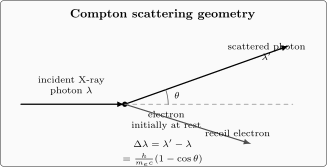
Compton scattering made the energy-momentum aspect of photons difficult to avoid. The modern endpoint is not a classical bullet model of light, but a quantum-field description in which photons are excitations of electromagnetic modes.
These relations are necessary but not sufficient for a full photon theory. Early light quanta explained some exchange processes, but they did not yet provide a complete account of interference, polarization, multiphoton states, emission and absorption dynamics, or gauge-field locality.
Photon States in Quantum Optics
Section titled “Photon States in Quantum Optics”Quantum optics treats light modes as quantum systems. A single field mode behaves like a harmonic oscillator, with number states
For a mode labeled by wavevector and polarization , a schematic one-photon state is
Realistic photons are usually wavepackets, not exact plane-wave modes. A one-photon wavepacket can be represented schematically as
with normalization depending on the chosen continuum convention.
Not all optical states have definite photon number. Coherent states approximate classical laser fields while containing a distribution over number states. Thermal light, squeezed light, entangled photon pairs, and number states are physically distinct quantum states of modes. The phrase “a photon” is therefore context-dependent: it may mean a counted detection event, a one-quantum Fock state, a wavepacket excitation, or a component of a more general optical state.
Photon Number Can Change
Section titled “Photon Number Can Change”Fixed-particle nonrelativistic quantum mechanics is not enough for photons because radiation processes change photon number. An excited atom may emit a photon:
An atom may absorb one:
Stimulated emission, absorption, spontaneous emission, Raman scattering, fluorescence, parametric down-conversion, and pair production all require a language in which the radiation field has variable occupation.
Semiclassical models are still useful. Treating the electromagnetic field as a prescribed classical drive can accurately describe many transition rates, Rabi oscillations, and spectroscopy experiments within a domain. But a classical external field cannot by itself describe spontaneous emission as the creation of a field quantum, nor can it describe photon counting statistics of the emitted field.
The many-particle bridge is From Quantum Statistics to Fock Space, and the canonical operator language is Creation and Annihilation Operators.
Relativistic Locality
Section titled “Relativistic Locality”Photons are massless spin-1 excitations. They have no rest frame, carry polarization constrained by gauge structure, and are not naturally described by the same position-space wavefunction framework used for a massive nonrelativistic particle.
Relativistic locality also changes the question. A theory of light and charged matter must describe local interactions between electromagnetic fields and charged fields. It must respect causality, Lorentz symmetry, gauge invariance, and conservation laws. In such a theory, particle number is generally not fundamental in the same way as charge or energy-momentum conservation.
This is one reason quantum field theory is not optional decoration for photons. It supplies:
- local field operators rather than only particle coordinates;
- creation and annihilation operators for field modes;
- a vacuum state with physical structure;
- emission and absorption as interaction processes;
- a natural treatment of processes in which particle number changes;
- a framework for relativistic covariance and gauge symmetry.
Nonrelativistic quantum mechanics remains indispensable as an approximation. Atomic and optical systems often use effective Hamiltonians, rotating-wave approximations, and finite-mode models. The point is not that every photon problem requires full high-energy QED. The point is that the conceptual home of photons is field quantization.
Field Modes and Creation Operators
Section titled “Field Modes and Creation Operators”The mathematical bridge starts from the harmonic oscillator. A single oscillator has
In field theory, each free electromagnetic mode behaves like an oscillator. Suppressing normalization and gauge details, the free-field Hamiltonian has the schematic form
The number operator for a mode is
Acting with raises the occupation of that mode by one; acting with lowers it. This is the field-mode version of photon creation and annihilation.
The formula is schematic because real quantum electrodynamics includes gauge constraints, continuum normalization, interactions with charged fields, renormalization, and subtleties of the vacuum. For orientation, see Harmonic Oscillator to Fields and Field Operators.
Continuing Path
Section titled “Continuing Path”A responsible path from photon evidence to field theory goes through several layers:
- historical evidence for energy and momentum quanta: Photoelectric Effect and Compton Scattering;
- photon concept and cautions: From Light Quanta to Photons;
- occupation-number language: Fock Space and Occupation-Number Basis;
- field modes: Harmonic Oscillator to Fields;
- many-particle operator language: Second Quantization;
- relativistic scattering and interactions: Scattering.
At every step, avoid reading the final theory backward into the earliest experiments. Photoelectric and Compton evidence made photons plausible and powerful. Quantum field theory explains why the photon concept has the structure it does.
Common Mistakes
Section titled “Common Mistakes”- Treating photons as tiny classical pellets with definite hidden trajectories.
- Assuming single-photon detection events by themselves remove the need for wave amplitudes.
- Forgetting polarization, mode structure, and wavepacket shape.
- Treating photon number as generally conserved.
- Confusing a semiclassical drive with a quantized radiation field.
- Thinking quantum field theory is needed only for very high energies. Photon creation and annihilation already point to field language at ordinary atomic and optical scales.
- Ignoring gauge constraints and locality when trying to make a photon position wavefunction act like a nonrelativistic particle wavefunction.
Cross-Links
Section titled “Cross-Links”- Light Quanta and Photon Evidence
- Einstein’s Light Quantum Hypothesis
- Photoelectric Effect
- Millikan’s Photoelectric Measurements
- Compton Scattering
- Photon Momentum
- From Light Quanta to Photons
- Lasers as Quantum Technology
- Entanglement in Quantum Optics
- Fock Space
- Harmonic Oscillator to Fields
- Second Quantization
References
Section titled “References”- A. Einstein, “Über einen die Erzeugung und Verwandlung des Lichtes betreffenden heuristischen Gesichtspunkt,” Annalen der Physik 322, 132-148, 1905, DOI: 10.1002/andp.19053220607.
- A. H. Compton, “A Quantum Theory of the Scattering of X-rays by Light Elements,” Physical Review 21, 483-502, 1923, DOI: 10.1103/PhysRev.21.483.
- G. N. Lewis, “The Conservation of Photons,” Nature 118, 874-875, 1926.
- P. A. M. Dirac, “The Quantum Theory of the Emission and Absorption of Radiation,” Proceedings of the Royal Society A 114, 243-265, 1927, DOI: 10.1098/rspa.1927.0039.
- R. J. Glauber, “Coherent and Incoherent States of the Radiation Field,” Physical Review 131, 2766-2788, 1963, DOI: 10.1103/PhysRev.131.2766.
- C. Cohen-Tannoudji, J. Dupont-Roc, and G. Grynberg, Photons and Atoms: Introduction to Quantum Electrodynamics, Wiley, 1989.
- R. Loudon, The Quantum Theory of Light, 3rd ed., Oxford University Press, 2000.
Exercises
Section titled “Exercises”- Why does photon emission force a variable-particle-number description?
Solution
If an excited atom emits a photon, the radiation field changes from an -photon state to an -photon state in the relevant mode or wavepacket. A fixed-particle Hilbert space cannot represent this process as a state within one sector. Fock space can, because it contains a direct sum over particle-number sectors.
- What is the difference between a semiclassical drive and a quantized radiation mode?
Solution
A semiclassical drive treats the electromagnetic field as a prescribed classical function of space and time while the atom or material system is quantum. A quantized radiation mode is itself a quantum degree of freedom with states such as , operators and , and photon-number fluctuations. The semiclassical approximation can be excellent for strong coherent fields, but it cannot describe all photon-counting and spontaneous-emission phenomena.
- In the schematic state , what do and label?
Solution
The vector labels the wavevector of the mode, fixing its propagation direction and frequency in vacuum through . The label denotes polarization. The creation operator adds one excitation to that electromagnetic mode. Real photons are often wavepackets, so exact labels are idealizations.