From Spin Experiments to Spin Formalism
Spin entered quantum mechanics through evidence that did not fit ordinary orbital motion: discrete Stern–Gerlach splitting, anomalous Zeeman patterns, atomic doublets, and Pauli’s two-valuedness. The modern result is a compact formalism: a spin- system is described by a two-dimensional Hilbert space, spin components are represented by Pauli matrices, and rotations act through .
This page is a bridge. The historical experiment belongs to Stern–Gerlach Experiment, the conceptual spin page is What Spin Is and Is Not, and the canonical algebra begins at Spin-1/2 Hilbert Space.
Discrete Outcomes
Section titled “Discrete Outcomes”The Stern–Gerlach experiment sends a neutral atomic beam through an inhomogeneous magnetic field. A classical distribution of magnetic-moment orientations suggests a continuous smear of deflections. The observed split beam instead points to discrete projection outcomes.
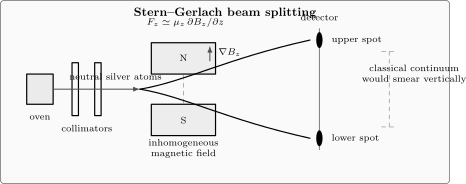
An inhomogeneous magnetic field converts magnetic-moment projection into spatial deflection. In the spin- idealization, a single analyzer has two output beams associated with two eigenvalues of the measured spin component.
In modern notation, an apparatus oriented along a unit vector measures the spin component
For spin-,
so the possible outcomes are
The key change from a classical picture is not merely that two values appear. It is that each apparatus axis defines a different observable. A state with a sharp projection is generally not sharp along . Sequential Stern–Gerlach experiments therefore reveal both discreteness and noncommuting measurement axes.
Two-Level Systems
Section titled “Two-Level Systems”A spin- Hilbert space is two-dimensional. Choosing the eigenbasis,
A general pure state is
with
The probabilities for a -axis measurement are
The relative phase between and is physically important. It affects measurements along axes other than , even though an overall global phase does not change the physical ray. This is why a two-level system is richer than a classical bit with two possible labels.
Spin is the cleanest historical entrance, but the same two-dimensional mathematics appears in many places: two atomic levels, two localized wells, polarization qubits, superconducting circuit states, and effective avoided crossings. The canonical two-level-system path starts at Two-Level Systems and Spin-1/2 as a Canonical System.
Spin Projection
Section titled “Spin Projection”For any measurement direction , the spin-up and spin-down projectors can be written
Given a normalized state , the probabilities are
This formula is the formal version of the two-spot experiment. The magnet orientation chooses ; the spin state determines the probabilities; the measurement output is one of the two eigenvalues.
For example, the -axis eigenstates are
Thus a state prepared as gives equal probabilities for and . This is not ignorance about a hidden classical label inside the same formalism. It is the Born rule applied to a different measurement basis.
The measurement-theory canonical pages are Projective Measurement and Sequential Measurements.
Pauli Matrices
Section titled “Pauli Matrices”In the basis, the Pauli matrices are
Spin operators are
The Pauli matrices satisfy
which implies
This algebra is the spin- representation of angular momentum. It explains why spin components along different axes cannot generally have simultaneous sharp values. It also supplies a basis for every Hermitian two-by-two Hamiltonian:
The vector behaves like an effective field in the two-level Hilbert space. That form appears in spin magnetic resonance, avoided crossings, driven atoms, and qubit Hamiltonians. The detailed matrix treatment belongs to Pauli Matrices and Pauli-Matrix Hamiltonians.
SU(2) Rotations
Section titled “SU(2) Rotations”Spin is not merely a two-outcome measurement label. It is tied to spatial rotations. A spin- rotation by angle about is represented by
The half-angle is a signature of the relation between and . A rotation multiplies a spinor by , while a rotation returns it to itself. For a single isolated ray, the sign is not observable; in interference and relative-phase contexts, the spinor structure matters.
The angular-momentum algebra is the shared structure behind orbital angular momentum, spin, and rotations. The spinor-specific treatment is Spin Rotations, and the broader algebraic home is Angular Momentum Algebra.
Qubit Language
Section titled “Qubit Language”A qubit is an abstract two-dimensional quantum system. Spin- supplies the prototype, but the word “qubit” does not mean “electron spin” by definition. It means the system has a chosen two-dimensional computational subspace with coherent superpositions, controlled operations, and measurements.
The Bloch-sphere parameterization makes the connection explicit. A pure spinor can be written, up to global phase, as
The corresponding Bloch vector is
For density operators,
This language unifies spin measurements, two-level atoms, driven systems, and quantum-information gates. Its danger is overfamiliarity: the Bloch sphere is a representation of a two-dimensional Hilbert space, not a literal sphere on which a microscopic arrow always points. Use Bloch Sphere for spinors and Bloch Sphere: Wave-Mechanics Perspective for broader two-level systems.
Common Mistakes
Section titled “Common Mistakes”- Treating “spin up” and “spin down” as absolute labels rather than eigenstates relative to an axis.
- Saying the original Stern–Gerlach experiment directly measured a free electron spin.
- Confusing Pauli matrices with physical spin operators .
- Forgetting that noncommuting spin components cannot all have simultaneous sharp values in the standard formalism.
- Treating the Bloch vector as a classical magnetic moment with a definite hidden orientation.
- Assuming every qubit is physically a spin- particle rather than a two-dimensional quantum encoding.
Cross-Links
Section titled “Cross-Links”- Spin and Discrete Outcomes
- Stern–Gerlach Experiment
- Space Quantization
- Electron Spin
- Magnetic Moments
- Pauli Matrices in Historical Context
- What Spin Is and Is Not
- Spin-1/2 Hilbert Space
- Pauli Matrices
- Spin Rotations
- Bloch Sphere
- Two-Level Systems
References
Section titled “References”- W. Gerlach and O. Stern, “Der experimentelle Nachweis der Richtungsquantelung im Magnetfeld,” Zeitschrift für Physik 9, 349-352, 1922.
- W. Pauli, “Über den Zusammenhang des Abschlusses der Elektronengruppen im Atom mit der Komplexstruktur der Spektren,” Zeitschrift für Physik 31, 765-783, 1925.
- G. E. Uhlenbeck and S. Goudsmit, “Spinning Electrons and the Structure of Spectra,” Nature 117, 264-265, 1926.
- W. Pauli, “Zur Quantenmechanik des magnetischen Elektrons,” Zeitschrift für Physik 43, 601-623, 1927.
- J. J. Sakurai and J. Napolitano, Modern Quantum Mechanics, 3rd ed., Cambridge University Press, 2020.
- R. Shankar, Principles of Quantum Mechanics, 2nd ed., Springer, 1994.
- M. A. Nielsen and I. L. Chuang, Quantum Computation and Quantum Information, Cambridge University Press, 2010.
Exercises
Section titled “Exercises”- A spin- state is . What are the probabilities for measuring ?
Solution
Use
The amplitudes for and are both , so
- Show that projects onto in the standard basis.
Solution
In the standard basis,
Therefore
which leaves unchanged and annihilates .
- Why is a qubit not the same thing as a classical bit with an unknown value?
Solution
A classical bit has one of two values, even if an observer is ignorant of which one. A qubit state can be a coherent superposition with a relative phase. That phase affects measurements in other bases and enables interference. A mixed state can represent ignorance, but a pure superposition is not merely an unknown classical bit value.