From Bell Experiments to Quantum Information
Bell experiments transformed entanglement from a philosophical puzzle into an experimentally testable and operationally useful feature of quantum theory. EPR correlations raised the question of completeness and locality. Bell’s theorem made the question experimentally sharp. Later quantum information theory turned entanglement into a resource for communication, computation, cryptography, metrology, and device-independent certification.
This page is a bridge. The historical pages are EPR Argument, Bell’s Theorem as Historical Turning Point, and Bell Inequality Experiments. The modern formal pages are Bell States, Entangled States, and Entanglement in Quantum Information.
EPR Correlations
Section titled “EPR Correlations”The EPR argument used perfect correlations to challenge the completeness of quantum mechanics. In modern two-spin language, the clean prototype is the singlet state
If both parties measure spin along the same axis, their outcomes are perfectly anticorrelated. More generally, for measurement directions and , quantum mechanics predicts
for ideal spin- singlet measurements with outcomes encoded as .
The historical force of EPR was not that quantum mechanics fails to calculate correlations. It calculates them very well. The question was whether those correlations imply that the quantum state is incomplete, or whether nature itself violates assumptions about separability, locality, or predetermined values.
Bell Inequality Violations
Section titled “Bell Inequality Violations”Bell’s theorem showed that local hidden-variable theories obey inequalities that quantum mechanics can violate. In the CHSH scenario, Alice chooses between settings , Bob chooses between , and each outcome is . Define
Under the CHSH local hidden-variable assumptions,
Quantum mechanics can reach
for suitable measurements on an entangled state. The maximum quantum value is the Tsirelson bound, not the algebraic maximum .
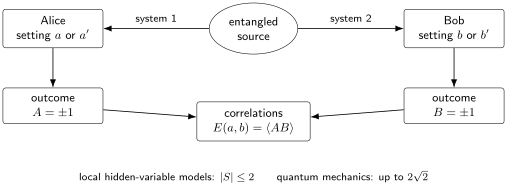
A Bell test compares correlations from separated measurement choices. Bell violations rule out local hidden-variable models satisfying the relevant assumptions, while quantum mechanics remains compatible with no-signaling.
The experimental story moved from early tests to Aspect’s time-varying analyzer experiments and then to modern loophole-free Bell tests. The canonical reference card is CHSH Inequality, and the historical arc is Bell Inequality Experiments and Loophole-Free Bell Tests.
Entanglement as Nonclassical Correlation
Section titled “Entanglement as Nonclassical Correlation”Quantum information theory reframes entanglement as a structured nonclassical correlation between subsystems. A pure bipartite state is entangled when it cannot be written as a product
For two qubits, the Bell states form a maximally entangled basis. The state is one example, but the broader language includes Schmidt decomposition, reduced density matrices, entanglement entropy, concurrence, witnesses, and LOCC transformations.
Bell nonlocality and entanglement are related but not identical:
- every Bell-violating state is entangled;
- not every entangled mixed state violates a given Bell inequality without further processing or choices;
- steering, entanglement, and Bell nonlocality are distinct levels of nonclassical correlation;
- Bell tests certify more than ordinary entanglement witnesses, but under different assumptions.
This distinction matters for reliable language. Entanglement is the resource concept used across quantum information. Bell violation is a stronger, scenario-dependent statement about observed correlations.
No-Signaling
Section titled “No-Signaling”Bell violations do not allow faster-than-light communication. The reason is visible in the reduced-state formalism. If Alice and Bob share , Alice’s local statistics are computed from
Bob’s choice of measurement basis cannot change Alice’s averaged local density operator. It can change correlations revealed when Alice and Bob later compare records, but it cannot transmit a controllable message through the marginal statistics alone.
In a Bell experiment, each side sees locally random outcomes. The nonclassical structure appears in joint correlations:
No-signaling is not an optional patch added to hide nonlocality. It is built into the tensor-product and reduced-state structure of ordinary quantum mechanics. For the conceptual treatment, see Entanglement in Foundations and What These Experiments Do and Do Not Prove.
Device-Independent Protocols
Section titled “Device-Independent Protocols”Bell tests also created a new idea: certify some quantum behavior from observed input-output correlations, without fully trusting the internal description of the devices. This is the seed of device-independent quantum information.
In a device-independent setting, one treats the apparatus as a box with inputs and outputs. A Bell violation can certify that the behavior is incompatible with local hidden-variable models. With additional assumptions and finite-statistical analysis, such correlations can support:
- randomness certification;
- device-independent quantum key distribution;
- self-testing of states and measurements;
- entanglement certification without a detailed device model;
- security proofs based on observed nonlocal correlations.
This is powerful but not magic. Device-independent protocols still need assumptions: spacelike separation or trusted isolation as appropriate, independent setting choices, calibrated timing, finite-statistics treatment, and protection against side channels. Bell violations are resources only when the experimental and cryptographic assumptions match the protocol.
Quantum Information Roadmap
Section titled “Quantum Information Roadmap”The path from Bell experiments to quantum information is a chain of reinterpretations:
- EPR made entanglement a conceptual challenge.
- Bell made locality assumptions experimentally testable.
- Bell tests made nonclassical correlations laboratory facts.
- Quantum information made entanglement a resource.
- Device-independent protocols used Bell violations as certificates.
The practical study path is:
- foundations history: EPR Argument, Bohm’s Spin Version of EPR, and Bell Inequality Experiments;
- state language: Bell States and Entangled States;
- measures and transformations: Schmidt Decomposition, Entanglement Entropy, and LOCC Preview;
- applications: Entanglement in Quantum Information and Quantum Information Roadmap;
- theorem references: Bell Theorem and CHSH Inequality.
Common Mistakes
Section titled “Common Mistakes”- Saying Bell experiments prove faster-than-light signaling.
- Saying Bell experiments prove one specific interpretation of quantum mechanics.
- Treating every entangled state as automatically Bell-violating in every experimental scenario.
- Confusing ordinary correlation with entanglement.
- Confusing entanglement certification with device-independent certification.
- Ignoring loopholes, finite statistics, setting independence, and detector assumptions.
- Treating no-signaling as the same thing as locality in the Bell hidden-variable sense.
Cross-Links
Section titled “Cross-Links”- Foundations Experiments and Quantum Reality
- EPR Argument
- Bohm’s Spin Version of EPR
- Bell’s Theorem as Historical Turning Point
- Bell Inequality Experiments
- Loophole-Free Bell Tests
- What These Experiments Do and Do Not Prove
- Bell States
- Entangled States
- Entanglement in Foundations
- Entanglement in Quantum Information
- CHSH Inequality
References
Section titled “References”- A. Einstein, B. Podolsky, and N. Rosen, “Can Quantum-Mechanical Description of Physical Reality Be Considered Complete?,” Physical Review 47, 777-780, 1935.
- D. Bohm, Quantum Theory, Prentice-Hall, 1951.
- J. S. Bell, “On the Einstein Podolsky Rosen Paradox,” Physics 1, 195-200, 1964.
- J. F. Clauser, M. A. Horne, A. Shimony, and R. A. Holt, “Proposed Experiment to Test Local Hidden-Variable Theories,” Physical Review Letters 23, 880-884, 1969.
- A. Aspect, P. Grangier, and G. Roger, “Experimental Tests of Realistic Local Theories via Bell’s Theorem,” Physical Review Letters 47, 460-463, 1981.
- B. Hensen et al., “Loophole-free Bell inequality violation using electron spins separated by 1.3 kilometres,” Nature 526, 682-686, 2015.
- N. Brunner, D. Cavalcanti, S. Pironio, V. Scarani, and S. Wehner, “Bell nonlocality,” Reviews of Modern Physics 86, 419-478, 2014.
- M. A. Nielsen and I. L. Chuang, Quantum Computation and Quantum Information, Cambridge University Press, 2010.
Exercises
Section titled “Exercises”- Why does a Bell violation rule out more than ordinary classical correlation?
Solution
Ordinary classical correlations can be produced by shared randomness. Bell inequalities constrain correlations that can arise from local hidden-variable models with shared randomness and local response functions. A Bell violation exceeds that bound, so it cannot be explained by shared randomness satisfying the Bell assumptions.
- Explain why Bell violations do not allow Alice to signal to Bob.
Solution
Bob’s local statistics are determined by his reduced density operator. Alice’s choice of measurement can change correlations revealed after comparing data, but it does not change Bob’s averaged marginal distribution in a controllable way. Without the later classical comparison channel, Bob cannot infer Alice’s setting from his local outcomes alone.
- For the singlet state, the ideal correlation is . What is the correlation when the two measurement axes are the same?
Solution
If , then , so
This means the outcomes are perfectly anticorrelated when both parties measure along the same axis.