Complete Sets of Commuting Observables
A complete set of commuting observables (CSCO) is a mutually compatible family whose joint eigenvalue labels distinguish basis states, up to phase, within a specified Hilbert space or sector.
The idea has two parts:
- Commuting: the observables admit simultaneous sharp alternatives and a common eigenbasis in the finite-dimensional setting.
- Complete: every nonzero joint eigenspace is one-dimensional, so no unexplained degeneracy label remains.
If the family is
a simultaneous eigenstate satisfies
for every . Completeness means that the tuple
identifies one ray rather than a multidimensional subspace.
This page owns the label-and-degeneracy structure. The criterion for compatibility itself is developed in Compatible Observables, while dynamical labels protected by symmetry are the subject of Simultaneous Eigenstates and Good Quantum Numbers.
Finite-Dimensional Setting
Section titled “Finite-Dimensional Setting”Let be self-adjoint operators on a finite-dimensional Hilbert space . Assume pairwise commutation:
Then the family can be simultaneously diagonalized. There exists an orthonormal basis whose vectors are eigenvectors of every .
Pairwise commutation is enough for simultaneous diagonalization here because the operators are self-adjoint and the dimension is finite. It is not by itself a completeness condition. Several basis vectors may still share the same full tuple of eigenvalues.
Joint Eigenspaces
Section titled “Joint Eigenspaces”For a candidate tuple , define the joint eigenspace
Only tuples for which this intersection is nonzero occur. The simultaneous eigenvectors with those values are exactly the nonzero vectors in .
The Hilbert space decomposes as an orthogonal direct sum,
If
the tuple leaves a residual degeneracy. Basis vectors must still be written as
Joint Spectral Projectors
Section titled “Joint Spectral Projectors”Write the spectral decomposition of each observable as
Because the observables commute, all their spectral projectors commute in finite dimensions. The joint projector is
Its range is the joint eigenspace:
The nonzero joint projectors satisfy
This projector formulation is the cleanest test of completeness because it is independent of basis choices inside degenerate subspaces.
Definition of Completeness
Section titled “Definition of Completeness”The commuting family is complete on when every nonzero joint eigenspace is one-dimensional:
Equivalently,
for every nonzero joint projector. One may then write
and the resolution of identity becomes
The tuple identifies a normalized basis vector up to multiplication by a global phase. A CSCO labels rays, not phase conventions.
Refining Degeneracy Step by Step
Section titled “Refining Degeneracy Step by Step”The constructive way to build a CSCO is to refine only the degeneracies that remain.
Start with . Its eigenspaces may have dimensions greater than one. Because commutes with , it preserves each eigenspace of . Diagonalize the restriction of inside every degenerate block. This replaces each block by smaller joint eigenspaces.
If some joint blocks are still multidimensional, restrict to those blocks and diagonalize again. Continue until all nonzero joint eigenspaces have dimension one.
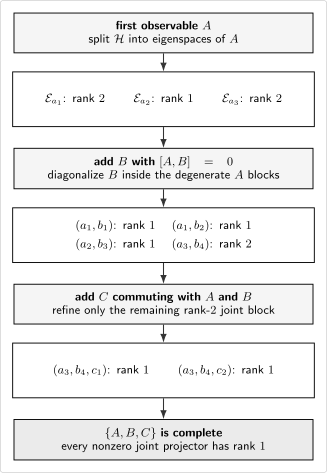
Each added commuting observable acts within the blocks already selected by the earlier labels. The family becomes complete when every surviving joint projector has rank one.
The process is local to each degenerate block. An added observable need not split every block; it is useful if the full family eventually resolves all of them.
A Three-Dimensional Example
Section titled “A Three-Dimensional Example”Consider
The eigenvalue has a two-dimensional eigenspace, so alone is not complete. Now let
The operators commute. Their joint labels are
If these three tuples are distinct, every joint eigenspace is one-dimensional, and is complete. The value of on the eigenspace does not need to differ from both and unless doing so is required to keep the full tuples distinct. It is the tuple, not any one entry, that labels a state.
One Observable Can Be Complete
Section titled “One Observable Can Be Complete”A CSCO need not contain several operators. A single nondegenerate self-adjoint observable has one-dimensional eigenspaces, so
is already complete.
Conversely, a family can contain many commuting observables and still fail to be complete if a multidimensional joint eigenspace remains. Cardinality alone says nothing.
In a finite-dimensional space, any fixed orthonormal basis can be labeled by a single self-adjoint operator with distinct assigned eigenvalues:
This artificial operator shows that a one-element CSCO always exists once a basis is chosen. Physically useful CSCOs are preferred because their operators have dynamical, symmetry, geometric, or experimental meaning.
Minimal, Redundant, and Independent Labels
Section titled “Minimal, Redundant, and Independent Labels”Completeness does not imply minimality. If is complete and , then
is still complete, but is redundant. It adds no refinement because its value is determined by the existing tuple.
Likewise, adding the identity or a constant observable changes no joint eigenspace. A minimal CSCO is a complete family from which no observable can be removed without losing completeness. Minimal CSCOs need not be unique and need not have the same number of members when observables with different spectral structures are allowed.
The word independent is often used informally for nonredundant labels, but it should not be confused with statistical independence. CSCO eigenvalues can be functionally constrained or correlated while still labeling basis states.
Completeness Is Relative to a Space or Sector
Section titled “Completeness Is Relative to a Space or Sector”The phrase “complete” is incomplete unless the space being labeled is stated. An observable can be complete on one sector and incomplete on a larger Hilbert space.
Suppose
An orbital CSCO labels only . On the full tensor product, every orbital tuple is repeated once for each unresolved spin state. One must add spin labels or explicitly declare that a spin sector has been fixed.
The same issue occurs with:
- repeated copies of an angular-momentum irreducible representation;
- particle number, charge, parity, or other superselection sectors;
- center-of-mass and internal degrees of freedom;
- boundary-condition sectors;
- radial, flavor, band, lattice, and internal labels.
Throughout a calculation, the declared sector is part of the CSCO statement.
Spin One-Half
Section titled “Spin One-Half”For a particle whose Hilbert space is only the two-dimensional spin- space, has two nondegenerate values:
Thus is complete on this fixed spin space.
The Casimir operator is constant:
It does not distinguish the two states. The conventional pair
is complete but not minimal when the spin- sector is already fixed. becomes useful when the Hilbert space contains several possible total spin values.
Any spin component also has a nondegenerate spectrum, so is another CSCO. Different choices define different orthonormal bases; completeness does not make the choice unique.
Orbital Angular Momentum
Section titled “Orbital Angular Momentum”The angular-momentum components do not commute pairwise:
The conventional commuting pair is
Its simultaneous eigenvectors satisfy
On the standard angular Hilbert space , each pair occurs once, so is complete for angular wavefunctions.
On a three-dimensional particle Hilbert space, the same pair does not resolve the radial degree of freedom. One needs a radial or energy label appropriate to the Hamiltonian. This is a direct example of sector-relative completeness.
The operator algebra is developed in Angular Momentum Algebra.
Adding Two Angular Momenta
Section titled “Adding Two Angular Momenta”For two fixed angular momenta and , the uncoupled basis is labeled by
If and have already been fixed as sector data, the nonconstant labels and suffice for that tensor-product basis.
The coupled basis instead uses
For fixed , the labels distinguish the coupled basis states. These two CSCOs describe different bases of the same Hilbert space, related by Clebsch–Gordan coefficients. See Coupled and Uncoupled Bases.
For three or more angular momenta, the same total can occur with multiplicity. Intermediate operators such as
can provide the extra commuting label. The chosen coupling tree is part of the basis convention.
Ideal Spinless Hydrogen Bound States
Section titled “Ideal Spinless Hydrogen Bound States”For the nonrelativistic spinless Coulomb Hamiltonian, the bound states are conventionally labeled
The commuting family
has eigenvalue equations
On the ideal spinless bound-state Hilbert space, the tuple identifies one state up to phase. The energy alone is highly degenerate; and refine that degeneracy.
Several qualifications matter:
- this statement is for the bound sector;
- spin adds another degree of freedom;
- relativistic, fine-structure, hyperfine, and external-field terms change which operators commute with the Hamiltonian;
- the Coulomb problem has an enlarged dynamical symmetry, so alternative complete label systems can be constructed.
The model-specific spectrum and degeneracy are developed in Hydrogen Atom.
Multiple CSCOs for One System
Section titled “Multiple CSCOs for One System”A Hilbert space generally admits many CSCOs. Choosing one is choosing an orthonormal basis with physically meaningful labels.
For an isotropic problem, one may prefer angular-momentum labels. In a Cartesian separable problem, number operators or component energies may be more convenient. In a coupled-spin problem, either coupled or uncoupled labels may be useful depending on the Hamiltonian and the interaction being treated.
Two different CSCOs need not commute with each other as families. Their bases can be incompatible, just as the and bases are incompatible even though each single observable is complete on a spin- space.
Completeness therefore does not select one privileged basis. The Hamiltonian, symmetries, boundary conditions, observables of interest, and experimental arrangement guide the choice.
Joint Measurement Interpretation
Section titled “Joint Measurement Interpretation”For a complete finite-dimensional family, the rank-one joint projectors
define a projective measurement in the joint eigenbasis. For a normalized pure state,
Because the individual spectral projectors commute, ideal measurements can be refined to these joint alternatives. Under the standard Lüders model, the joint projector is independent of the order in which the compatible labels are filtered.
This formal statement does not guarantee that every member of a convenient CSCO corresponds to an equally practical laboratory measurement. Nor does one joint outcome reconstruct an arbitrary unknown state. It only distinguishes the simultaneous eigenstates of that basis.
The state-update and ordering questions belong to Sequential Measurements.
CSCO Is Not Informational Completeness
Section titled “CSCO Is Not Informational Completeness”A CSCO is basis complete: its eigenvalue tuples label the rays in one orthonormal basis. It is not an informationally complete measurement for state tomography.
For example, measuring is a CSCO measurement on a spin- Hilbert space. Its probabilities determine the populations in the basis but not the relative phase between those components. Many different density operators have the same statistics.
An informationally complete POVM has enough outcomes across noncommuting directions to reconstruct an arbitrary density operator. That is a different use of the word “complete.”
Good Quantum Numbers and Dynamics
Section titled “Good Quantum Numbers and Dynamics”An observable need not commute with the Hamiltonian merely to belong to some CSCO. A CSCO defines a basis at a given time; a good quantum number is a label preserved by the dynamics or useful for stationary states.
To label energy eigenstates, one normally includes and chooses additional operators satisfying
Their eigenvalues can then label stationary states. If a perturbation changes the Hamiltonian so that a commutator becomes nonzero, the old quantum number may cease to be exact even though it remains a useful basis label or approximation.
The exact, approximate, and symmetry-protected meanings are developed in Simultaneous Eigenstates and Good Quantum Numbers.
Maximal Commuting Families
Section titled “Maximal Commuting Families”Textbooks sometimes use complete commuting set and maximal commuting set almost interchangeably. In finite dimensions, the clean operator-algebra statement is:
A commuting self-adjoint family has one-dimensional joint eigenspaces if and only if the unital star-algebra it generates is the full maximal abelian algebra of operators diagonal in its joint eigenbasis.
This does not mean that no further observable can be appended. Every operator diagonal in the same basis commutes with the family, and many are functions of the existing labels. What is maximal is the generated abelian algebra, not a literal finite list with no possible additions.
A listed CSCO may therefore be redundant while still generating, through functions and combinations, the full diagonal algebra associated with its basis.
Continuous and Infinite-Dimensional Caveat
Section titled “Continuous and Infinite-Dimensional Caveat”In infinite dimensions, the textbook phrase “” can be too weak for unbounded operators. Algebraic commutation on a small common domain does not automatically imply commuting spectral measures or a common spectral representation.
The appropriate robust condition is strong commutation: the spectral projectors of the self-adjoint operators commute. Joint spectral theory then replaces a discrete basis by a direct-integral representation with discrete and continuous labels.
In that setting, completeness is associated with spectral multiplicity one: the full joint spectral label should leave no unresolved multiplicity space in the representation being used. Generalized eigenvectors may be delta-normalized rather than Hilbert-space vectors, and continuous labels do not correspond to ordinary rank-one projectors at individual points.
These issues require the machinery of Spectral Theorem, Practical Version and the domain cautions in Hermitian vs Self-Adjoint Operators.
Practical CSCO Audit
Section titled “Practical CSCO Audit”For a proposed finite-dimensional label family:
- State the space or sector. Include all degrees of freedom that are being labeled.
- Check self-adjointness. Each proposed label operator must represent a sharp observable on the intended space.
- Check pairwise commutation. Verify .
- Find the joint projectors. Form products of the commuting spectral projectors.
- Discard zero tuples. Not every Cartesian combination of eigenvalues occurs.
- Compute joint ranks. Completeness requires every nonzero rank to be one.
- Add a refining observable if needed. Diagonalize its restriction inside the remaining degenerate blocks.
- Identify redundancy. Remove labels that are functions of the others if a minimal set is desired.
- Check dynamics separately. To call the labels good quantum numbers, verify commutation with .
- Reassess after changing the model. Couplings, fields, boundaries, and symmetry breaking can alter the useful CSCO.
Common Mistakes
Section titled “Common Mistakes”- Equating commutation with completeness. Commuting observables can leave large joint degeneracies.
- Counting operators instead of joint ranks. One nondegenerate observable can be complete; many commuting observables can be incomplete.
- Omitting the space or sector. is complete on a fixed spin- space but not on a larger orbital-spin Hilbert space.
- Adding only functions of existing labels. Such observables do not refine joint eigenspaces.
- Assuming a CSCO is unique. Different complete families define different bases of the same Hilbert space.
- Using noncommuting labels together. and do not form a joint sharp label system.
- Forgetting multiplicity copies. The same values can occur more than once in composite or many-body systems.
- Calling every CSCO label a conserved quantum number. Conservation also requires the relevant commutator with the Hamiltonian.
- Confusing CSCO completeness with tomography. One complete eigenbasis measurement does not determine an arbitrary quantum state.
- Using ordinary commutators carelessly for unbounded operators. Strong commutation is a spectral condition.
Scope and Canonical Boundaries
Section titled “Scope and Canonical Boundaries”This page owns completeness of joint eigenvalue labels. Nearby pages own the ingredients and applications:
- Compatible Observables develops the commutation and common-refinement criterion.
- Spectral Decomposition develops eigenspace projectors and block structure.
- Projectors develops the geometry of the joint alternatives.
- Simultaneous Eigenstates and Good Quantum Numbers develops dynamically meaningful labels and symmetry changes.
- Coupled and Uncoupled Bases develops two important alternative CSCO choices for composite angular momentum.
- Hydrogen Atom develops the model-specific origin of and the Coulomb degeneracies.
Summary
Section titled “Summary”- A finite-dimensional CSCO is a pairwise commuting self-adjoint family whose nonzero joint eigenspaces are all one-dimensional.
- Joint projectors are products of the commuting individual spectral projectors.
- Degeneracy is refined by diagonalizing each new observable inside the blocks preserved by the earlier observables.
- A single nondegenerate observable can be complete.
- Completeness does not imply minimality, independence, conservation, or informational completeness.
- A CSCO is always relative to a declared Hilbert space or sector.
- Spin, angular momentum, composite systems, and hydrogen illustrate how additional labels resolve different kinds of degeneracy.
- Different CSCOs define different complete bases for the same system.
- Good quantum numbers require dynamical compatibility with the Hamiltonian in addition to mutual commutation.
- In infinite dimensions, strong commutation and joint spectral multiplicity replace the simple finite-dimensional rank-one criterion.
References
Section titled “References”- P. A. M. Dirac, The Principles of Quantum Mechanics, 4th ed., Oxford University Press, 1958.
- J. von Neumann, Mathematical Foundations of Quantum Mechanics, Princeton University Press, 1955.
- L. D. Landau and E. M. Lifshitz, Quantum Mechanics: Non-Relativistic Theory, 3rd ed., Pergamon, 1977.
- A. Messiah, Quantum Mechanics, Dover, 1999.
- R. Shankar, Principles of Quantum Mechanics, 2nd ed., Springer, 1994.
- J. J. Sakurai and J. Napolitano, Modern Quantum Mechanics, 3rd ed., Cambridge University Press, 2020.
- C. Cohen-Tannoudji, B. Diu, and F. Laloë, Quantum Mechanics, Wiley, 1977.
- B. C. Hall, Quantum Theory for Mathematicians, Springer, 2013.
Exercises
Section titled “Exercises”Exercise 1: Joint projectors
Section titled “Exercise 1: Joint projectors”Let
be commuting finite-dimensional self-adjoint operators. Show that is the orthogonal projector onto the joint eigenspace with values .
Solution
Commutation of and implies commutation of their spectral projectors:
Therefore
and
Its range lies in both and . Conversely, any vector in their intersection is fixed by both projectors and therefore by their product. The range is exactly the joint eigenspace.
Exercise 2: Resolve a degeneracy
Section titled “Exercise 2: Resolve a degeneracy”Let
Determine whether and are complete on .
Solution
The operator has two eigenspaces, each of dimension two, so is not complete.
The joint tuples for are
Each tuple occurs on exactly one standard basis vector. Every nonzero joint projector therefore has rank one, so is complete.
Exercise 3: Redundant observable
Section titled “Exercise 3: Redundant observable”Suppose is a CSCO and define
Does adding refine the joint eigenspaces? Is still complete?
Solution
On a joint eigenstate with labels ,
The value of is already determined by , so it cannot split any joint eigenspace of and . It is redundant. The enlarged family is still complete because adding a commuting observable cannot merge the existing rank-one joint spaces, but it is not a more informative label system.
Exercise 4: Spin-sector dependence
Section titled “Exercise 4: Spin-sector dependence”Explain why is complete on a fixed spin- Hilbert space but not on
when .
Solution
On , the two values each have a one-dimensional eigenspace. Thus is nondegenerate and complete.
On the tensor product, the operator is really . For either spin value, every orbital vector is allowed. Each eigenspace has dimension , so the spin label leaves the orbital degree of freedom unresolved.
Exercise 5: Angular momentum labels
Section titled “Exercise 5: Angular momentum labels”On the angular Hilbert space , explain why alone is not complete and why is complete.
Solution
For fixed , the value
is shared by the states with . Thus leaves an angular degeneracy.
Adding supplies the value . Each pair corresponds to one spherical harmonic up to phase, so every joint eigenspace is one-dimensional on .
Exercise 6: Three spin one-half particles
Section titled “Exercise 6: Three spin one-half particles”For three spin- particles, the total-spin labels do not always identify a unique coupled basis state. What additional commuting label can be used in the coupling scheme where particles 1 and 2 are combined first?
Solution
The tensor product contains two independent copies of the total representation. In the coupling scheme where particles 1 and 2 are combined first, use
Its label or distinguishes the two ways to obtain total . For fixed individual spins, the family
is complete for this coupled basis.
Exercise 7: CSCO versus tomography
Section titled “Exercise 7: CSCO versus tomography”Why does the CSCO measurement not determine an arbitrary spin- density operator?
Solution
The two probabilities determine only the diagonal entries of in the basis. They do not determine the off-diagonal coherence, or equivalently the and components of the Bloch vector. States with different relative phases can have identical statistics. A tomographic measurement must probe additional, incompatible directions or use an informationally complete POVM.
Exercise 8: Joint probabilities
Section titled “Exercise 8: Joint probabilities”Let be a finite-dimensional CSCO with rank-one joint projectors . Show that the -outcome probability is the marginal
Solution
The eigenspace is the orthogonal sum of all joint eigenspaces with the same , so
For a normalized pure state,