Compatible Observables
Two compatible observables admit one sharp measurement whose outcomes can be coarse-grained to reproduce either observable separately. In the standard finite-dimensional projective formalism, this operational statement is equivalent to a familiar algebraic test:
For self-adjoint matrices, four descriptions say the same thing:
- and commute.
- Every spectral projector of commutes with every spectral projector of .
- The two projective measurements possess a common projective refinement.
- The Hilbert space has an orthonormal basis of simultaneous eigenvectors of and .
These equivalences make compatibility simultaneously an operator-algebra property, a statement about invariant subspaces, and a claim about which sharp outcome alternatives can be measured together.
The qualifications matter. One common eigenvector is not enough. Commutation does not imply statistical independence or sharp values in an arbitrary state. For unbounded operators, a formal commutator on a small common domain is weaker than commutation of spectral measures. For generalized measurements, joint measurability is broader than pairwise commutation of effects.
Scope and Convention
Section titled “Scope and Convention”Unless stated otherwise, this page assumes a finite-dimensional complex Hilbert space and self-adjoint operators and . Their spectral decompositions are
where and project onto complete eigenspaces, including all degeneracy. Thus
and similarly for the .
The basic commutator is
Compatibility here means compatibility of the sharp observables or their spectral projective measurements. It does not assert that every physical apparatus realizing those outcome statistics is nondisturbing.
Four Equivalent Criteria
Section titled “Four Equivalent Criteria”For self-adjoint operators on a finite-dimensional Hilbert space, the following statements are equivalent.
Operator criterion
Section titled “Operator criterion”The operators commute:
Spectral criterion
Section titled “Spectral criterion”All spectral projectors commute:
Joint-measurement criterion
Section titled “Joint-measurement criterion”There is a projective measurement with outcomes and projectors whose marginals reproduce the two original projective measurements:
Representation criterion
Section titled “Representation criterion”There is an orthonormal basis
such that
and
The label records any degeneracy left after both eigenvalues have been specified. The existence and interpretation of individual common eigenstates is developed further in Simultaneous Eigenstates.
Why Commutation Gives a Common Basis
Section titled “Why Commutation Gives a Common Basis”Suppose
Let be the eigenspace of with eigenvalue . For any ,
Commutation gives
Therefore : every eigenspace of is invariant under . Because is self-adjoint, its restriction to each finite-dimensional invariant subspace can be diagonalized with an orthonormal basis.
Diagonalize separately inside every , then combine the resulting bases. The union is an orthonormal basis of the whole Hilbert space, and every basis vector is an eigenvector of both and .
This proof reveals the role of degeneracy. If is one-dimensional, has no room to mix vectors inside it. If is multidimensional, may act nontrivially within the block while never coupling it to a different -eigenspace.
Why a Common Basis Gives Commutation
Section titled “Why a Common Basis Gives Commutation”Conversely, suppose the simultaneous eigenvectors form a basis. On each basis vector,
Thus and agree on a basis and therefore agree on every vector:
The argument requires a complete common basis. Two operators can share one or several eigenvectors without being compatible on the whole Hilbert space.
One Shared Eigenvector Is Not Compatibility
Section titled “One Shared Eigenvector Is Not Compatibility”Consider
The vector is a simultaneous eigenvector:
Nevertheless,
The operators agree on one one-dimensional sector but are incompatible on the subspace spanned by and . Compatibility is a global statement about the declared Hilbert space or sector.
From Operators to Spectral Projectors
Section titled “From Operators to Spectral Projectors”In finite dimension, each spectral projector of can be written as a polynomial in . If the distinct eigenvalues are , then
Therefore implies
for every . Applying the same reasoning to gives
for every pair .
Conversely, if every commutes with every , then
so . This projector formulation survives more cleanly than a naive operator commutator when spectra are continuous or operators are unbounded.
Constructing the Joint Projective Measurement
Section titled “Constructing the Joint Projective Measurement”If and commute, define
Some may be zero because not every pair of eigenvalues occurs. The nonzero products project onto the joint eigenspaces.
Self-adjointness and idempotence
Section titled “Self-adjointness and idempotence”Commutation gives
and
Thus is an orthogonal projector.
Orthogonality
Section titled “Orthogonality”For two joint labels,
Completeness and marginals
Section titled “Completeness and marginals”The joint projectors resolve the identity:
Summing over one label returns the original alternatives:
These relations make a common refinement of the two spectral projective measurements.
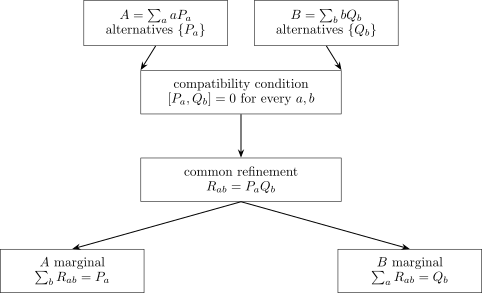
For compatible sharp observables, the products are joint projectors. Summing over forgets the label and returns ; summing over forgets the label and returns .
Joint Born Probabilities
Section titled “Joint Born Probabilities”For a density operator , the joint Born distribution is
For a pure state ,
The marginals are exactly the individual Born probabilities:
Compatibility is therefore what permits and to be represented by one ordinary joint probability distribution for every state, within this sharp projective setting.
Operational Meaning for Ideal Sequential Measurements
Section titled “Operational Meaning for Ideal Sequential Measurements”Suppose an ideal Lüders measurement of yields , followed by an ideal measurement of yielding . The joint probability is
Using cyclicity of the trace,
If and commute, then
so
Reversing the order gives the same result:
Conditioned on the joint outcome , the ideal updated state is
provided . The detailed probability tree and state updates belong to Sequential Measurements.
This order independence concerns ideal projective instruments. An apparatus can append an extra outcome-dependent unitary or couple to unrecorded degrees of freedom while realizing the same projectors. Compatibility of observables does not make every such implementation mutually nondisturbing.
Degeneracy: Preserved Blocks, Not Arbitrary Bases
Section titled “Degeneracy: Preserved Blocks, Not Arbitrary Bases”The slogan “commuting observables have the same eigenvectors” is imprecise in the presence of degeneracy. Commutation guarantees that a simultaneous basis can be chosen; it does not guarantee that every eigenbasis selected for one operator diagonalizes the other.
Consider
The first two coordinate vectors are eigenvectors with eigenvalue , but neither is a eigenvector. Because is proportional to the identity inside their two-dimensional subspace, may mix them without leaving that subspace. Directly,
Diagonalizing inside the degenerate block gives
The simultaneous labels are
Here resolves the degeneracy of . The canonical treatment of whether a family removes all residual degeneracy is Complete Sets of Commuting Observables. The corresponding ideal update within a degenerate eigenspace is treated in Degenerate Measurements and Lüders Rule.
Nondegenerate Observables
Section titled “Nondegenerate Observables”If has a nondegenerate spectrum and , every one-dimensional -eigenspace is preserved by . Therefore
In finite dimension one can define a function on the spectrum of by
Then
Thus a compatible supplies no new refinement of a nondegenerate measurement: once is known, is determined. Compatibility and independence of labels are different questions.
Compatible Families
Section titled “Compatible Families”For a finite family of self-adjoint matrices
pairwise commutation,
implies simultaneous diagonalizability. The proof proceeds recursively: diagonalize , restrict to each preserved eigenspace, and continue inside the successively refined joint subspaces.
If is the spectral projector of , the joint projectors are
Pairwise commutation makes the product independent of ordering. A compatible family need not be complete: a nonzero can still have rank greater than one.
Compatibility Is Not Completeness
Section titled “Compatibility Is Not Completeness”Compatibility asks whether the alternatives can be jointly refined. Completeness asks whether the surviving joint alternatives are one-dimensional within a declared space or sector.
For example, on a Hilbert space with orbital angular momentum sectors,
so and are compatible. Their labels may still leave other degrees of freedom, such as a radial quantum number, unspecified.
Likewise, the identity commutes with every observable but refines nothing. Compatibility is necessary for a CSCO, not sufficient.
Compatibility Is Not Statistical Independence
Section titled “Compatibility Is Not Statistical Independence”Joint measurability supplies a joint distribution, but it does not force that distribution to factorize:
in general.
For two qubits, consider
The operators act on different tensor factors, so
In the state
the only joint outcomes are and , each with probability . Both marginals are unbiased, yet the outcomes are perfectly correlated:
The probability structure of such examples is developed in Correlations and Covariance.
Compatibility Does Not Make Every State Sharp
Section titled “Compatibility Does Not Make Every State Sharp”Let be a simultaneous eigenbasis. A general state can be a superposition
Unless all nonzero coefficients share the same and , the state has nonzero spread in one or both observables. Compatibility means that sharp joint alternatives exist and form a complete decomposition, not that the prepared state occupies only one of them.
A joint eigenstate can satisfy
but a superposition of joint eigenstates can have
Compatibility and Uncertainty
Section titled “Compatibility and Uncertainty”The Robertson relation reads
For compatible observables, the commutator lower bound vanishes:
This does not predict zero variances in an arbitrary state. It says that the commutator contributes no state-independent obstruction to a common sharp state. The covariance term in the stronger Robertson–Schrödinger relation may also be nonzero for a superposition of joint eigenstates. See General Uncertainty Relations for the derivation and equality conditions.
Standard Examples
Section titled “Standard Examples”Angular momentum
Section titled “Angular momentum”The total orbital angular momentum and one chosen component commute:
The states are simultaneous eigenstates:
and
By contrast,
so and are incompatible.
A symmetry and the Hamiltonian
Section titled “A symmetry and the Hamiltonian”If a parity-invariant Hamiltonian satisfies
its energy eigenspaces are preserved by parity. Energy eigenvectors can be chosen with definite parity. If an energy level is nondegenerate, its eigenvector is automatically a parity eigenvector; if it is degenerate, parity must be diagonalized inside that energy eigenspace.
Commutation with adds a dynamical statement: the compatible label is also conserved under the corresponding unitary evolution.
Spinless hydrogenic labels
Section titled “Spinless hydrogenic labels”For the ideal spinless Coulomb Hamiltonian,
The labels can therefore be assigned simultaneously to bound states. The model-specific degeneracies and radial structure belong to the hydrogenic system pages; the label-completeness question belongs to the CSCO article.
Observables on separate tensor factors
Section titled “Observables on separate tensor factors”Operators of the form
always commute because
This algebraic compatibility does not preclude correlations created by the state, as the two-qubit example above demonstrates.
Position and Momentum as a Contrast
Section titled “Position and Momentum as a Contrast”Position and momentum obey the canonical relation
on an appropriate common domain. Their spectral projective measurements do not possess a common sharp refinement. This incompatibility underlies the position–momentum uncertainty relation, though uncertainty, measurement disturbance, and noncommutativity should not be collapsed into one slogan.
The representation and domain qualifications for this equation are treated in Canonical Commutation Relations.
Infinite-Dimensional and Unbounded Operators
Section titled “Infinite-Dimensional and Unbounded Operators”For bounded self-adjoint operators, the equation is defined on the whole Hilbert space and is equivalent to commutation of their spectral measures.
For unbounded self-adjoint operators, products such as and may have different domains. Verifying
on some dense common domain need not establish full measurement compatibility.
The robust condition is strong commutativity. If and are the spectral projections associated with Borel sets and , require
for every pair of Borel sets. Then
defines a joint projection-valued measure. This is the infinite-dimensional counterpart of .
Domain statements should therefore specify what commutes, on which domain, and whether spectral projections commute. A formal vanishing commutator is not a substitute for that audit.
Generalized Measurements: A Different Criterion
Section titled “Generalized Measurements: A Different Criterion”For POVMs and , joint measurability means that there is a POVM such that
If all effects commute with all effects , then
is a joint POVM, so commutation is sufficient. Unlike the sharp projective case, it is not necessary: sufficiently unsharp noncommuting measurements can be jointly measurable.
Thus the equivalence
belongs specifically to sharp projective observables. See POVMs: First Encounter for the generalized framework.
A Practical Compatibility Audit
Section titled “A Practical Compatibility Audit”For a textbook finite-dimensional problem:
- Identify the self-adjoint operators and the Hilbert space or sector on which they act.
- Compute , or exploit tensor-factor, symmetry, or block structure.
- If the commutator vanishes, identify degenerate eigenspaces of one observable.
- Diagonalize the other observable inside each preserved degenerate block.
- Construct for joint alternatives when probabilities are needed.
- Check that zero joint projectors are omitted and the nonzero projectors sum to .
- Use and verify both marginals.
For unbounded operators, replace step 2 by a domain and spectral-measure analysis. For POVMs, look directly for a parent joint POVM.
Common Mistakes
Section titled “Common Mistakes”- Calling observables compatible because they share one eigenvector.
- Saying that commuting observables are diagonal in every eigenbasis of either operator; degeneracy allows basis freedom inside invariant blocks.
- Confusing a common eigenbasis with a state that is presently one common eigenvector.
- Treating compatibility as statistical independence.
- Assuming a compatible family is automatically a complete set of labels.
- Forgetting that may commute with while supplying no new information.
- Using a vanishing Robertson commutator bound to conclude that both variances vanish.
- Claiming that arbitrary instruments for compatible observables are nondisturbing.
- Applying the matrix commutator test to unbounded operators without checking domains or spectral projections.
- Extending “compatible iff commuting” unchanged from projective measurements to POVMs.
Canonical Boundaries
Section titled “Canonical Boundaries”This page owns the compatibility criterion and the common-refinement picture for sharp observables. Nearby pages own related questions:
- Commutators develops the algebra and identities of .
- Simultaneous Eigenstates develops common eigenvectors and simultaneous sharp labels.
- Complete Sets of Commuting Observables owns completeness, residual degeneracy, and label selection.
- Sequential Measurements owns ordered projective-measurement probabilities and state updates.
- POVMs: First Encounter owns generalized measurement effects and their probability rule.
Summary
Section titled “Summary”- Two finite-dimensional sharp observables are compatible exactly when their self-adjoint operators commute.
- Commutation is equivalent to commuting spectral projectors, a simultaneous orthonormal eigenbasis, and a common projective refinement.
- The joint projectors are , and their marginals recover the original projective measurements.
- A common eigenvector is not enough; compatibility concerns the complete Hilbert space or declared sector.
- Degeneracy requires diagonalizing one observable inside eigenspaces preserved by the other.
- Compatibility permits a joint probability distribution but does not imply statistical independence, completeness, or sharp values in every state.
- Ideal Lüders measurements of compatible observables have order-independent joint statistics, but arbitrary implementations can add disturbance.
- Unbounded operators require strong commutativity of spectral measures, and POVM joint measurability is broader than commutation.
References
Section titled “References”- P. A. M. Dirac, The Principles of Quantum Mechanics, 4th ed., Oxford University Press, 1958.
- J. von Neumann, Mathematical Foundations of Quantum Mechanics, Princeton University Press, 1955.
- M. Reed and B. Simon, Methods of Modern Mathematical Physics, Vol. I: Functional Analysis, rev. ed., Academic Press, 1980.
- B. C. Hall, Quantum Theory for Mathematicians, Springer, 2013.
- J. J. Sakurai and J. Napolitano, Modern Quantum Mechanics, 3rd ed., Cambridge University Press, 2020.
- T. Heinosaari and M. Ziman, The Mathematical Language of Quantum Theory: From Uncertainty to Entanglement, Cambridge University Press, 2012.
- P. Busch, P. Lahti, J.-P. Pellonpää, and K. Ylinen, Quantum Measurement, Springer, 2016.
Exercises
Section titled “Exercises”Exercise 1: Common basis implies commutation
Section titled “Exercise 1: Common basis implies commutation”Suppose and have an orthonormal simultaneous eigenbasis :
Prove that .
Solution
On every basis vector,
Therefore for every . Because the vectors span the Hilbert space and the commutator is linear,
for every . Hence .
Exercise 2: Resolve a degenerate block
Section titled “Exercise 2: Resolve a degenerate block”For
verify that and commute and find an orthonormal simultaneous eigenbasis.
Solution
Both matrices preserve
and . On the first block, is the identity times , so it commutes with the restriction of . On the second block both are scalar. Hence .
The eigenvectors of the first block of are
Together with , they form an orthonormal simultaneous eigenbasis. Their joint eigenvalue pairs are
Exercise 3: Joint projectors
Section titled “Exercise 3: Joint projectors”Let and be commuting PVMs. Show that
is a PVM and has and as marginals.
Solution
Because and commute,
and
For distinct joint outcomes,
Finally,
and
Thus the form a projective measurement with the required marginals.
Exercise 4: A shared vector is insufficient
Section titled “Exercise 4: A shared vector is insufficient”For
show that is a common eigenvector but the observables are not compatible.
Solution
The first columns give
so is a common eigenvector. However,
Therefore
The common vector spans only one sector; incompatibility remains on its orthogonal complement.
Exercise 5: Order-independent ideal statistics
Section titled “Exercise 5: Order-independent ideal statistics”Let . Starting from the Lüders sequential probabilities, show that measuring then or then gives the same joint distribution.
Solution
For then ,
For the reverse order,
Since , both expressions equal
Exercise 6: Compatible but correlated
Section titled “Exercise 6: Compatible but correlated”For
and
compute the joint distribution and covariance.
Solution
The state has amplitude only on and . Therefore
with the two mixed-sign probabilities equal to zero. Hence
while
The covariance is
The observables are compatible because they commute, but their outcomes are not independent in this state.
Exercise 7: Nondegeneracy and functional dependence
Section titled “Exercise 7: Nondegeneracy and functional dependence”Let be a self-adjoint matrix with distinct eigenvalues , and suppose . Show that for some function defined on the spectrum of .
Solution
Each eigenspace of is one-dimensional. Since preserves every -eigenspace,
for some real . Define . Spectral calculus gives
Because the spectrum is finite, a polynomial interpolating the values at the points may be used for .
Exercise 8: Jointly measurable unsharp spin components
Section titled “Exercise 8: Jointly measurable unsharp spin components”For , define qubit effects
Show that is a joint POVM for unsharp and spin measurements when , even though the marginal effects do not commute when .
Solution
The Bloch vector of has length . Its eigenvalues are
Thus every is positive exactly when
Summing over gives
and summing over gives
Also , so the form a parent POVM for both marginals. For ,
This example shows why joint measurability and effect commutation are not equivalent for unsharp POVMs.