Anticommutators
The anticommutator of two operators is the symmetric product
It complements the antisymmetric commutator
Together, the two brackets recover either ordering:
and
For Hermitian observables, this split separates two physically different pieces of an ordered product:
- is Hermitian and carries the real symmetric correlation.
- is anti-Hermitian and carries order sensitivity.
Anticommutators enter symmetrized covariance, the Robertson–Schrödinger uncertainty relation, Pauli and Clifford-type algebras, open-system generators, and fermionic canonical relations. Those appearances share notation but not always the same physical role.
The longer reusable identity list remains in Commutators and Anticommutators. This page owns the Core Formalism interpretation and its standard quantum applications.
Definition and Ordering Meaning
Section titled “Definition and Ordering Meaning”Acting on a state,
The anticommutator adds the two orderings. It does not measure their difference and is not an alternative compatibility test.
If
then
and and are said to anticommute.
This differs sharply from commuting:
If two operators anticommute, then
Thus nonzero anticommuting operators are generally noncommuting. The logical exception is worth remembering: if , then the operators both commute and anticommute. Orthogonal-support projectors provide such examples.
Basic Algebra
Section titled “Basic Algebra”The anticommutator is bilinear:
and similarly in the first slot. It is symmetric:
Special cases include
and
Unlike the commutator, the anticommutator does not obey an ordinary Leibniz rule. A useful mixed identity is
For finite matrices, cyclicity gives
which need not vanish. This contrasts with
Hermiticity and the Symmetric Observable Product
Section titled “Hermiticity and the Symmetric Observable Product”If and are Hermitian matrices, then
Therefore
is Hermitian and can itself represent an observable in the finite-dimensional setting. The operation is called the Jordan product.
The ordinary product need not be Hermitian, because
The Jordan product removes the anti-Hermitian ordering part and keeps the observable-valued symmetric part.
For a density operator ,
is real whenever the relevant products and traces are well-defined.
The Jordan Product Is Not Associative
Section titled “The Jordan Product Is Not Associative”The Jordan product is commutative:
but it is generally not associative. Direct expansion gives
Nested commutators therefore measure the failure of the symmetric product to associate. Parentheses cannot be dropped from repeated Jordan products.
For example, with Pauli matrices,
whereas
The product is still highly structured; its nonassociativity is not a defect. It encodes a different algebraic aspect of observables from the Lie bracket defined by the commutator.
Sum and Difference Squares
Section titled “Sum and Difference Squares”Anticommutators are the cross terms in operator squares:
and
Consequently,
This polarization identity shows how the symmetric product can be recovered from observable squares.
If and anticommute, the cross term vanishes:
Centered Observables and Covariance
Section titled “Centered Observables and Covariance”For observables and in a state , define centered operators
and
Here
The symmetrized covariance is
Expanding the centered operators gives
For Hermitian and , this is real and symmetric under exchange:
The ordered centered moment splits as
Thus
while the commutator supplies its imaginary part. The statistical interpretation, compatible-observable joint distributions, and connected correlations are developed in Correlations and Covariance.
Covariance Matrices Are Positive Semidefinite
Section titled “Covariance Matrices Are Positive Semidefinite”For a family of Hermitian observables , define
For any real vector , let
Then
Therefore is a real positive-semidefinite matrix. The anticommutator is what makes the matrix symmetric while retaining the physical quadratic fluctuation of every real linear combination of observables.
Robertson–Schrödinger Uncertainty
Section titled “Robertson–Schrödinger Uncertainty”The stronger two-observable uncertainty relation is
Equivalently,
The commutator term measures the antisymmetric obstruction, while the anticommutator term records aligned fluctuations. A state can have and still obey a nontrivial bound because its symmetrized covariance is nonzero.
The Cauchy–Schwarz derivation, equality condition, and domain assumptions belong to General Uncertainty Relations.
Pauli Matrices: Dot and Cross Products
Section titled “Pauli Matrices: Dot and Cross Products”For real vectors and , the Pauli identity is
Taking symmetric and antisymmetric parts gives
and
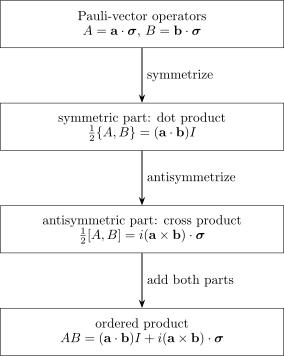
For Pauli-vector observables, the anticommutator extracts the Euclidean dot product, while the commutator extracts the oriented cross product. Their sum reconstructs the ordered matrix product.
In component form,
and
Orthogonal directions satisfy
They anticommute but do not commute unless one operator vanishes. The spin and rotation interpretation belongs to Pauli Matrices.
Anticommuting Hermitian Involutions
Section titled “Anticommuting Hermitian Involutions”Suppose and are Hermitian and satisfy
For real and ,
Hence every eigenvalue of obeys
The possible eigenvalues are therefore
Another useful consequence is
because and . Conjugation by reverses the sign of .
No nonzero vector can be a simultaneous eigenvector of both involutions. If
with , then
contradicting anticommutation.
Spectral Pairing
Section titled “Spectral Pairing”More generally, if
and
then
Whenever , it is an eigenvector with eigenvalue . Thus an invertible anticommuting operator pairs the nonzero spectrum of between and .
Zero modes require separate care. If , no partner is produced, and if , the sign-reversed eigenvalue is the same eigenvalue.
The Anticommutator of Positive Operators Need Not Be Positive
Section titled “The Anticommutator of Positive Operators Need Not Be Positive”Hermiticity does not imply positivity. Let
Both and are rank-one projectors and therefore positive. Yet
Its eigenvalues are
Because , the anticommutator is not positive. Symmetrizing a product restores Hermiticity, not positivity.
Open-System Preview: Lindblad Dissipation
Section titled “Open-System Preview: Lindblad Dissipation”A single-channel Lindblad dissipator has the form
The jump term alone changes the trace. The anticommutator term supplies the matching symmetric subtraction:
while
Therefore
The full completely positive dynamics, Hamiltonian term, and many-channel form belong to the Lindblad–GKSL Equation.
Fermionic Preview
Section titled “Fermionic Preview”Fermionic creation and annihilation operators satisfy canonical anticommutation relations
Setting in the second relation gives
so
No mode can be created or annihilated twice in succession. The number operator
obeys
so its eigenvalues are and .
These statements require a mode ordering and an antisymmetric Fock-space construction. Their canonical home is Fermionic Anticommutation Relations.
For graded operator algebras, the commutator and anticommutator are unified by
When both operators are odd, the graded commutator becomes an ordinary anticommutator. This grading is a structural statement, not a license to replace commutators by anticommutators arbitrarily.
Domain Caveats
Section titled “Domain Caveats”For unbounded operators, both products must exist. The natural domain is
Hermiticity calculations assume that adjoints and products are defined on appropriate domains. Even if and are self-adjoint separately, the sum on a naive intersection need not automatically be self-adjoint.
Covariance and uncertainty formulas additionally require the state to have finite second moments. In infinite-dimensional examples, always distinguish a formal algebraic expression from a closed or self-adjoint operator with a declared domain.
A Practical Workflow
Section titled “A Practical Workflow”- Identify whether braces denote an anticommutator, a set, or a Poisson bracket from context.
- Preserve both operator orderings when expanding .
- For Hermitian inputs, use Hermiticity as a result check.
- Center observables before interpreting an anticommutator expectation as covariance.
- Use or Pauli dot products to simplify symmetric cross terms.
- Do not infer compatibility from anticommutation.
- Do not infer positivity from Hermiticity of the symmetric product.
- For unbounded operators, check the domains of both and .
- In fermionic or graded settings, state mode labels and parity conventions.
Common Mistakes
Section titled “Common Mistakes”- Confusing with .
- Calling anticommuting observables simultaneously measurable.
- Forgetting the factor of in .
- Assuming the Jordan product is associative because it is commutative.
- Calling a covariance without centering the observables.
- Treating the anticommutator of positive operators as automatically positive.
- Replacing a commutator by an anticommutator in a generator or Heisenberg equation.
- Using fermionic canonical relations without mode ordering or Fock-space context.
- Ignoring domains when or is unbounded.
- Forgetting that braces also denote sets and classical Poisson brackets.
Canonical Boundaries
Section titled “Canonical Boundaries”This page owns the symmetric-product interpretation and its immediate Core Formalism applications. Nearby pages own the deeper developments:
- Commutators and Anticommutators owns the reusable identity catalog.
- Correlations and Covariance owns joint fluctuations, covariance matrices, and statistical examples.
- General Uncertainty Relations owns the Robertson and Robertson–Schrödinger derivations.
- Pauli Matrices owns spin- observables and rotations.
- Fermionic Anticommutation Relations owns the canonical fermionic algebra, occupation states, and signs.
- Lindblad–GKSL Equation owns Markovian open-system dynamics.
Summary
Section titled “Summary”- The anticommutator is the symmetric combination of two operator orderings.
- For Hermitian and , is the Hermitian Jordan product.
- The Jordan product is commutative but generally not associative.
- Anticommutators supply cross terms in squares and the real symmetric part of ordered expectation values.
- Centered anticommutator expectations define symmetrized covariance and the covariance term in the Robertson–Schrödinger inequality.
- In Pauli algebra, the anticommutator extracts a dot product while the commutator extracts a cross product.
- Anticommuting Hermitian involutions have no common eigenvector and produce simple norm-like square identities.
- Hermiticity of does not imply positivity.
- Lindblad dissipators and fermionic mode algebras use anticommutators for specialized structural reasons developed in their canonical pages.
- Unbounded anticommutators require a common product domain and do not become self-adjoint automatically.
References
Section titled “References”- P. A. M. Dirac, The Principles of Quantum Mechanics, 4th ed., Oxford University Press, 1958.
- P. Jordan, J. von Neumann, and E. Wigner, “On an Algebraic Generalization of the Quantum Mechanical Formalism,” Annals of Mathematics 35, 29–64 (1934).
- R. Shankar, Principles of Quantum Mechanics, 2nd ed., Springer, 1994.
- J. J. Sakurai and J. Napolitano, Modern Quantum Mechanics, 3rd ed., Cambridge University Press, 2020.
- L. E. Ballentine, Quantum Mechanics: A Modern Development, 2nd ed., World Scientific, 2014.
- M. A. Nielsen and I. L. Chuang, Quantum Computation and Quantum Information, Cambridge University Press, 2010.
- H.-P. Breuer and F. Petruccione, The Theory of Open Quantum Systems, Oxford University Press, 2002.
Exercises
Section titled “Exercises”Exercise 1: Ordered-product decomposition
Section titled “Exercise 1: Ordered-product decomposition”Starting from the definitions of the commutator and anticommutator, derive
If and are Hermitian, identify the Hermitian and anti-Hermitian pieces.
Solution
Adding the two brackets gives
Dividing by yields the formula. For Hermitian and , is Hermitian and is anti-Hermitian.
Exercise 2: Jordan associator
Section titled “Exercise 2: Jordan associator”Let . Prove
Solution
Expanding the first association gives
The second gives
Subtracting,
Exercise 3: Pauli-vector decomposition
Section titled “Exercise 3: Pauli-vector decomposition”Use
to derive the anticommutator and commutator of and .
Solution
Expand both vector operators in components:
Reversing and keeps the dot product and reverses the cross product. Therefore
and
Exercise 4: Anticommuting involutions
Section titled “Exercise 4: Anticommuting involutions”Suppose and . Show that
has eigenvalues whenever both signs occur in the representation.
Solution
Squaring gives
If , then
Hence . The algebra fixes the allowed values; the representation determines their multiplicities and whether both signs are present.
Exercise 5: Qubit covariance
Section titled “Exercise 5: Qubit covariance”Let
and let
Show that
Solution
The expectation values are
The Pauli anticommutator gives
Subtracting the product of means yields the stated covariance.
Exercise 6: Positivity counterexample
Section titled “Exercise 6: Positivity counterexample”For
verify that both are positive projectors but is not positive.
Solution
Both matrices satisfy and , so their eigenvalues are and .
Their anticommutator is
Its characteristic polynomial is
with roots
The smaller root is negative, so is Hermitian but not positive.
Exercise 7: Trace preservation in a dissipator
Section titled “Exercise 7: Trace preservation in a dissipator”For
show that .
Solution
Cyclicity gives
For the anticommutator term,
The two contributions cancel.
Exercise 8: Fermionic nilpotency and occupation
Section titled “Exercise 8: Fermionic nilpotency and occupation”For one fermionic mode, assume
Show that and that satisfies .
Solution
The second relation gives
so . For the number operator,
The last term vanishes because ; equivalently, . Therefore