Aharonov–Bohm Effect: First Encounter
The Aharonov–Bohm effect shows that electromagnetic potentials cannot be dismissed as mere calculational decoration in quantum mechanics. A charged particle can acquire a measurable phase shift from magnetic flux enclosed by its path even when the magnetic field vanishes everywhere the particle travels.
This first-encounter page emphasizes the wave-mechanics derivation and the flux-threaded ring model. The geometric and gauge-theoretic interpretation is developed in Aharonov–Bohm Effect.
The basic magnetic setup is:
- an inaccessible flux region, such as an ideal long solenoid;
- two coherent paths passing around that region;
- along the accessible paths;
- nonzero magnetic flux through the excluded region.
The observed effect is an interference shift. It is not a local magnetic force on the particle along its path. It is a gauge-invariant relative phase.
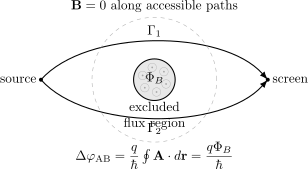
Two paths can enclose magnetic flux even when along each path. The relative phase is .
Phase From Minimal Coupling
Section titled “Phase From Minimal Coupling”For a particle of charge , minimal coupling uses
In a static magnetic Aharonov–Bohm setup, take and place the particle in a region where
along the accessible paths. Locally, this means can be written as a gradient:
Locally, such a vector potential can be removed by a gauge transformation of the wavefunction. The surprise is global: if the accessible region has a hole, one cannot always choose a single-valued on the whole region.
For a path , the magnetic contribution to the wave phase is
Only relative phases are observable. For two paths and with the same endpoints, the relative phase is
Equivalently, the two paths form a closed loop , so
By Stokes theorem, if surrounds magnetic flux ,
with orientation conventions understood. Thus
The phase is meaningful modulo . Therefore the effect is periodic in flux with period
What Is Gauge Invariant
Section titled “What Is Gauge Invariant”The vector potential is gauge dependent. A line integral along a single open path is also gauge dependent, because a gauge transformation changes it by endpoint terms. The closed-loop phase is different:
is gauge invariant for ordinary single-valued gauge transformations.
This is the clean statement of the effect. The vector potential itself is not a directly observable field. The gauge-invariant holonomy around the excluded flux region is observable through interference.
If the accessible region were simply connected and everywhere on it, every closed-loop integral of would vanish after a suitable gauge choice. The Aharonov–Bohm geometry is different because the accessible region is punctured by an excluded flux tube.
Interference Shift
Section titled “Interference Shift”Suppose two paths arrive at a detector with nonmagnetic relative phase . The intensity has the schematic form
Changing the enclosed flux shifts the fringes:
Increasing the flux by changes the phase by in magnitude, so the interference pattern returns to itself.
This is a phase effect, not a claim that the local Lorentz force is nonzero along the paths. In the ideal magnetic Aharonov–Bohm setup, the particle travels through a field-free region while still enclosing inaccessible flux.
Ring Form
Section titled “Ring Form”A particle on a ring threaded by flux is the simplest exactly solvable version. Let the ring have radius and moment of inertia
If the flux through the ring is , a convenient vector potential on the ring is
Minimal coupling gives
Using the single-valued basis
the energies are
The flux shifts the angular-momentum parabola. The free-ring degeneracy between and is generally split, and degeneracies occur again at special flux values such as half-integer flux in the appropriate orientation convention.
Equivalently, one can use a gauge transformation to remove from the local Hamiltonian on the ring, but the price is a twisted boundary condition. That is the same physics in different language: the phase cannot be made globally invisible unless the enclosed flux is an integer multiple of the flux quantum.
The canonical ring model, including flux-shifted energies and current interpretation, is Particle on a Ring.
Why This Is Not Classical Force Physics
Section titled “Why This Is Not Classical Force Physics”Classically, a charged particle responds locally to fields through the Lorentz force
If and along the path, there is no local Lorentz force there. The Aharonov–Bohm effect is therefore not explained by an ordinary classical force acting along the accessible path.
Quantum mechanically, the wavefunction is sensitive to phase. The phase is not a local force; it is part of how amplitudes from different paths combine. The gauge-invariant closed-loop phase can be nontrivial even when the field strength vanishes locally on the accessible region.
This does not mean that arbitrary gauge choices are observable. It means that global gauge-invariant phase data can be observable.
Local Versus Global Gauge Removal
Section titled “Local Versus Global Gauge Removal”In a small field-free patch, can be removed locally. Around a flux tube, one can choose patches, but a single globally smooth and single-valued phase convention may fail.
A useful ideal vector potential outside a thin flux tube is
Outside the tube,
But around a circle of radius ,
Locally flat does not imply globally trivial. The later mathematical language for this statement is holonomy on a space with a noncontractible loop.
Common Mistakes
Section titled “Common Mistakes”- Saying the effect proves that itself is gauge-invariantly observable.
- Forgetting that the observable is a relative phase or interference shift.
- Claiming the particle must pass through nonzero in the ideal magnetic setup.
- Using Stokes theorem while ignoring that the spanning surface crosses an excluded flux region.
- Dropping the sign of without stating the orientation convention.
- Treating the ring spectrum as nonperiodic in flux; it is periodic after relabeling integer .
- Confusing this first wave-mechanics effect with the full topology of gauge bundles.
Exercises
Section titled “Exercises”- Derive the Aharonov–Bohm phase for two paths enclosing flux .
Solution
The path-dependent magnetic phase is
For two paths with the same endpoints,
If the closed loop encloses flux , then
so
- Show that the interference shift is periodic in flux.
Solution
The phase changes by
Changing flux by changes the phase by
The interference pattern is unchanged when this is an integer multiple of . The smallest positive period in flux magnitude is therefore
- Derive the flux-shifted ring spectrum.
Solution
On a ring,
Acting on ,
Therefore
Since ,
- Why can a vector potential with outside a solenoid still have nonzero loop integral?
Solution
The accessible region is not simply connected; the solenoid core is removed. Locally, can be a gradient in small field-free patches. Globally, a loop around the removed core cannot be contracted to a point without crossing the excluded flux region.
For
the curl vanishes for , but
The loop detects the global flux even though the local field vanishes on the accessible path.
Where This Is Used
Section titled “Where This Is Used”- Gauge Transformations: First Encounter supplies the local phase transformation law.
- Aharonov–Bohm Effect is the canonical geometric and holonomy explanation.
- Minimal Coupling in Wave Mechanics supplies the Hamiltonian and vector-potential coupling.
- Particle on a Ring gives the canonical ring spectrum used as the solvable model.
- Aharonov–Bohm Rings turns the phase into an open-device magnetoconductance diagnostic and separates from mechanisms.
- Periodic Boundary Conditions explains the single-valued and twisted boundary-condition viewpoint.
- Holonomy gives the later mathematical language for closed-loop phase.
- Homotopy and Winding explains why loops around an excluded flux region are topologically distinct.
- U(1) Bundles and Quantum Phase gives the phase-bundle interpretation.
References
Section titled “References”- Y. Aharonov and D. Bohm, “Significance of electromagnetic potentials in the quantum theory,” Physical Review 115, 485-491, 1959.
- R. G. Chambers, “Shift of an electron interference pattern by enclosed magnetic flux,” Physical Review Letters 5, 3-5, 1960.
- A. Tonomura et al., “Evidence for Aharonov-Bohm effect with magnetic field completely shielded from electron wave,” Physical Review Letters 56, 792-795, 1986.
- M. Peshkin and A. Tonomura, The Aharonov-Bohm Effect, Springer, 1989.
- J. J. Sakurai and J. Napolitano, Modern Quantum Mechanics, 3rd ed., Cambridge University Press, 2020.