Charged Harmonic Oscillator in a Magnetic Field
A charged harmonic oscillator in a magnetic field is the simplest exactly solvable model that combines ordinary confinement with Landau quantization. It is often called the Fock–Darwin problem in two dimensions.
The model interpolates between two canonical limits:
- when the magnetic field vanishes, it is the isotropic two-dimensional harmonic oscillator;
- when the harmonic confinement vanishes, it becomes the Landau-level problem, with a zero-frequency guiding-center mode.
This page treats the spinless single-particle model. Real quantum dots, trapped charged particles, and semiconductor devices can add spin, Zeeman splitting, anisotropic confinement, disorder, finite thickness, and interactions.
Hamiltonian
Section titled “Hamiltonian”Consider a particle of mass and charge moving in the plane with harmonic confinement
and a uniform magnetic field
Minimal coupling gives
Use symmetric gauge,
Define the signed cyclotron frequency
and the positive cyclotron frequency
Expanding the Hamiltonian gives
where
and
The magnetic field has done two things. It added a quadratic diamagnetic term, increasing the effective radial oscillator frequency from to , and it coupled to angular momentum through .
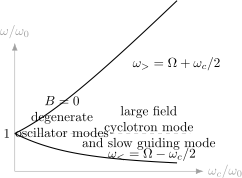
The magnetic field splits the two circular oscillator modes. At they are degenerate at ; as confinement is removed relative to the field, one mode approaches the cyclotron frequency and the other becomes the guiding-center zero mode.
Spectrum
Section titled “Spectrum”The eigenstates can be labeled by a radial quantum number
and an angular quantum number
The Fock–Darwin energies are
The first term is the isotropic two-dimensional oscillator spectrum with frequency . The second term splits states with opposite angular momentum. The sign of the splitting depends on the sign of .
Equivalently, the system can be written in terms of two circular oscillator modes with frequencies
The corresponding energies can be written as
with the assignment of clockwise versus counterclockwise angular momentum set by the sign of . This circular-mode form makes the Landau-level limit especially transparent.
Wavefunctions
Section titled “Wavefunctions”Because symmetric gauge preserves rotations about the axis, the eigenfunctions have angular form
The radial functions are the two-dimensional oscillator radial functions with the magnetic-field-modified frequency . Up to normalization,
where
The magnetic field changes the radial length scale through and changes the energies through the angular-momentum splitting. It does not remove the usefulness of angular-momentum labels; in symmetric gauge, they are the natural labels.
Limits
Section titled “Limits”Zero Magnetic Field
Section titled “Zero Magnetic Field”When ,
The spectrum becomes
the ordinary isotropic two-dimensional oscillator spectrum. States with the same
belong to the same oscillator shell.
Weak Magnetic Field
Section titled “Weak Magnetic Field”For small , the leading splitting is linear:
The quadratic diamagnetic shift enters through
Thus weak fields first split angular-momentum partners; the radial confinement shift is second order in .
Landau-Level Limit
Section titled “Landau-Level Limit”When ,
The circular-mode frequencies become
The high-frequency circular mode is the cyclotron motion. The zero-frequency mode is the guiding-center freedom responsible for Landau-level degeneracy. A weak harmonic trap lifts that degeneracy by giving the guiding center a slow restoring energy.
This is the clean conceptual bridge: Landau levels are what remains when one circular oscillator mode has a finite cyclotron frequency and the other loses its restoring force.
Quantum-Dot Preview
Section titled “Quantum-Dot Preview”The Fock–Darwin spectrum is a standard first model for a lateral quantum dot with approximately parabolic confinement in a perpendicular magnetic field. In that setting:
- models the confinement strength;
- tunes the cyclotron scale;
- angular-momentum states shift relative to each other as the field changes;
- spin and interactions must be added for realistic many-electron dots.
The single-particle spectrum is useful because it isolates the orbital physics. It should not be mistaken for a complete device model.
Common Mistakes
Section titled “Common Mistakes”- Using the positive in the angular term without tracking the sign of .
- Forgetting the diamagnetic contribution to .
- Treating the model as one-dimensional; the angular-momentum term is intrinsically two-dimensional.
- Expecting Landau-level degeneracy to survive unchanged when .
- Including Zeeman splitting without saying that spin has been added to the spinless model.
- Calling every magnetic oscillator spectrum “Landau levels” even when confinement has lifted the degeneracy.
Exercises
Section titled “Exercises”- Expand the symmetric-gauge Hamiltonian and identify .
Solution
In symmetric gauge,
so
Adding gives
Since ,
- Starting from the two-dimensional oscillator spectrum with frequency , derive the Fock–Darwin energies.
Solution
The isotropic two-dimensional oscillator energies are
The angular-momentum term is
Since , this contributes
Therefore
- Check the limit.
Solution
As ,
The energy becomes
which is the isotropic two-dimensional oscillator spectrum.
- Check the limit using circular-mode frequencies.
Solution
If , then
Therefore
and
The finite mode is the cyclotron oscillator. The zero mode is the guiding-center degeneracy of the Landau problem.
- For , which sign of angular momentum is lowered by the magnetic term?
Solution
If , then , and the angular term is
Positive lowers the energy and negative raises it, all else equal. If the sign of is reversed, this conclusion reverses.
Where This Is Used
Section titled “Where This Is Used”- Quantum Dots adds charging energy, reservoirs, spin filling, and transport spectroscopy to this single-particle benchmark.
- Quantum Harmonic Oscillator supplies the oscillator spectrum and length-scale intuition.
- Particle in a Uniform Magnetic Field supplies the magnetic oscillator and cyclotron-frequency setup.
- Landau Gauge and Symmetric Gauge explains why symmetric gauge is natural for the rotational form used here.
- Landau Levels are recovered when the harmonic confinement is removed.
- Degeneracy of Landau Levels explains the guiding-center degeneracy that confinement lifts.
- Orbital Angular Momentum supplies the operator and angular labels.
- Oscillator as a Universal Local Model explains why parabolic confinement is a useful first approximation.
References
Section titled “References”- C. G. Darwin, “The diamagnetism of the free electron,” Mathematical Proceedings of the Cambridge Philosophical Society 27, 86-90, 1931.
- V. Fock, “Bemerkung zur Quantelung des harmonischen Oszillators im Magnetfeld,” Zeitschrift für Physik 47, 446-448, 1928.
- L. D. Landau and E. M. Lifshitz, Quantum Mechanics: Non-Relativistic Theory, 3rd ed., Pergamon, 1977.
- R. Shankar, Principles of Quantum Mechanics, 2nd ed., Springer, 1994.
- J. J. Sakurai and J. Napolitano, Modern Quantum Mechanics, 3rd ed., Cambridge University Press, 2020.