Particle on a Ring
A particle on a ring is the canonical quantum system with one periodic angular coordinate. The configuration space is the circle , not an interval with two separate ends. That single geometric fact forces integer angular momentum, periodic boundary conditions, and a spectrum symmetric under clockwise and counterclockwise circulation.
This page is the angular-systems treatment. For a more introductory route from one-dimensional boxes to periodic motion, see Particle on a Ring: First Encounter.
Configuration Space
Section titled “Configuration Space”Let a particle of mass be constrained to a circle of fixed radius . Its position is specified by one angle,
with the identification
The Hilbert space is , with inner product
A scalar wavefunction must be single-valued on the circle:
For the free second-derivative Hamiltonian, the derivative is periodic as part of the same self-adjoint domain:
The probability density is density per unit angle. Density per unit arc length differs by the factor .
Hamiltonian and Angular Momentum
Section titled “Hamiltonian and Angular Momentum”The moment of inertia is
Classically, the kinetic energy is
In the angle representation,
so the free-ring Hamiltonian is
Thus the ring is a free particle with a compact coordinate. The differential expression resembles a particle in a box, but the boundary condition is periodic rather than Dirichlet or Neumann.
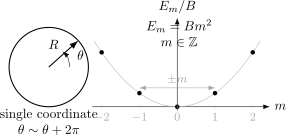
The ring has one periodic coordinate , and the free spectrum is quadratic in the integer angular-momentum label: with . The states and are degenerate when no flux or external field selects an orientation.
Eigenfunctions and Integer Quantum Number
Section titled “Eigenfunctions and Integer Quantum Number”The angular-momentum eigenvalue equation is
Solving gives
Single-valuedness requires
so
Therefore
The normalized eigenfunctions are
The integer can be positive, negative, or zero. Positive and negative values represent opposite orientations of angular momentum around the ring.
Energy Spectrum and Degeneracy
Section titled “Energy Spectrum and Degeneracy”Acting with the Hamiltonian gives
Define
Then
The level is nondegenerate. Every nonzero level is twofold degenerate:
This degeneracy is a time-reversal and orientation symmetry of the free ring. The two states have equal kinetic energy but opposite angular momentum:
The ground state has because the constant wavefunction has no angular variation and therefore no kinetic energy. This does not contradict the harmonic oscillator’s zero-point energy; the ring has no confining angular potential with a finite-width minimum.
Probability Current Around the Ring
Section titled “Probability Current Around the Ring”For the angular Schrödinger equation,
the angular probability density obeys
The angular probability current is
For the eigenstate ,
The density of is constant, but the current is not zero unless . This is a useful warning: a stationary probability density does not imply the absence of probability flow.
Relation to Translations on a Compact Space
Section titled “Relation to Translations on a Compact Space”The ring is also the periodic-box basis written geometrically. If is arc length and is the circumference, then periodicity gives
The tangential momentum is
and the angular momentum is
The energy
is the same spectrum written in linear or angular language. This is the simplest example of how compact configuration spaces quantize generator eigenvalues.
Magnetic Flux Preview
Section titled “Magnetic Flux Preview”If the particle has charge , magnetic flux through the ring shifts the spectrum even when the magnetic field vanishes on the ring itself. This is the ring version of the Aharonov–Bohm effect.
With a tangential vector potential representing flux , minimal coupling gives
Define the dimensionless flux
The single-valued basis remains convenient, and the energies become
The sign of depends on the sign of the charge and on the chosen orientation for . The invariant lesson is that flux shifts the parabola in and can split the degeneracy.
Equivalently, one may remove the vector potential locally and impose a twisted boundary condition. The two descriptions are related by a gauge transformation. The general rule behind this preview is Minimal Coupling in Wave Mechanics, and the full wave-mechanics phase discussion is Aharonov–Bohm Effect: First Encounter.
Common Mistakes
Section titled “Common Mistakes”- Treating and as independent endpoints.
- Allowing arbitrary real for an ordinary single-valued scalar wavefunction.
- Forgetting the negative angular-momentum states.
- Confusing the particle mass with the angular quantum number .
- Thinking the constant ground state contradicts oscillator zero-point energy.
- Inferring zero current from a time-independent density.
- Ignoring charge and orientation conventions when writing the flux-shifted spectrum.
Exercises
Section titled “Exercises”- Normalize on the ring.
Solution
The normalization condition is
Thus
Choosing the overall phase to be gives
- Show that periodicity forces to be an integer.
Solution
The eigenfunction has the form
Periodic single-valuedness gives
After canceling the common factor,
Therefore is an integer. Writing gives
- Compute the angular current in the state .
Solution
For
we have
Thus
The imaginary part is , so
- Which free-ring levels are degenerate?
Solution
The energy is
Therefore
For , the pair and is twofold degenerate. The level is nondegenerate because .
- At what dimensionless flux are the and states degenerate?
Solution
The flux-shifted energies are
Set :
Expanding gives
so
Thus the degeneracy occurs at half a flux quantum in the chosen orientation convention.
Where This Is Used
Section titled “Where This Is Used”- Particle on a Ring: First Encounter introduces the same model from the periodic-box viewpoint.
- Propagators and Boundary Conditions derives the ring kernel as both an angular-momentum sum and a winding sum.
- Particle on a Sphere generalizes compact angular motion from to .
- Rigid Rotor generalizes the one-angle ring to orientation on the sphere.
- Angular Probability Distributions compares the measure with the measure .
- Probability Current supplies the current formula and the warning that stationary density need not mean zero flow.
- Minimal Coupling in Wave Mechanics supplies the flux-shifted Hamiltonian.
- Aharonov–Bohm Rings contrasts this closed spectrum with open-ring conductance harmonics, reservoirs, and dephasing.
- Translations and Momentum explains the generator viewpoint behind .
- Kicked Rotor Preview adds periodic impulsive driving and compares the resulting classical and quantum maps.
References
Section titled “References”- D. J. Griffiths and D. F. Schroeter, Introduction to Quantum Mechanics, 3rd ed., Cambridge University Press, 2018.
- R. Shankar, Principles of Quantum Mechanics, 2nd ed., Springer, 1994.
- J. J. Sakurai and J. Napolitano, Modern Quantum Mechanics, 3rd ed., Cambridge University Press, 2020.
- Y. Aharonov and D. Bohm, “Significance of Electromagnetic Potentials in the Quantum Theory,” Physical Review 115, 485-491, 1959.