Particle on a Sphere
A particle on a sphere is the canonical quantum system whose configuration space is the two-dimensional sphere . The radius is fixed, so there is no radial motion; all dynamics is angular. Its eigenfunctions are spherical harmonics, and its energy levels are organized by orbital angular momentum.
This page is the geometry-first version of the rotor problem. Rigid Rotor uses the same mathematics for molecular rotations, while Angular and Radial Separation embeds the same angular eigenproblem inside full three-dimensional central potentials.
Configuration Space
Section titled “Configuration Space”Let a particle of mass be constrained to a sphere of fixed radius . Its position is described by the angles
The Hilbert space is
where
The inner product is
Normalization means
The factor is part of the surface-area measure. Omitting it changes the Hilbert space and gives the wrong orthogonality relations.
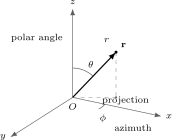
For a particle constrained to a sphere, is fixed and only the angular coordinates and remain dynamical. The measure on the sphere is .
Hamiltonian
Section titled “Hamiltonian”The kinetic energy of a particle moving on a sphere is angular kinetic energy. With moment of inertia
the Hamiltonian is
Using
this becomes
The unit-sphere Laplacian is
There is no radial derivative. The particle is not free in three-dimensional space; it is free on the curved configuration space .
Boundary and Regularity Conditions
Section titled “Boundary and Regularity Conditions”The sphere has no boundary, but spherical coordinates have coordinate singularities. Ordinary scalar wavefunctions must be single-valued under
and must be regular at the poles and , where is not a physical coordinate.
These requirements are what quantize the angular eigenfunctions. The integer comes from periodicity in . The allowed values and the restriction
come from the regularity of the polar equation.
Spherical-Harmonic Eigenstates
Section titled “Spherical-Harmonic Eigenstates”The eigenfunctions of the angular Laplacian are the spherical harmonics:
Equivalently,
The allowed labels are
Thus a stationary state can be written
The mathematical normalization and phase convention are developed in Spherical Harmonics. The angular-momentum interpretation is developed in Spherical Harmonics as Angular-Momentum States.
Energy Levels and Degeneracy
Section titled “Energy Levels and Degeneracy”Since the Hamiltonian is proportional to , the energy depends on but not on :
For fixed , there are
values of . Therefore the degeneracy is
This degeneracy follows from rotational invariance. The label is the projection of angular momentum onto a chosen axis, but a free particle on a sphere has no preferred axis. Different values are different orientations inside the same angular-momentum multiplet.
The ground state is
with
As with the particle on a ring, a zero ground-state energy is possible because there is no confining angular potential with a preferred equilibrium orientation.
Relation to the Particle on a Ring
Section titled “Relation to the Particle on a Ring”Particle on a Ring has one angular coordinate and eigenfunctions
The particle on a sphere has two angular coordinates. The azimuthal dependence is still Fourier-like:
but regularity in the polar angle introduces the additional quantum number and the bound .
The ring spectrum is quadratic in one integer:
The sphere spectrum is quadratic in the angular-momentum Casimir:
The replacement of by is the simplest concrete step from rotations in a plane to rotations in three dimensions.
Relation to the Rigid Rotor
Section titled “Relation to the Rigid Rotor”The particle on a sphere and the ideal linear rigid rotor have the same Hamiltonian form:
The difference is interpretation. For a particle on a sphere, the point on is literally the particle’s position direction at fixed radius. For a linear rigid rotor, the point on represents the orientation of a molecular axis, and the moment of inertia is set by masses and bond length.
This distinction matters once one discusses molecular spectroscopy, nuclear exchange symmetry, dipole selection rules, centrifugal distortion, or external fields. Those are rotor and molecular-physics refinements. The core angular kinetic-energy spectrum is already visible in the particle-on-a-sphere model.
Common Mistakes
Section titled “Common Mistakes”- Forgetting the measure in normalization.
- Treating the coordinate singularities at the poles as physical boundaries.
- Allowing and to vary independently; one must have .
- Expecting the energy to depend on in a rotationally invariant problem.
- Confusing a particle constrained to a sphere with a free particle in three-dimensional space.
- Treating as hydrogen-specific rather than as angular kinetic-energy eigenfunctions.
- Using half-integer angular momentum labels for ordinary scalar wavefunctions on .
Exercises
Section titled “Exercises”- Normalize the ground state .
Solution
The normalization integral is
The area of the unit sphere is
Therefore the integral is .
- List the degeneracy of the first four energy levels.
Solution
The degeneracy at fixed is
For , this gives
- Derive the energy eigenvalue from the angular Laplacian equation.
Solution
The Hamiltonian is
The spherical harmonics obey
Therefore
So
- Explain why does not change the energy.
Solution
The Hamiltonian is proportional to , not to . All states with the same have the same eigenvalue,
even though they have different eigenvalues . Since no external field or boundary condition selects the axis, different values are degenerate orientations of the same angular-momentum multiplet.
Where This Is Used
Section titled “Where This Is Used”- Particle on a Ring gives the one-angle predecessor with integer angular momentum.
- Rigid Rotor uses the same Hamiltonian for molecular orientation.
- Rigid Rotor as an Angular-Momentum System highlights the same spectrum as a Casimir and multiplet problem.
- Spherical Harmonics as Wavefunctions explains angular probabilities, real and complex bases, nodes, and visualization.
- Rotational Spectra applies the same angular energy ladder to ideal molecular rotation lines.
- Angular Probability Distributions is the measure-first guide to and angular marginals.
- Rotor in External Fields: First Encounter shows how selecting a lab axis changes the angular problem.
- Spherical Coordinates fixes the angle convention and the measure .
- Angular and Radial Separation uses this angular eigenproblem inside central-potential wavefunctions.
- Orbital Angular Momentum explains the operator and its relation to rotations.
- Spherical Harmonics supplies the mathematical reference for the basis functions.
References
Section titled “References”- D. J. Griffiths and D. F. Schroeter, Introduction to Quantum Mechanics, 3rd ed., Cambridge University Press, 2018.
- R. Shankar, Principles of Quantum Mechanics, 2nd ed., Springer, 1994.
- J. J. Sakurai and J. Napolitano, Modern Quantum Mechanics, 3rd ed., Cambridge University Press, 2020.
- R. N. Zare, Angular Momentum: Understanding Spatial Aspects in Chemistry and Physics, Wiley, 1988.