Spherical Coordinates
Spherical coordinates are the natural coordinate system for central potentials, angular wavefunctions, rigid rotors, and partial-wave expansions. They are useful because they separate distance from direction, but they are also a common source of errors: the volume element, unit vectors, and Laplacian all change.
This page fixes the coordinate convention used in this volume:
Here is the polar angle measured down from the positive axis, and is the azimuthal angle in the plane.
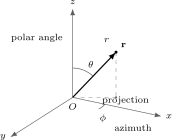
The convention used here is the standard physics convention: is distance from the origin, is the polar angle from the positive axis, and is the azimuthal angle of the projection into the plane.
Coordinate Definitions
Section titled “Coordinate Definitions”The Cartesian coordinates are
and
Conversely,
and
The function chooses the correct quadrant for the azimuth. At , the angles are undefined because every direction labels the same physical point.
Unit Vectors
Section titled “Unit Vectors”The spherical unit vectors are
and
The vector points outward. The vector points in the direction of increasing polar angle, and points in the direction of increasing azimuth.
Unlike Cartesian unit vectors, these unit vectors depend on position. Differentiating a vector field in spherical coordinates therefore requires differentiating both components and basis vectors.
Volume And Solid Angle
Section titled “Volume And Solid Angle”The volume element is
The solid-angle element is
Thus
A normalized wavefunction obeys
This is the same normalization as , written in spherical coordinates. The factor is not optional; it is the Jacobian of the coordinate transformation.
Radial And Angular Probability
Section titled “Radial And Angular Probability”For a spherically symmetric probability density, the probability of finding the particle between and is
For a separated central-potential wavefunction
with
the radial normalization is
This is why the radial probability density is , not just . If , then the same condition becomes
Gradient
Section titled “Gradient”For a scalar function ,
The factors and appear because a change in angle corresponds to an arc length, not a Cartesian distance. Near the poles, , so the coordinate expression is singular even though the underlying space is not.
Laplacian
Section titled “Laplacian”For scalar wavefunctions, the spherical-coordinate Laplacian is
It is often useful to separate the radial and angular parts:
where the unit-sphere angular Laplacian is
In quantum mechanics,
so the Laplacian may also be written as
This identity is the coordinate bridge to Angular and Radial Separation, angular momentum, and the radial Schrödinger equation.
Separation Ansatz
Section titled “Separation Ansatz”For a central potential,
try a product form
The angular equation is the eigenvalue problem on the unit sphere:
The angular functions are spherical harmonics,
with
The radial function then obeys a one-dimensional equation on the half-line, with the angular eigenvalue producing the centrifugal term. The separation step is derived in Angular and Radial Separation, and the deeper radial boundary conventions belong to Radial Schrödinger Equation.
Coordinate Singularities
Section titled “Coordinate Singularities”Spherical coordinates are singular at the origin and at the polar axis:
- at , every direction labels the same point;
- at and , the azimuth is undefined;
- the factors in derivative formulas reflect a coordinate singularity, not a physical singularity.
Physical scalar wavefunctions must be single-valued and regular where the space itself is regular. In particular,
for ordinary scalar wavefunctions. Spinor sign changes under rotations are a different issue and belong to the spin-volume discussion of .
Common Mistakes
Section titled “Common Mistakes”- Swapping the physics convention for and without saying so.
- Forgetting the Jacobian in normalization and expectation values.
- Replacing the spherical Laplacian by only for radial functions.
- Treating the poles as physical singularities rather than coordinate singularities.
- Forgetting that spherical unit vectors depend on angle.
- Using instead of and losing the quadrant of .
Where This Is Used
Section titled “Where This Is Used”- Schrödinger Equation in Three Dimensions introduces the three-dimensional equation and volume normalization.
- Separation of Variables explains why central potentials separate in spherical coordinates.
- Angular and Radial Separation derives the central-potential split into and .
- Central Potentials explains the rotationally invariant systems that use these coordinates.
- Radial Schrödinger Equation uses the spherical Laplacian to derive the radial equation.
- Hydrogen Atom uses and radial normalization.
- Particle on a Sphere freezes and keeps only the angular kinetic-energy problem on .
- Position-Space Representation writes orbital angular momentum as differential operators in these coordinates.
- Spherical Coordinates for Angular Momentum focuses on the symmetry-side split into , , and spherical harmonics.
- Spherical Harmonics gives the angular eigenfunctions on .
- Rigid Rotor uses the angular part of the Laplacian as the whole kinetic-energy operator.
References
Section titled “References”- D. J. Griffiths and D. F. Schroeter, Introduction to Quantum Mechanics, 3rd ed., Cambridge University Press, 2018.
- R. Shankar, Principles of Quantum Mechanics, 2nd ed., Springer, 1994.
- G. B. Arfken, H. J. Weber, and F. E. Harris, Mathematical Methods for Physicists, 7th ed., Academic Press, 2012.
- M. L. Boas, Mathematical Methods in the Physical Sciences, 3rd ed., Wiley, 2006.
Exercises
Section titled “Exercises”- Compute the volume of a ball of radius using the spherical volume element.
Solution
Use
Then
The three factors are
Thus
- For a radial function , simplify the spherical Laplacian.
Solution
If depends only on , all angular derivatives vanish. Therefore
Equivalently,
The second term is the part often missed by treating as if it were a Cartesian coordinate.
- Show that the unit-sphere area is .
Solution
The area element on the unit sphere is
Thus