Density of States: First Encounter
The density of states counts how many quantum states are available per energy interval. The simplest useful derivation comes from a free particle in a large box: replace the continuum by discrete box-normalized momentum states, count points in momentum space, and then take the large-box limit.
This page is a first encounter. It derives the one-particle, spinless, three-dimensional free-particle density of states. Many-body density of states, band density of states, phonon density of states, and thermodynamic applications belong in later application volumes.
What Is Being Counted
Section titled “What Is Being Counted”For a finite system with discrete energy levels, the exact density of states can be written formally as
where labels independent energy eigenstates. This expression is a distribution: it is a set of spikes at the exact energy levels.
In a large box, the levels become very dense. Instead of tracking each spike, one counts the number of states in a small energy window:
Equivalently,
where is the number of states with energy less than or equal to . The notation is also common, but this page uses to avoid confusing density of states with finite-level degeneracy.
Periodic Box Regulator
Section titled “Periodic Box Regulator”Put a spinless free particle in a cubic periodic box of side length and volume
The normalized plane waves are
with allowed wavevectors
Each allowed state occupies one cell of volume
in -space. Therefore a large-box sum becomes
The box is only a regulator. The physical continuum result is obtained after converting sums to integrals and keeping finite densities or finite rates.
Counting Points Inside a Sphere
Section titled “Counting Points Inside a Sphere”For a free particle,
States with energy less than or equal to correspond to points inside a sphere of radius
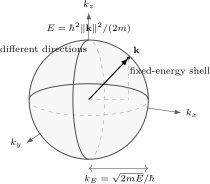
In three dimensions, fixed energy means a sphere in momentum space. Density-of-states counting comes from the number of allowed points in a thin spherical shell.
The number of states inside the sphere is approximately
Thus
Equivalently, the number of states in a thin shell from to is
The factor is the surface area of the sphere in -space. It is the geometric reason that the three-dimensional free-particle density of states grows with energy.
Converting From k to Energy
Section titled “Converting From k to Energy”Using
the cumulative state count becomes
Differentiate with respect to energy:
This is the spinless three-dimensional free-particle density of states for a large volume. Per unit volume,
The units are states per energy. The volume factor is physical for an extensive system: doubling the box volume doubles the number of available one-particle states in the same energy interval.
Spin and Internal Degeneracy
Section titled “Spin and Internal Degeneracy”The result above counts one spatial state for each allowed value. If there is an internal degeneracy that does not change the energy, multiply by that factor.
For a spin- particle with no spin-dependent splitting,
and
For an electron in a model where spin is included but magnetic and spin-orbit splittings are ignored, . If a magnetic field or spin-dependent interaction splits the spin states, this simple multiplier is no longer the right description.
Boundary Conditions and the Large-Box Limit
Section titled “Boundary Conditions and the Large-Box Limit”Periodic boundary conditions are convenient because every allowed point has the same cell volume. Hard-wall boxes use standing waves and positive mode numbers instead. For a large cubic hard-wall box, the allowed spacing is in each positive direction, so one counts one octant of -space.
The leading volume term is the same:
The finite-size corrections differ. Boundary conditions affect surface terms, edge terms, and low-lying levels, but the leading bulk density of states is independent of the regulator when the large-box limit is taken correctly.
Density of States Versus Degeneracy
Section titled “Density of States Versus Degeneracy”Finite-level degeneracy and density of states are related but not identical.
Degeneracy asks how many independent states have exactly the same energy. In a finite cubic box, for example, different integer triples may give the same value of .
Density of states asks how many states lie in an energy interval. In the large-box limit, neighboring energies become so close that the smooth shell count is more useful than exact degeneracy at a single energy.
The connection is the energy shell: exact degeneracies are discrete repeated points on a shell, while the density of states counts how many allowed points lie in a thin shell.
Dimensional Comparison
Section titled “Dimensional Comparison”The energy dependence changes with spatial dimension because the shell geometry changes.
For a free particle in spatial dimensions, the number of states below wavenumber scales as
Since ,
Thus a one-dimensional free-particle density of states scales like , a two-dimensional one is constant, and the three-dimensional one scales like . The proportionality constants depend on the normalization volume, boundary convention, and internal degeneracies.
Common Mistakes
Section titled “Common Mistakes”- Forgetting the shell factor in three dimensions.
- Counting only positive components when using periodic boundary conditions.
- Double-counting spin by both multiplying by and separately listing spin labels.
- Treating the smooth as accurate for a small box with widely spaced levels.
- Dropping the volume factor before converting to density per unit volume.
- Confusing exact finite-level degeneracy with the number of states in an energy interval.
- Mixing -space and -space counting without the Jacobian .
Where This Is Used
Section titled “Where This Is Used”- Free Particle in Three Dimensions introduces momentum vectors, energy shells, and the periodic-box regulator.
- Plane Waves and Delta Normalization explains why box-normalized sums become continuum integrals.
- Three-Dimensional Box provides the hard-wall comparison.
- Degeneracy in Separable Systems distinguishes exact degeneracy from large-box state density.
- Normalization Conventions records the box and delta normalization conventions used in the derivation.
- Landau Levels gives a magnetic example where state counting is tied to flux rather than ordinary free-particle shells.
- Density of States in Transition Rates develops weighted final-state measures, normalization cancellation, threshold laws, and the continuum time window.
References
Section titled “References”- D. J. Griffiths and D. F. Schroeter, Introduction to Quantum Mechanics, 3rd ed., Cambridge University Press, 2018.
- R. Shankar, Principles of Quantum Mechanics, 2nd ed., Springer, 1994.
- N. W. Ashcroft and N. D. Mermin, Solid State Physics, Holt, Rinehart and Winston, 1976.
- R. K. Pathria and P. D. Beale, Statistical Mechanics, 3rd ed., Academic Press, 2011.
Exercises
Section titled “Exercises”- Derive the cumulative count for a spinless free particle in a periodic cubic box.
Solution
Allowed points are separated by in each direction, so one state occupies -space volume
The volume of a sphere of radius is . Therefore
- Starting from , derive the three-dimensional free-particle density of states.
Solution
Use
Differentiating gives
Thus
- How does including unsplit spin- states change the result?
Solution
For spin with no spin-dependent splitting, each spatial momentum state has two spin states. Therefore
and
This multiplier is valid only when both spin states have the same energy.