Free Particle in Three Dimensions
A free particle in three dimensions has no potential energy and moves on ordinary space. Its stationary states are plane waves labeled by a momentum vector, not by a single signed wavenumber. This one change is enough to introduce energy shells, angular degeneracy, three-dimensional delta normalization, and the momentum-space counting used in density-of-states arguments.
On all of , the Hamiltonian is
The one-dimensional free particle remains the best first encounter with plane waves. This page generalizes that model to vector momentum and prepares the language used in scattering and many-particle applications.
Plane Waves
Section titled “Plane Waves”For a wavevector
a plane-wave solution has the form
The dispersion relation is
The momentum operator is
Acting on the plane wave,
Thus the momentum vector is
The energy is
A single plane wave has a definite momentum vector and is completely delocalized. Physical localized free particles are wave packets built by superposing many such vectors.
Energy Shells
Section titled “Energy Shells”In one dimension, a positive free-particle energy corresponds to two momenta, . In three dimensions, a positive energy corresponds to all momentum vectors on a sphere:
Equivalently,
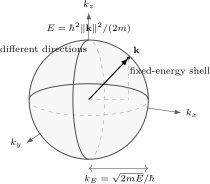
For a three-dimensional free particle, fixed energy means fixed , not a unique direction. The sphere in momentum space is the first geometric source of three-dimensional density-of-states factors.
The degeneracy at fixed energy is therefore angular and continuous. Boundary conditions or box regulators can discretize the allowed momentum vectors, but the full-space free Hamiltonian remembers that direction does not affect the kinetic energy.
Delta Normalization In Three Dimensions
Section titled “Delta Normalization In Three Dimensions”Momentum eigenstates are commonly normalized by
In position representation, the convention is
With this convention,
and
Equivalently, one may label states by :
The two conventions differ by powers of . Mixing them without changing the integration measure is a common source of wrong factors.
Wave Packets
Section titled “Wave Packets”A normalized physical state can be written as
with
The position-space wavefunction is
The group velocity of a packet centered near is
This is the vector form of the classical velocity. Spreading occurs because the phase is quadratic in , so different momentum components dephase relative to each other.
Probability Current
Section titled “Probability Current”The three-dimensional current density is
For a plane wave ,
Thus the current points in the momentum direction. In scattering, this vector current is used to define incident flux, outgoing flux, and differential cross sections. The plane wave itself is not square-normalizable; the current formula is interpreted within a chosen normalization or flux convention.
Periodic Box Regulator
Section titled “Periodic Box Regulator”Put the particle in a cubic periodic box of side length and volume
The normalized plane waves are
where
The allowed values form a cubic lattice in momentum space. In the large-box limit,
This is the basic counting rule behind many density-of-states calculations. It differs from the hard-wall Three-Dimensional Box, whose eigenfunctions are standing sine waves. Both are valid regulators; they impose different boundary conditions.
Density Of States Preview
Section titled “Density Of States Preview”For a spinless free particle in a large periodic box, the allowed values form a lattice. The number of states in a shell between and is approximately
The shell factor is the geometric reason three-dimensional free particles naturally produce a density of states that grows with energy. The full derivation, spin multiplier, and normalization caveats are the canonical topic of Density of States: First Encounter.
Spherical Waves: First Encounter
Section titled “Spherical Waves: First Encounter”Plane waves are natural for definite momentum. Spherical waves are natural for sources, scattering, and outgoing radiation from a localized interaction region.
For , an outgoing spherical free wave has the asymptotic form
Its radial current falls like , so the total flux through a sphere remains finite. This is why scattering amplitudes are usually defined as coefficients of outgoing spherical waves at large .
The detailed partial-wave expansion belongs to scattering theory. The point here is only the first dictionary:
Common Mistakes
Section titled “Common Mistakes”- Treating a fixed energy as if it selected a unique momentum direction.
- Forgetting that is a three-dimensional distribution.
- Mixing and normalizations without the corresponding powers of .
- Using periodic-box plane waves and hard-wall sine modes as if they were the same basis.
- Dropping the shell factor in three-dimensional state counting.
- Treating spherical waves as normalized bound states; they are asymptotic continuum waves.
Where This Is Used
Section titled “Where This Is Used”- Free Particle gives the one-dimensional model and dispersion relation.
- Plane Waves and Delta Normalization explains the continuum normalization in one dimension.
- Schrödinger Equation in Three Dimensions gives the 3D equation, volume normalization, and current.
- Three-Dimensional Box gives the hard-wall finite-volume comparison.
- Spherical Coordinates gives the coordinate convention behind spherical waves and angular shells.
- Degeneracy in Separable Systems distinguishes angular energy-shell degeneracy from discrete box degeneracies.
- Density of States: First Encounter derives the large-box state-counting formula from these energy shells.
- Probability Current gives the continuity-equation meaning of flux.
- Free Particle Hamiltonian is the reference card for the kinetic-energy operator.
References
Section titled “References”- D. J. Griffiths and D. F. Schroeter, Introduction to Quantum Mechanics, 3rd ed., Cambridge University Press, 2018.
- R. Shankar, Principles of Quantum Mechanics, 2nd ed., Springer, 1994.
- C. Cohen-Tannoudji, B. Diu, and F. Laloë, Quantum Mechanics, Wiley, 1977.
- L. D. Landau and E. M. Lifshitz, Quantum Mechanics: Non-Relativistic Theory, 3rd ed., Pergamon, 1977.
- J. R. Taylor, Scattering Theory: The Quantum Theory of Nonrelativistic Collisions, Dover, 2006.
Exercises
Section titled “Exercises”- Verify that is an eigenfunction of and .
Solution
The gradient is
Therefore
Also,
so
- Derive the three-dimensional sum-to-integral rule for a periodic cubic box.
Solution
Each component has spacing
One allowed state occupies volume
in -space. Therefore, for a smooth function ,
- Explain why the density of states in three dimensions grows like for a free particle.
Solution
States at fixed lie on a sphere in -space. The shell volume is proportional to
Since
one has and . Thus