Inelastic Scattering Preview
Inelastic scattering is a collision in which the outgoing asymptotic channel has a different internal energy or different channel label from the incoming one. Translational kinetic energy can become rotational, vibrational, electronic, hyperfine, spin, nuclear, or collective excitation energy; the reverse process can release stored internal energy into motion.
The defining distinction is not whether the trajectory bends. Elastic scattering can redirect momentum through a large angle while preserving the internal state. A collision is inelastic when the final asymptotic state carries physically different internal information.
This page connects three canonical subjects without replacing them. Multichannel Scattering Preview owns the channel -matrix and Feshbach structure, Fermi’s Golden Rule owns the transition-rate limit, and Bridge to QFT Scattering owns the relativistic translation. The purpose here is to make the kinematics, flux normalization, and experimental meaning of an inelastic cross section explicit.
Elastic, Inelastic, and Reaction Channels
Section titled “Elastic, Inelastic, and Reaction Channels”Let an asymptotic channel label specify the separated objects, their internal quantum numbers, and their relative motion. A transition is written
The terminology is convention dependent at the edges, but the following classification is useful.
| Process | What changes asymptotically? | Example |
|---|---|---|
| elastic | direction or phase, but not the internal channel | ground-state atom scattered through an angle |
| inelastic excitation | internal state, with the same particle partition | rotational excitation of a molecule |
| superelastic de-excitation | internal state releases energy into relative motion | collisionally quenched excited atom |
| rearrangement or reaction | grouping, species, or particle content | charge transfer or chemical reaction |
| breakup or production | number of asymptotic fragments | molecular dissociation or particle production |
In atomic and molecular collision theory, inelastic often means the same constituents in different internal states, while reactive is reserved for a new arrangement. In nuclear and particle physics, inelastic is frequently used more broadly for every nonelastic final channel. A calculation should state which convention its reported inclusive cross section uses.
Internal States and Channel Thresholds
Section titled “Internal States and Channel Thresholds”For a projectile and target with relative coordinate , a useful free Hamiltonian is
Let
For a fixed two-body partition, the internal energy supplies the channel threshold. More generally, rest energies, binding energies, and the choice of fragments are included in a threshold . Energy conservation in channel reads
where is the channel reduced mass. The channel is open when and closed when . A closed channel carries no flux to infinity, although virtual coupling to it can still shift an open-channel amplitude or generate a resonance.
A Q-value convention
Section titled “A Q-value convention”Define the channel Q-value by
Then the final relative kinetic energy is
With this convention:
- is endothermic; the collision must supply internal energy.
- is exothermic; internal or binding energy is released into motion.
- does not by itself imply an elastic process, because degenerate internal states can still differ.
For an endothermic transition, the channel opens only when
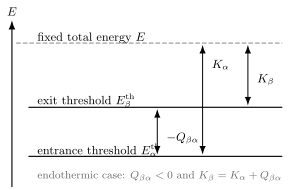
At fixed total energy , raising the internal threshold from to reduces the outgoing kinetic energy. The exit channel is open only when its threshold lies below . Reversing the thresholds describes an exothermic transition.
Coupling Internal and Relative Motion
Section titled “Coupling Internal and Relative Motion”Write the interaction as an operator on both relative and internal coordinates,
where denotes the target or composite system’s internal variables. Expanding a stationary state in internal eigenstates gives, schematically,
The channel-coupling potentials are
Diagonal elements distort motion without changing the internal state. Off-diagonal elements drive transitions. If symmetry forces an off-diagonal matrix element to vanish, that channel is forbidden at the corresponding order even when it is kinematically open.
For a simplified partial-wave problem with one reduced mass, the radial equations have the coupled form
This equation makes the mechanism transparent: channel amplitudes exchange probability only where the off-diagonal couplings are appreciable. Full reactive scattering may require different Jacobi coordinates and reduced masses for different arrangements, so one common radial coordinate is then only a schematic guide.
Channel-Resolved Scattering Amplitudes
Section titled “Channel-Resolved Scattering Amplitudes”Choose an incoming channel . In a coordinate-space normalization convenient for cross sections, the large-distance state has the structure
Here is the internal channel state and is the amplitude for the resolved transition . Different dynamical histories leading to the same final channel contribute coherently to . Orthogonal final internal channels are distinct records and their probabilities are summed after squaring.
This distinction prevents a common error. If two amplitudes and end in the same state, the probability contains interference:
If they end in orthogonal states and , an unresolved detector gives
Cross Sections and the Velocity Factor
Section titled “Cross Sections and the Velocity Factor”The outgoing spherical wave in channel carries radial current proportional to
while the incident plane wave carries current in this normalization. Therefore
with
For the same reduced mass in both channels, the prefactor is . It is one only in elastic scattering with equal incoming and outgoing speeds. The factor is not an optional convention: it converts amplitude into outgoing flux.
If the incoming channel has degeneracy and the experiment does not polarize or resolve internal substates, the reported observable usually averages over initial labels and sums over final labels:
The inclusive inelastic cross section is a sum over the channels counted as inelastic by the stated convention:
When the final internal spectrum is continuous, the channel sum becomes an energy integral and one measures distributions such as
The detector definition decides which quantum numbers are held fixed, summed, averaged, or integrated. Differential and Total Cross Sections gives the general event-rate interpretation.
The Golden-Rule Connection
Section titled “The Golden-Rule Connection”In weak coupling, a transition from an incoming continuum state to final states near has the golden-rule form
For one target, a cross section is the transition rate divided by the incident particle flux density:
With one incoming plane-wave particle normalized in a volume ,
The normalization volume cancels against the continuum density of final states. What remains is the same physical structure seen above: a squared transition amplitude, an energy-conserving phase-space factor, and division by incident flux.
The golden rule is the weak-coupling limit, not the complete scattering theory. Repeated interaction and outgoing boundary conditions are resummed by the transition operator
At first Born order, , and the golden-rule matrix element is recovered. Beyond that order, the exact on-shell -matrix replaces the bare interaction. In an energy-normalized convention, this connection is summarized schematically by
Factors of , momenta, and move when state normalizations change. T-Matrix fixes the nonrelativistic convention used for exact amplitudes, while Fermi’s Golden Rule states the time-scale assumptions behind the rate limit.
A Two-Level Target in First Born Approximation
Section titled “A Two-Level Target in First Born Approximation”Consider target states and separated by
Take an interaction
where is diagonal in the target states and can excite the target. With the Fourier-transform convention
the first Born excitation amplitude is
For equal entrance and exit reduced masses,
The channel is closed when the expression under the square root is negative. Above threshold,
Because the outgoing speed differs from the incoming speed, the momentum transfer is not determined by the angle alone:
This elementary model separates three ingredients:
- Kinematics: and the channel threshold.
- Spatial resolution: the form factor .
- Internal dynamics: the matrix element .
A selection rule can make the third factor vanish. A rapidly decaying form factor can suppress large momentum transfer even when the transition is symmetry allowed. A channel can therefore be kinematically open yet dynamically weak.
Threshold Laws
Section titled “Threshold Laws”Opening a channel creates nonanalytic energy dependence because
For a short-range interaction and a fixed entrance momentum, the Wigner threshold law for an exit partial wave has the form
Thus an -wave exit channel turns on as , whereas a -wave exit channel turns on as . The centrifugal barrier suppresses higher exit angular momenta near threshold.
This compact law has qualifications:
- if the entrance channel is simultaneously near its own threshold, entrance powers also matter;
- Coulomb or other long-range tails modify the short-range law;
- a nearby bound state or resonance can dominate the smooth threshold scaling;
- detector resolution can smear the mathematical cusp.
For an exothermic -wave process as , the rate coefficient
can approach a finite limit even while . A divergent cross section does not then imply a divergent event rate per incident density; the incident speed vanishes at the same time.
Conservation Laws and Selection Rules
Section titled “Conservation Laws and Selection Rules”Energy conservation decides whether a channel is open. Symmetry decides whether it can couple. Depending on the Hamiltonian, useful conserved quantities include total angular momentum, its projection, parity, total spin, exchange symmetry, and charges.
For example, if the coupling operator is a spherical tensor of rank , angular-momentum addition constrains which internal rotational states can be connected. Parity gives an independent condition. The spatial relative-motion partial wave can exchange angular momentum with the target, so a rule for the target alone is not generally a rule for the complete collision.
The reliable procedure is to apply symmetry to the complete channel state and interaction matrix element,
not to infer a transition from energy conservation alone. Selection Rules in Transition Rates develops the matrix-element logic, and Identical-Particle Scattering treats exchange constraints when the outgoing particles are indistinguishable.
Exclusive and Inclusive Measurements
Section titled “Exclusive and Inclusive Measurements”An exclusive measurement specifies the final channel as fully as the apparatus permits: internal level, spin state, emission direction, energy, or fragment identity. An inclusive measurement sums over some or all unobserved final channels.
If a projectile transfers momentum and energy to a many-body target, a common observable is a double-differential cross section. Schematically,
where the dynamic structure factor has the spectral form
This is golden-rule physics written as a target correlation spectrum. The channel sum is now a sum over many-body excitations. Structure Factors owns the normalized many-body spectrum, detailed balance, moments, and probe-specific forward models; Linear Response Preview develops the response viewpoint.
Inclusive sums are also what make unitarity operational. If every open final channel is included, lost elastic probability reappears in inelastic or reactive channels. Observing only one elastic element can give
without violating unitarity of the full -matrix. Unitarity derives the channel sum, and Optical Theorem relates the inclusive total cross section to forward elastic scattering.
Detailed Balance
Section titled “Detailed Balance”Time-reversal invariance relates a transition to its inverse. For angle-integrated two-body cross sections, with initial substates averaged and final substates summed, a common detailed-balance relation is
Here is the channel degeneracy. The two sides are evaluated at the same total energy and with reversed kinematics. External magnetic fields, polarization conventions, identical-particle factors, or time-reversal-violating dynamics require corresponding care. Detailed balance is a strong normalization and phase-space check because it tests both matrix-element reciprocity and channel counting.
Bridge to Relativistic Reactions
Section titled “Bridge to Relativistic Reactions”The nonrelativistic result already contains the skeleton of a relativistic cross section:
In quantum field theory, the fixed-particle potential matrix element becomes an invariant amplitude , the density of states becomes Lorentz-invariant multiparticle phase space , and particle production is a natural inelastic channel. Schematically,
The bar denotes the required spin sums and averages, and is the relativistic flux factor. The logic survives; the normalization and kinematics change.
Practical Workflow
Section titled “Practical Workflow”- List the asymptotic channels and state exactly what each label contains.
- Record every threshold and reduced mass .
- At the chosen total energy, classify channels as open or closed and compute each and .
- Apply exact conservation laws and symmetry selection rules before doing dynamics.
- Compute the relevant coupling matrix elements or on-shell .
- Convert amplitudes to cross sections with the outgoing-to-incoming velocity ratio.
- Sum, average, or integrate over final and initial labels exactly as the experiment does.
- Check threshold scaling, unitarity, and detailed balance where applicable.
Common Mistakes
Section titled “Common Mistakes”- Calling every change of direction inelastic.
- Forgetting to define whether rearrangement and breakup are included in .
- Setting when internal excitation changes the outgoing speed.
- Adding probabilities for two pathways that end in the same coherent final state.
- Adding amplitudes for orthogonal final internal states that should be summed incoherently.
- Treating a closed channel as dynamically irrelevant rather than merely unable to carry asymptotic flux.
- Applying the golden rule near strong coupling, a sharp resonance, or substantial initial-state depletion.
- Confusing the sign of the Q-value; state the convention before using endothermic or exothermic.
- Ignoring spin averages, degeneracies, identical-particle factors, or detector acceptance.
- Interpreting as failure of unitarity instead of elastic flux entering other open channels.
Exercises
Section titled “Exercises”1. Excitation threshold
Section titled “1. Excitation threshold”A projectile with reduced mass scatters from a two-level target whose excited state lies an energy above the ground state. The incoming relative wave number is . Find the outgoing wave number for excitation, the threshold condition, and the kinematic factor multiplying .
Solution
Energy conservation gives
Therefore
The excitation channel is open only if
For equal reduced masses, the differential cross section is
The kinematic factor vanishes at threshold, although a singular or resonant amplitude can modify the naive smooth turn-on.
2. Derive the velocity ratio
Section titled “2. Derive the velocity ratio”An outgoing channel has asymptotic radial wave
Use probability currents to derive the channel differential cross section.
Solution
At leading order in , the outgoing radial current is
The flux crossing area per unit time is
Dividing by the incident plane-wave current gives
3. Gaussian transition form factor
Section titled “3. Gaussian transition form factor”In the two-level model, let
Find and describe the angular dependence of the first Born excitation cross section.
Solution
The three-dimensional Gaussian transform factorizes into three one-dimensional integrals:
Thus
Because
large-angle scattering generally requires larger momentum transfer and is exponentially suppressed when is large compared with the relevant wavelength. Internal excitation also changes , so the elastic identity does not apply.
4. Coherent paths and orthogonal channels
Section titled “4. Coherent paths and orthogonal channels”Two dynamical paths lead to the same final channel with amplitudes and . Two other paths lead to orthogonal final channels with amplitudes and . What does an unresolved detector count in each case?
Solution
For the same final channel, amplitudes add before squaring:
For orthogonal final channels, tracing or summing over the unobserved channel label removes the cross term:
Detector nonresolution does not make orthogonal records coherent. Interference requires indistinguishable alternatives ending in the same quantum state, or in final states with nonzero overlap.
5. Threshold exponents
Section titled “5. Threshold exponents”Near an endothermic threshold, suppose the entrance momentum is finite and the short-range transition amplitude is smooth. Determine the energy dependence for exit and waves.
Solution
Let
Then . The Wigner law gives
For ,
For ,
Long-range interactions or nearby poles can change these powers or dominate the observed line shape.
6. Elastic deficit in one partial wave
Section titled “6. Elastic deficit in one partial wave”For one incoming channel , suppose the full open-channel partial-wave -matrix is unitary and
Show that the summed transition probability into all other open channels is , and find the corresponding inelastic partial cross section in the standard flux-normalized convention.
Solution
Unitarity of the incoming column gives
Separating the elastic term,
The summed inelastic partial cross section is therefore
The elastic element can have magnitude below one while the complete open-channel -matrix remains unitary.
Cross-Links
Section titled “Cross-Links”- Differential and Total Cross Sections
- S-Matrix
- T-Matrix
- Unitarity
- Optical Theorem
- Multichannel Scattering Preview
- Fermi’s Golden Rule
- Density of States in Transition Rates
- Selection Rules in Transition Rates
- Linear Response Preview
- Structure Factors
- Identical-Particle Scattering
- Bridge to QFT Scattering
References
Section titled “References”- J. R. Taylor, Scattering Theory: The Quantum Theory of Nonrelativistic Collisions, Wiley, 1972.
- M. L. Goldberger and K. M. Watson, Collision Theory, Wiley, 1964.
- C. J. Joachain, Quantum Collision Theory, North-Holland, 1975.
- R. G. Newton, Scattering Theory of Waves and Particles, 2nd ed., Springer, 1982.
- N. F. Mott and H. S. W. Massey, The Theory of Atomic Collisions, 3rd ed., Oxford University Press, 1965.
- E. P. Wigner, “On the Behavior of Cross Sections Near Thresholds,” Physical Review 73, 1002–1009 (1948), doi:10.1103/PhysRev.73.1002.
- J. J. Sakurai and J. Napolitano, Modern Quantum Mechanics, 3rd ed., Cambridge University Press, 2020.
- G. L. Squires, Introduction to the Theory of Thermal Neutron Scattering, 3rd ed., Cambridge University Press, 2012.