Identical-Particle Scattering
Two identical outgoing particles cannot be assigned persistent experimental labels. In the center-of-mass frame, detecting one particle with momentum and the other with defines one unordered final event. The alternatives conventionally called direct scattering through angle and exchange scattering through angle therefore lead to the same final record.
The amplitudes, not their probabilities, must be combined:
The sign is the exchange parity of the spatial scattering channel. It is for a symmetric spatial state and for an antisymmetric spatial state. For particles with spin or other internal structure, this spatial sign is fixed by the symmetry of the complete state, not by the words boson or fermion alone.
Symmetrization Postulate is the canonical home for the exchange rule, and Spin and Spatial Wavefunctions owns the pairing of spatial and spin symmetries. This page develops their observable scattering consequences: direct–exchange interference, event counting, partial-wave selection, spin averages, and threshold behavior.
Setup and Counting Convention
Section titled “Setup and Counting Convention”Consider two identical nonrelativistic particles of mass in their center-of-mass frame. Their incoming momenta are
and elastic scattering produces the unordered pair
Let be the angle between and . The symbol denotes the amplitude that would be used if the two outgoing slots were distinguishable. Unless stated otherwise, assume a central, spin-independent, short-range interaction.
This page quotes event cross sections: one collision producing the pair counts once. From here onward, denotes an event cross section unless stated otherwise. There are two equivalent conventions:
- choose one representative from each antipodal pair and integrate over one hemisphere ;
- integrate over the full sphere and multiply by .
A detector may register two hits from one collision, but that instrumental particle count must not be confused with the number of scattering events. Stating the convention prevents an otherwise easy factor-of-two error.
Direct and Exchange Amplitudes
Section titled “Direct and Exchange Amplitudes”Introduce temporary slot labels and . They organize a calculation but do not distinguish the physical particles.
- Direct assignment: incoming slot at is associated with outgoing . Its scattering angle is , so its amplitude is .
- Exchange assignment: incoming slot is associated with outgoing . Its scattering angle is , so its amplitude is .
Both assignments describe the same unordered detector event. If no final record distinguishes them, quantum mechanics requires a coherent sum.
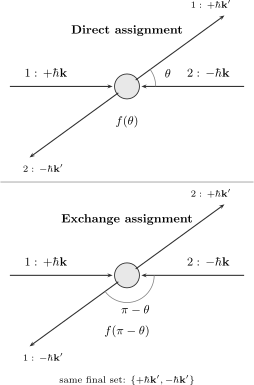
The direct and exchange drawings differ only in which temporary slot label is attached to each detected momentum. Their angles are and , but the physical final set is identical. The drawings are bookkeeping assignments, not classical particle trajectories.
For a spatial exchange eigenstate, the combined amplitude is
Here denotes a symmetric spatial channel, while denotes an antisymmetric spatial channel.
For spinless identical bosons, only the symmetric choice occurs. For spinless identical fermions, only the antisymmetric choice occurs. Spinful particles require the total-state analysis developed below.
Symmetrized Differential Cross Section
Section titled “Symmetrized Differential Cross Section”If labels one representative direction in a chosen hemisphere , the event differential cross section is
Expanding the modulus makes the exchange interference visible:
The first two terms are the direct and exchange probabilities that would remain if the assignments became distinguishable. The last term is purely coherent. Depending on the relative phase, it can enhance or suppress the event rate.
The total event cross section can be written in either equivalent form:
The factor is the nonrelativistic counterpart of the final-state phase-space factor used for two identical particles in relativistic scattering. It removes double counting of the same unordered pair. Do not combine a hemisphere integral with another factor of , and do not use a full-sphere integral without it when counting events.
Normalization factors from symmetrized two-particle states do not license an extra arbitrary in . With consistently normalized incident states, flux, and final-state counting, the formulas above give the observable cross section.
Ninety-Degree Test
Section titled “Ninety-Degree Test”At , the direct and exchange angles coincide:
Therefore
A symmetric spatial channel is enhanced at , while an antisymmetric spatial channel has an exact node there. This is a useful diagnostic, but the node is not a statement that all fermions avoid : fermions in an antisymmetric spin state occupy a symmetric spatial channel and use the plus amplitude.
Partial-Wave Selection
Section titled “Partial-Wave Selection”For a central short-range interaction, write the distinguishable-particle amplitude as
where, in a one-channel elastic problem,
Because
and
the exchange amplitude is
Thus
The projector in square brackets eliminates half the angular momenta:
Symmetric spatial states contain only even ; antisymmetric spatial states contain only odd . This is the relative-coordinate version of exchange parity, since exchanging the particles sends
Using Legendre orthogonality and the event-counting factor gives
and
The coefficient is twice the distinguishable-particle coefficient for an allowed partial wave. The coherent direct and exchange amplitudes produce a factor of four, while counting each final pair once removes a factor of two. Partial-Wave Cross Sections derives the distinguishable-particle sums and their unitarity bounds.
Bosons, Fermions, and Threshold Behavior
Section titled “Bosons, Fermions, and Threshold Behavior”For a short-range potential without a threshold anomaly, the Wigner threshold law gives
The lowest symmetry-allowed partial wave therefore controls low-energy scattering.
Spinless bosons
Section titled “Spinless bosons”The spatial state is symmetric, so the wave is allowed. With scattering length ,
The low-energy event cross section is
For comparison, distinguishable particles with the same -wave amplitude have . The doubled bosonic result is exchange enhancement together with one-count-per-pair normalization.
Spin-polarized identical fermions
Section titled “Spin-polarized identical fermions”For two fermions in a symmetric internal state, the spatial state is antisymmetric. The wave is forbidden, and the wave is the leading channel. Define the -wave scattering volume by
Away from a threshold resonance,
so
The suppression is why ultracold identical fermions in the same spin state collide much less efficiently than bosons through short-range interactions. Long-range tails, resonant -wave scattering, and inelastic channels can modify this simple limit.
Spin Dependence
Section titled “Spin Dependence”Exchange symmetry constrains the total state. If a factorized channel has spatial and spin exchange parities
then
For two identical spin- fermions:
| Spin channel | Spin exchange parity | Spatial channel | Partial waves |
|---|---|---|---|
| singlet, | symmetric, | even | |
| triplet, | antisymmetric, | odd |
Suppose the interaction is spin independent and the incoming ensemble is unpolarized. The four equally weighted spin states decompose into one singlet and three triplet states. The spin-averaged event differential cross section is therefore
With
this can also be written
Spin channels are orthogonal, so their probabilities are averaged; one does not average the singlet and triplet amplitudes before squaring. If the interaction depends on spin, use channel-dependent amplitudes such as and , and allow for spin-changing transitions when permitted.
For two particles of general spin , a coupled spin state of total spin has exchange parity
In an unpolarized, uncorrelated ensemble its statistical weight is
These weights are useful only after the spatial symmetry and any -dependent dynamics have been identified.
Internal States and Effective Distinguishability
Section titled “Internal States and Effective Distinguishability”Identical particles can carry internal states that leave different final records. Symmetrization is never abandoned, but exchange interference in a reduced spatial measurement depends on whether those records are distinguishable.
Let the direct and exchange alternatives produce internal marker states and . With
the relevant outgoing state has the schematic form
If the detector ignores the internal marker, tracing it out gives
Three limits organize the physics:
- If , the alternatives are fully indistinguishable and exchange interference has unit visibility.
- If , orthogonal records identify the alternatives and the probabilities add incoherently.
- If the overlap has magnitude between zero and one, exchange interference has partial visibility and its phase can shift the pattern.
The relevant question is not merely whether the particles belong to the same species. It is whether the complete experimental record can distinguish which assignment occurred. Spin preparation, hyperfine state, excitation, recoil correlations, and detector resolution can all matter.
Coulomb Exchange Pattern
Section titled “Coulomb Exchange Pattern”Unscreened Coulomb scattering is long-ranged, so the short-range partial-wave assumptions above do not apply directly. Its exact amplitude nevertheless provides a clean exchange-interference example. With Sommerfeld parameter
one convention for the Coulomb amplitude is
Combining the direct and exchange amplitudes gives
where is restricted to one representative hemisphere. The logarithmic Coulomb phase is unobservable in the single direct Rutherford term, but it becomes measurable through direct–exchange interference.
At , the plus channel is four times the single labeled Rutherford contribution at that angle, while the minus channel vanishes. The ideal total cross section still diverges because of the forward Coulomb singularity; experiments compare finite angular acceptances. Coulomb Scattering develops the long-range asymptotics and Rutherford result.
Experimental Signatures
Section titled “Experimental Signatures”Exchange effects are most transparent when several diagnostics agree:
- a enhancement or node in a fixed spatial-symmetry channel;
- elimination of odd or even partial waves;
- -wave enhancement for identical bosons;
- threshold suppression of spin-polarized identical fermions;
- changes in the angular pattern when spin or internal-state distinguishability is altered;
- interference between allowed partial waves, such as imaged - and -wave patterns in collisions of identical bosonic atoms.
Real data also contain detector acceptance, incoherent mixtures, multiple channels, and interaction-dependent phase shifts. Exchange symmetry selects and combines amplitudes; it does not determine their dynamical values.
Link to Composite and Many-Body Systems
Section titled “Link to Composite and Many-Body Systems”For composite particles, the same analysis applies when the collision energy is low enough that the objects behave as identical asymptotic particles. Their bosonic or fermionic statistics follow from the complete composite state. If internal excitations become resolved, they enter the channel labels and may reduce or reorganize exchange interference.
In many-body theory, the direct and exchange terms of two-body matrix elements are the algebraic descendants of the same indistinguishable alternatives. Slater determinants enforce fermionic antisymmetry, while symmetric occupation states enforce bosonic symmetry. Exchange is not an additional force; it is a consequence of the allowed state space and coherent amplitude addition.
The canonical many-body construction begins with Indistinguishability, Symmetric and Antisymmetric Wavefunctions, and Slater Determinants.
A Reliable Workflow
Section titled “A Reliable Workflow”For an identical-particle scattering calculation:
- Move to center-of-mass and relative variables.
- Specify every measured or unobserved final label, including spin and internal state.
- Identify the direct and exchange assignments leading to the same final record.
- Enforce exchange symmetry on the complete state to determine the spatial sign.
- Add amplitudes coherently only when the corresponding final records overlap.
- Count each unordered final pair once, using a hemisphere or a full-sphere factor of .
- Average probabilities over an incoherent initial spin ensemble and sum over unobserved orthogonal final channels.
- Apply detector acceptance and any long-range or threshold modifications.
Common Mistakes
Section titled “Common Mistakes”- Using the minus amplitude for every fermionic collision without checking the spin symmetry.
- Adding and when the assignments are indistinguishable.
- Integrating over the full sphere without the identical-pair factor of .
- Applying both a hemisphere restriction and a second factor of .
- Averaging singlet and triplet amplitudes instead of their probabilities for an unpolarized ensemble.
- Allowing an wave for fully spin-polarized identical fermions.
- Treating slot labels as persistent particle identities.
- Applying short-range threshold formulas unchanged to an unscreened Coulomb interaction.
Exercises
Section titled “Exercises”- Suppose the distinguishable-particle amplitude is angle independent, . Find the event differential and total cross sections in symmetric and antisymmetric spatial channels.
Solution
The amplitudes are
and
Therefore, on a representative hemisphere,
A hemisphere has solid angle , so
The same result follows by integrating over and multiplying by .
- Starting from the partial-wave expansion of , derive the even- and odd- selection rules and the corresponding event total cross sections.
Solution
Use
Then
For the plus sign, the bracket is for even and zero for odd . For the minus sign, the reverse holds. Orthogonality gives
where is the set of even integers and the set of odd integers. For elastic scattering, .
- Use the threshold laws to explain why spinless bosons have , while fully spin-polarized identical fermions have .
Solution
Symmetric spatial states allow even partial waves, so spinless bosons admit . Since ,
Fully spin-polarized identical fermions have a symmetric spin state and therefore an antisymmetric spatial state. The lowest allowed wave is . With ,
The conclusion assumes a short-range interaction and no threshold resonance.
- For unpolarized identical spin- fermions, verify the interference coefficient in
What is the result at ?
Solution
The singlet has weight and uses ; the triplet has weight and uses . Thus
At , , so
Equivalently, the singlet contribution is with weight , while all three triplet amplitudes vanish.
- Let the internal marker overlap be
Show how controls exchange-interference visibility.
Solution
Tracing over the marker gives
The exchange term is multiplied by . At , the marker states differ only by a phase and the interference has full visibility. At , they are orthogonal and the exchange term vanishes. Intermediate overlap gives partial visibility, while shifts the interference phase.
- Evaluate the symmetric and antisymmetric Coulomb exchange cross sections at and explain why this does not make the total Coulomb event cross section finite.
Solution
At ,
The bracket in the Coulomb formula becomes
Therefore
The finite value at says nothing about the forward limit. As , the direct Rutherford term still behaves as , so its angular integral diverges. A finite observable requires screening or a nonzero angular cutoff.
References
Section titled “References”- J. R. Taylor, Scattering Theory: The Quantum Theory of Nonrelativistic Collisions, Dover (2006).
- L. D. Landau and E. M. Lifshitz, Quantum Mechanics: Non-Relativistic Theory, 3rd ed., Pergamon (1977).
- C. J. Joachain, Quantum Collision Theory, 3rd ed., North-Holland (1983).
- J. J. Sakurai and J. Napolitano, Modern Quantum Mechanics, 3rd ed., Cambridge University Press (2021).
- B. Zwiebach, “Identical Particles and Exchange Degeneracy,” MIT OpenCourseWare, Quantum Physics III, lecture 22.4 (2018).
- N. R. Thomas, N. Kjærgaard, P. S. Julienne, and A. C. Wilson, “Imaging of and Partial-Wave Interference in Quantum Scattering of Identical Bosonic Atoms,” Physical Review Letters 93, 173201 (2004).