Partial-Wave Cross Sections
For a short-range central interaction, the total elastic cross section separates into nonnegative contributions from independent angular-momentum channels:
This formula is more than a convenient sum. It identifies which angular momenta dominate, explains threshold suppression, exposes resonance saturation, and gives a controlled convergence test for numerical calculations.
Differential and Total Cross Sections owns the general flux-to-observable construction. Partial-Wave Expansion derives the amplitude decomposition, Phase Shifts owns the meaning and extraction of , and Unitarity owns the allowed amplitude disk and channel bounds. This page is the canonical home for deriving, summing, and using partial-wave cross sections.
Scope and Convention
Section titled “Scope and Convention”Assume distinguishable spinless particles in three dimensions, elastic relative momentum , and a rotationally invariant short-range potential. The scattering amplitude is
where
The differential cross section is
For one-channel elastic scattering,
and
All formulas below use this normalization. Spin, identical-particle symmetrization, coupled channels, and long-range Coulomb phases require modifications that are stated where they matter. Identical-Particle Scattering owns the direct–exchange interference, event-counting factor, and even/odd partial-wave projections.
Derivation from Legendre Orthogonality
Section titled “Derivation from Legendre Orthogonality”Squaring the partial-wave amplitude gives a coherent double sum:
At a fixed angle, different partial waves interfere. The simplification occurs only after integration over the complete sphere.
Legendre orthogonality is
Because ,
Therefore
For elastic phase shifts,
which gives
The dimensions are supplied entirely by . The phase shifts and are dimensionless.
Individual Angular-Momentum Channels
Section titled “Individual Angular-Momentum Channels”Define the elastic partial cross section
For purely elastic scattering, equivalent forms are
The full elastic result is an incoherent sum of these integrated contributions:
The factor reflects angular-momentum multiplicity and the Legendre addition theorem. It is already included in the plane-wave decomposition; it must not be inserted a second time.
Each is nonnegative. The cumulative sum
therefore grows monotonically toward the total elastic cross section. This makes useful for numerical convergence tests.
Differential Interference and Detector Acceptance
Section titled “Differential Interference and Detector Acceptance”The disappearance of cross terms is a full-solid-angle statement. A detector with an angular cut measures
and the restricted-domain Legendre integrals are not generally diagonal.
Suppose only and waves contribute:
Then
The interference term is odd in . It integrates to zero over the full sphere but generates a forward–backward asymmetry. The forward and backward hemispheres give
Adding them recovers
Thus partial cross sections diagnose the total strength by channel, but they do not reconstruct acceptance-limited data unless the coherent angular amplitude is retained.
Elastic, Reaction, and Total Sums
Section titled “Elastic, Reaction, and Total Sums”When inelastic channels are open, the diagonal elastic element can be written
The elastic cross section remains
The reaction cross section, meaning loss from the observed elastic channel into all other open channels, is
Equivalently,
The total cross section is
These expressions satisfy the optical theorem because
The channel-by-channel probability interpretation and the bounds implied by are developed at Unitarity.
Low-Energy Dominance of the s-Wave
Section titled “Low-Energy Dominance of the s-Wave”For a sufficiently short-range nonsingular potential away from exceptional threshold behavior, the threshold law is
At small phase shift,
Hence
The first channels scale as
This is why the wave normally dominates low-energy distinguishable-particle scattering.
With scattering length ,
so
when both and . Keeping the unitarizing denominator but neglecting effective-range corrections gives
Near a threshold pole, can be much larger than and the second condition is essential. Scattering Length and Effective-Range Expansion own that regime.
For identical spinless bosons, exchange symmetry permits only even ; for spin-polarized identical fermions, only odd survive, so the wave can become the leading channel. Identical final states also require a consistent angular integration domain or symmetry factor. The distinguishable-particle formula must not be reused unchanged; the complete derivation is in Identical-Particle Scattering.
Long-range potentials can alter threshold powers. The Coulomb interaction is not covered by the short-range law above.
Unitarity Limit
Section titled “Unitarity Limit”Elastic unitarity constrains
Therefore
For a purely elastic channel, the bound is saturated when
At that point,
The -wave limit is
This bound grows as , but it is a bound at fixed momentum, not a prediction that every low-energy cross section diverges. Saturation requires nonperturbative dynamics such as a nearby threshold pole or an elastic resonance.
Unitarity alone bounds each channel, not the infinite sum. A finite-range or analyticity argument is needed to determine how many partial waves can contribute appreciably.
Impact Parameter and the Black-Disk Sum
Section titled “Impact Parameter and the Black-Disk Sum”At large angular momentum, the semiclassical correspondence is
Associate partial wave with a transverse annulus bounded approximately by
Its area is
This is exactly the maximum reaction cross section carried by one partial wave. The multiplicity factor has a geometric impact-parameter interpretation.
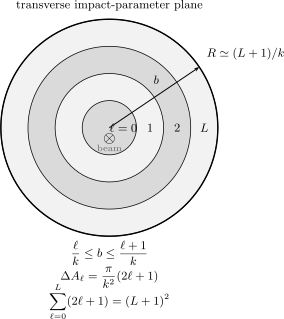
At large , partial wave samples . The annulus between and has area , matching the reaction-channel unitarity bound.
In the idealized black-disk model,
Every intercepted partial wave is completely absorbed. Since
the reaction and elastic-diffraction cross sections are
The total is
With ,
The reaction piece is the geometric shadow. The equal elastic piece is diffraction from that shadow. This factor-of-two extinction result is wave physics, not an extra absorptive area.
Examples
Section titled “Examples”Low-energy hard sphere
Section titled “Low-energy hard sphere”For an impenetrable sphere of radius , the boundary condition gives
Thus
The exact partial-wave sum is
For , the wave dominates and
Therefore
The low-energy quantum cross section is four times the geometric area . It should not be confused with the high-energy classical shadow. Hard-Sphere Scattering follows the exact sum from this threshold limit to the high-energy diffraction limit and derives the classical result separately.
Isolated elastic resonance
Section titled “Isolated elastic resonance”If a negligible background and an isolated resonance produce
then
At , the channel reaches its elastic unitarity limit if varies negligibly across the width. Breit–Wigner Form owns the pole-factor derivation and explains how background phases, inelasticity, thresholds, and overlapping poles deform this simple profile.
Reading a numerical channel budget
Section titled “Reading a numerical channel budget”Suppose a phase-shift solver returns, at one energy,
In units of , the channel weights are approximately
The total weight is about , so the wave supplies roughly , the wave , and the wave less than . These percentages describe the angle-integrated cross section. Even the small wave can have a visible effect on angular asymmetry through interference with the wave.
Numerical Workflow
Section titled “Numerical Workflow”Given computed phase shifts or channel -matrix elements:
- Match conventions. Confirm the definitions of , , , and the angular measure.
- Compute channel contributions. Evaluate and, if needed, .
- Inspect the channel budget. Plot or tabulate contributions rather than reporting only their sum.
- Increase the cutoff. Require stability of the cumulative total as grows.
- Converge the amplitude separately. Differential observables can remain sensitive to a high- tail even when the integrated total looks stable.
- Check unitarity. Verify for elastic channels or match the deficit to explicit inelastic channels.
- Vary numerical controls. Test radial box size, matching radius, grid spacing, and potential-tail truncation.
A useful total-cross-section tail diagnostic is
This is an indicator, not a rigorous bound on all omitted . A long-range tail can make convergence slow and invalidate the estimate based on a short block of channels.
Common Mistakes
Section titled “Common Mistakes”- Dropping interference terms in a differential or acceptance-limited cross section.
- Multiplying by twice.
- Using the elastic phase-shift formula when .
- Calling the total cross section when reaction channels are open.
- Applying the short-range threshold law to an unscreened Coulomb potential.
- Assuming -wave dominance for spin-polarized identical fermions.
- Summing a fixed number of partial waves at all energies rather than increasing with .
- Treating the unitarity limit as a prediction instead of an upper bound.
- Comparing a low-energy hard-sphere result with the geometric area without recognizing diffraction.
- Declaring the differential amplitude converged because the integrated total has stabilized.
Exercises
Section titled “Exercises”Derive the elastic sum
Section titled “Derive the elastic sum”Starting from
derive the total elastic cross section.
Solution
Use
Then
For elastic scattering, .
Recover the s–p interference asymmetry
Section titled “Recover the s–p interference asymmetry”For
show that is proportional to .
Solution
With ,
Integrating over and gives
The interference cancels in the full sum but controls the asymmetry.
Obtain the threshold powers
Section titled “Obtain the threshold powers”Assume . Determine the low- scaling of for .
Solution
For small phase shift,
The prefactor gives
Hence
Sum the black disk
Section titled “Sum the black disk”Take for and above . Find the elastic, reaction, and total cross sections.
Solution
For an absorbed channel,
Using
gives
and
The elastic piece is diffraction from the absorbed disk.
Check the low-energy hard sphere
Section titled “Check the low-energy hard sphere”For , use
to find the low-energy hard-sphere cross section.
Solution
The boundary condition gives
Choose the branch continuous from zero:
Then
as .
Locate resonant saturation
Section titled “Locate resonant saturation”For a purely elastic partial wave with
find the peak cross section.
Solution
At ,
Therefore
where is the relative wave number at the resonance. This is the elastic partial-wave unitarity limit.
References
Section titled “References”- B. Zwiebach, “Chapter 7: Scattering,” MIT OpenCourseWare 8.06 Quantum Physics III (2018), PDF.
- J. R. Taylor, Scattering Theory: The Quantum Theory of Nonrelativistic Collisions, Dover, 2006, Chapters 3 and 11.
- R. G. Newton, Scattering Theory of Waves and Particles, 2nd ed., Springer, 1982, Chapters 10 and 11.
- C. J. Joachain, Quantum Collision Theory, 3rd ed., North-Holland, 1983, Chapters 3 and 7.
- L. D. Landau and E. M. Lifshitz, Quantum Mechanics: Non-Relativistic Theory, 3rd ed., Pergamon, 1977, Sections 132–134.
- Particle Data Group, “Kinematics,” Review of Particle Physics (2012), PDF.