Heisenberg’s Matrix Mechanics
Heisenberg’s matrix mechanics was a sharp break with the old attempt to picture electrons moving on classical orbits. It began from a disciplined demand: build the theory from quantities connected to observations, especially spectral transition frequencies and intensities, rather than from unobservable orbital coordinates.
This page explains the historical idea. It uses modern notation to make the structure legible, but the formal home of operators is Operators, and the formal home of commutators is Commutators.
Motivation From Spectra and Transitions
Section titled “Motivation From Spectra and Transitions”Atomic spectra were not pictures of electron paths. They were lists of sharply defined frequencies and intensities. The Ritz combination principle and Bohr frequency condition suggested that spectral lines connect pairs of stationary states:
Old quantum theory tried to preserve classical orbits while imposing quantization rules on them. That strategy worked surprisingly well for some hydrogen-like patterns, but it did not provide a general mechanics for intensities, transitions, multi-electron systems, or non-periodic motion.
Heisenberg’s 1925 move was to stop treating an electron orbit as the basic object. Instead, the theory should use quantities tied to transitions between states. A classical periodic coordinate could be expanded in Fourier components,
The old quantum correspondence suggested that the Fourier harmonics of a classical orbit should be replaced by transition quantities between quantum states:
This was not merely a change of symbols. It changed what counts as a legitimate quantity in the theory.
Observable Quantities Over Electron Orbits
Section titled “Observable Quantities Over Electron Orbits”In a classical model, an electron has a position at every time. Even if one cannot directly see the orbit, the model treats it as a well-defined path. Heisenberg’s reinterpretation was more austere: use quantities associated with observable radiation, such as transition frequencies and strengths.
For an allowed transition , one may associate a transition frequency and a transition quantity . In modern language, is a matrix element of an observable-like quantity :
Historically, the bra-ket notation and abstract Hilbert-space interpretation came later. The important early step was the array itself:
Diagonal entries describe quantities associated with a stationary state. Off-diagonal entries encode transitions between different states. This immediately fits spectroscopy better than an orbit picture does, because spectral lines are already indexed by pairs of states.
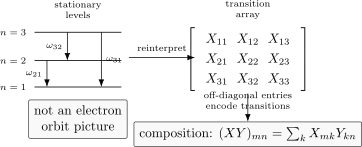
Matrix mechanics replaces a visualizable orbit with transition quantities indexed by pairs of stationary states. Off-diagonal entries encode transitions; multiplication of such arrays naturally sums over intermediate states.
Transition Amplitudes
Section titled “Transition Amplitudes”It is tempting to call every off-diagonal entry a probability amplitude, but that would read later language too quickly into the early theory. In Heisenberg’s setting, the entries were transition quantities tied to radiation and correspondence arguments. Their magnitudes were related to line strengths, while their phases and multiplication rules carried dynamical information.
A useful modern reconstruction is:
- frequencies come from energy differences, ;
- transition strengths are related to squared moduli such as ;
- time dependence can be attached to entries through factors ;
- products of quantities must respect the way transition frequencies compose.
The last point is decisive. If a transition from to can pass through an intermediate state , then the frequencies add:
That combination rule is exactly what makes the product of transition arrays look like matrix multiplication.
Noncommutative Multiplication
Section titled “Noncommutative Multiplication”Suppose and are two arrays of transition quantities. Their product is not obtained by multiplying entries independently. The natural composition rule sums over intermediate states:
Reversing the order gives
There is no general reason for these two sums to agree:
This was the structural shock. In classical mechanics, ordinary functions of position and momentum commute under pointwise multiplication. In matrix mechanics, the quantities that replace them need not commute.
Born and Jordan recognized that Heisenberg’s multiplication law was matrix multiplication. In modern notation, noncommutativity is measured by the commutator
For canonical position and momentum, the formal descendant is
This relation belongs to modern operator quantum mechanics, not to a naive picture of little matrices attached to classical orbits. The historical point is that noncommutativity entered because the observable transition quantities had a composition law unlike classical multiplication.
Historical Importance
Section titled “Historical Importance”Matrix mechanics mattered for several reasons.
First, it abandoned unobservable orbital pictures at exactly the point where old quantum theory had become strained. The new theory did not ask for the electron’s classical path inside the atom. It asked for transition quantities, frequencies, and algebraic relations.
Second, it explained why observables should be represented by structured objects rather than ordinary numbers. A quantity such as position or momentum is not merely a value; it has matrix elements between possible states.
Third, it introduced noncommutativity as a physical feature, not a notation choice. The order of operations can matter, and this later became central to compatibility, uncertainty relations, angular momentum, spin, and quantum field operators.
Fourth, it made clear that a quantum theory could be complete without being visualizable in classical terms. This was conceptually hard but mathematically fertile. Schrödinger’s later wave mechanics looked more familiar, but the equivalence of matrix and wave mechanics showed that the deeper theory was not a return to classical waves or classical orbits.
Relation to Modern Operator Language
Section titled “Relation to Modern Operator Language”Modern quantum mechanics rephrases matrix mechanics in Hilbert-space terms. A state is represented by a vector or ray, an observable by a self-adjoint operator, and a chosen basis turns operators into matrices:
Changing basis changes the matrix representation but not the operator itself. This is why matrix mechanics is now understood as one representation of the general formalism rather than a separate theory.
The historical page should therefore be read in two layers:
- historically, arrays of transition quantities replaced classical orbit variables;
- formally, those arrays became matrix representations of operators on state spaces.
The first layer explains why the move was necessary. The second layer explains why it survived.
What This Page Does Not Claim
Section titled “What This Page Does Not Claim”Matrix mechanics did not immediately contain every modern concept in its present form. It did not begin with the textbook Hilbert-space postulates, the Born rule in its mature form, spinor theory, density operators, or the modern measurement framework.
It also did not make wave mechanics irrelevant. Matrix mechanics and wave mechanics became understood as equivalent formulations. The historical importance of matrix mechanics is that it found the noncommutative operator structure before the more visually accessible wave equation became dominant in pedagogy.
Common Mistakes
Section titled “Common Mistakes”- Treating matrix mechanics as an awkward notation for wave mechanics.
- Thinking Heisenberg simply guessed matrices from linear algebra. The multiplication rule arose from transition quantities and frequency-combination logic; Born and Jordan then recognized the matrix structure.
- Reading modern bra-ket notation back into the 1925 paper without historical caution.
- Assuming noncommutativity is only a technical complication. It is a physical and algebraic feature of quantum observables.
- Saying matrix mechanics ignored experiment. It was built from spectral data and the demand to use observable quantities.
- Confusing the Heisenberg historical formulation with the modern Heisenberg picture of time evolution.
Cross-Links
Section titled “Cross-Links”- Matrix Mechanics and Operator Ideas
- Born and Jordan’s Matrix Formulation
- Dirac’s Transformation Theory
- Observables Before Operators
- Commutation Relations in Historical Context
- Historical Origin of Uncertainty
- Equivalence of Matrix and Wave Mechanics
- Line Spectra
- Rydberg Formula
- Limits of Old Quantum Theory
- Schrödinger’s Wave Mechanics
- Evidence to Postulates
- Operators
- Observables
- Operator Representations
- Commutators
- Noncommuting Observables
- Canonical Commutation Relations
- Equivalent Formulations
References
Section titled “References”- W. Heisenberg, “Über quantentheoretische Umdeutung kinematischer und mechanischer Beziehungen,” Zeitschrift für Physik 33, 879-893, 1925, DOI: 10.1007/BF01328377.
- M. Born and P. Jordan, “Zur Quantenmechanik,” Zeitschrift für Physik 34, 858-888, 1925, DOI: 10.1007/BF01328531.
- M. Born, W. Heisenberg, and P. Jordan, “Zur Quantenmechanik II,” Zeitschrift für Physik 35, 557-615, 1926, DOI: 10.1007/BF01379806.
- B. L. van der Waerden, ed., Sources of Quantum Mechanics, Dover, 1968.
- M. Jammer, The Conceptual Development of Quantum Mechanics, 2nd ed., American Institute of Physics, 1989.
- J. Mehra and H. Rechenberg, The Historical Development of Quantum Theory, Springer, 1982-2001.
- H. Kragh, Quantum Generations: A History of Physics in the Twentieth Century, Princeton University Press, 1999.
Exercises
Section titled “Exercises”- Explain why spectral lines naturally suggest quantities indexed by two states rather than by one classical orbit.
Solution
A spectral line corresponds to a transition between two stationary states, with frequency determined by an energy difference:
The observed quantity is therefore associated with a pair of labels , not with a single point on a classical trajectory. Matrix mechanics builds this pair-label structure into the basic quantities.
- Show that the frequency-combination rule supports matrix multiplication. If , compute .
Solution
Using the definition,
The intermediate label disappears from the final frequency, matching the idea that products of transition arrays should sum over intermediate states.
- For two arrays
compute and . Do they commute?
Solution
Multiplying in the first order gives
Multiplying in the reverse order gives
Since , the arrays do not commute.
- Why is it misleading to describe matrix mechanics as merely a less intuitive version of Schrödinger wave mechanics?
Solution
Matrix mechanics was historically earlier and introduced the noncommutative algebra of quantum quantities directly from spectral-transition reasoning. Wave mechanics later provided a differential-equation representation that was often more visually familiar. Their equivalence showed that both were representations of a deeper quantum structure; matrix mechanics was not just a clumsy rewrite of wave mechanics.