Gamow Factor
The Gamow factor is the dominant semiclassical suppression for two positively charged particles to reach short separation through their repulsive Coulomb barrier. Its characteristic dependence,
explains two otherwise startling observations: alpha-decay lifetimes can change by many orders of magnitude when the decay energy changes modestly, and low-energy nuclear fusion is concentrated in an energy window far above the thermal mean but far below the Coulomb-barrier height.
This page owns the Coulomb-specific WKB integral, its finite-radius correction, and those two consequences. Barrier Penetration and Tunneling owns the reusable smooth-barrier formula. Tunneling Applications: First Encounters gives the broader application map without repeating the derivation.
Conventions and Scope
Section titled “Conventions and Scope”Consider two particles with positive charge numbers and . In the center-of-mass frame, their relative coordinate has reduced mass
and positive relative energy . Define
Thus for the repulsive problem. In units where the Coulomb potential is written differently, every result below remains valid after identifying the coefficient in .
The dimensionless Coulomb, or Sommerfeld, parameter is
where
The subscript on matters. Elsewhere in WKB, an is often used for an accumulated forbidden-region phase. Here always means the Coulomb parameter.
We use the following terminology:
- is the dimensionless one-way barrier action.
- is the leading amplitude suppression.
- is the leading probability suppression.
- is the point-Coulomb Gamow factor.
Some authors instead call the Gamow factor or the Gamow exponent. Always inspect the author’s definition before comparing formulas.
Coulomb Barrier Geometry
Section titled “Coulomb Barrier Geometry”The outer classical turning point satisfies
so
A short-range nuclear interaction becomes important at a radius . In the simplest exterior-barrier model,
and the interval is classically forbidden. The region is classically allowed.
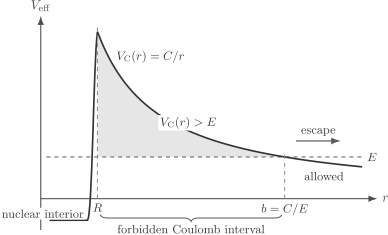
Minimal radial model for charged-particle escape or approach. The pure-Coulomb calculation begins at the nuclear matching radius and ends at the outer turning point . A realistic calculation replaces the sharp interior by a nuclear potential and determines the inner matching region dynamically.
For partial wave , the exact reduced radial wavefunction obeys
with
The pure Gamow derivation keeps the exterior Coulomb term and takes . The radius is then a matching cutoff, not generally a smooth turning point. This distinction becomes important when an accurate prefactor or decay rate is required.
Evaluating the WKB Exponent
Section titled “Evaluating the WKB Exponent”In the exterior forbidden interval, define the positive under-barrier momentum
The dimensionless action is
Introduce
and use the substitution
Since ,
The lower limit is
and corresponds to . Therefore
The elementary integral can be written as
where
The action is therefore
The prefactor simplifies because
Hence the finite-radius Coulomb action is
The corresponding leading penetrability is
This expression is the main result for a Coulomb tail cut off at radius . It retains both the energy dependence and the large correction caused by the finite nuclear size.
Point-Coulomb Limit
Section titled “Point-Coulomb Limit”If , then
and the square-root term vanishes. Thus
so
This is the point-Coulomb Gamow factor under the convention used here.
It is often useful to define the Gamow energy
Then
and
The characteristic nonanalytic dependence cannot be obtained from a finite-order expansion in the Coulomb interaction. It is a genuinely nonperturbative low-energy effect.
Energy sensitivity
Section titled “Energy sensitivity”Differentiating the point-Coulomb exponent gives
For a small energy change,
When , a percent-level change in energy can therefore produce an order-one or larger change in the logarithm of the penetrability.
Finite-Radius Correction
Section titled “Finite-Radius Correction”The point-Coulomb limit isolates the dominant low-energy dependence, but it is not usually an accurate absolute penetrability for a nucleus. For , the Coulomb shape function has the expansion
It follows that
For fixed , , and , the leading finite-radius term is independent of . Therefore
This explains a subtle but important fact:
- captures the leading low-energy slope.
- The finite radius can change the absolute penetrability enormously.
- Across a related family of nuclei, radius, charge, and structure dependence shifts the intercept and can also alter the slope beyond the leading approximation.
Calling every finite-radius correction a “prefactor” can be misleading. The leading correction is energy-independent in this expansion, but it still appears in an exponential and need not be numerically close to unity.
Illustrative heavy-nucleus scale
Section titled “Illustrative heavy-nucleus scale”Take an illustrative alpha-like channel with
Using
gives
The point-Coulomb factor is then
But , and the finite-radius integral gives
The example is not a precision decay calculation. It shows why the point-Coulomb factor should be read as the canonical energy-dependent suppression, not as permission to integrate an alpha-decay barrier all the way to .
Exact Coulomb Cross-Check
Section titled “Exact Coulomb Cross-Check”The regular repulsive -wave Coulomb solution contains the normalization factor
For ,
The exact result confirms the same dominant exponential and supplies an algebraic factor. It does not replace the finite-radius barrier calculation for escape from a nuclear interior, nor does it include the short-range reaction dynamics. The exact long-range phases and scattering conventions belong to Coulomb Scattering.
Alpha Decay and Nuclear Tunneling
Section titled “Alpha Decay and Nuclear Tunneling”In alpha decay, a parent nucleus produces an alpha particle and a daughter nucleus. The relative coordinate sees a short-range attractive nuclear region and a repulsive exterior Coulomb tail. For an alpha particle,
where is the daughter charge.
For a two-body decay to the daughter ground state, the relative kinetic energy is the decay energy :
The alpha particle’s laboratory kinetic energy is slightly smaller because the daughter recoils. The WKB barrier calculation uses the relative energy and reduced mass, not the alpha mass alone.
Rate model
Section titled “Rate model”A useful factorization of the decay rate is
Here:
- is the probability that an alpha-like cluster is preformed in the parent;
- is an assault or attempt frequency associated with motion in the interior;
- is the probability of penetrating the effective barrier on one attempt.
The decay width and half-life are
Only the penetrability is fixed by the elementary Gamow calculation. Predicting an absolute half-life also requires the nuclear interior, preformation, matching normalization, and angular-momentum channel.
Geiger–Nuttall behavior
Section titled “Geiger–Nuttall behavior”In the point-Coulomb approximation,
If the other factors vary slowly within a related sequence of emitters, then
This is the semiclassical origin of the Geiger–Nuttall trend. The symbols and are empirical family-dependent coefficients; they are not universal constants.
The finite-radius expansion explains why the trend is approximately linear rather than exact. Its leading correction changes the intercept, while variations in radius, reduced mass, preformation, angular momentum, shell structure, and daughter excitation produce additional deviations.
Angular momentum
Section titled “Angular momentum”If the emitted cluster carries orbital angular momentum, the barrier includes
This raises the action and suppresses the decay. In a careful radial WKB treatment, the Langer prescription replaces
inside the semiclassical momentum. The replacement repairs the behavior of radial WKB near the singular endpoint; it is not a change to the exact Hamiltonian.
Astrophysical Fusion Preview
Section titled “Astrophysical Fusion Preview”For a nonresonant reaction between charged nuclei, the cross section is commonly written
The astrophysical -factor collects the short-range nuclear matrix element and the more slowly varying kinematic and Coulomb contributions. This factorization is useful only over an energy range where is genuinely smoother than the Gamow exponential.
In a nondegenerate thermal plasma, the Maxwell–Boltzmann factor contributes . Ignoring slowly varying factors, the reaction-rate integrand contains
where
The first term penalizes particles in the high-energy thermal tail. The second penalizes low-energy Coulomb penetration. Their competition creates the Gamow peak.
Setting gives
At the stationary point,
A quadratic expansion gives the conventional full width
The interval centered near with this scale is called the Gamow window. It is an asymptotic diagnostic, not a hard-edged interval.
Resonances, subthreshold states, laboratory electron screening, plasma screening, quantum-degenerate distributions, and rapidly varying can all invalidate the simplest peak estimate. A reaction-rate calculation must inspect the actual integrand.
Historical Significance
Section titled “Historical Significance”In 1928, George Gamow applied wave mechanics to nuclear disintegration through barrier penetration. Ronald Gurney and Edward Condon independently developed the same physical explanation of alpha decay that year. The success was conceptually important: a quasi-bound nuclear state could have energy below the exterior barrier and still decay, with its lifetime controlled by a calculable exponential.
The historical argument did more than label alpha decay as “tunneling.” It connected the strong energy dependence of measured lifetimes to the shape of the Coulomb tail and helped establish barrier penetration as a quantitative prediction of wave mechanics.
Limitations and Domain of Validity
Section titled “Limitations and Domain of Validity”The Gamow factor is trustworthy as a dominant exponential only when its assumptions match the problem.
Semiclassical control
Section titled “Semiclassical control”Away from the outer turning point, the local WKB condition is
It fails as because . A turning-point connection formula repairs the local divergence. The integrated exponent can remain accurate when the action is large, but the local WKB wavefunction is never valid exactly at .
Model boundaries
Section titled “Model boundaries”An accurate nuclear calculation may need:
- a realistic nuclear plus Coulomb potential rather than a sharp radius;
- alpha or cluster preformation amplitudes;
- centrifugal and spin-coupling effects;
- daughter excitation and channel thresholds;
- deformation and orientation dependence;
- coupled channels or resonant dynamics;
- electron or plasma screening;
- a controlled matching prefactor.
For near-barrier energies, is not small and the point-Coulomb form should not be used. For , there is no exterior Coulomb-forbidden interval in this model.
Sign of the interaction
Section titled “Sign of the interaction”The suppression derived here assumes
For an attractive Coulomb interaction, under a signed convention and there is no repulsive Coulomb barrier of the form used in this derivation. Substituting a negative into and calling the result a tunneling probability is physically wrong.
Common Mistakes
Section titled “Common Mistakes”- Calling a probability instead of an amplitude-scale suppression.
- Integrating the alpha-decay Coulomb tail to when the nuclear interaction takes over near .
- Using the alpha-particle mass instead of the two-body reduced mass.
- Using the measured alpha laboratory energy where the relative decay energy is required, without accounting for recoil.
- Treating as a complete cross section or decay rate.
- Assuming the astrophysical -factor is smooth across a resonance.
- Forgetting the centrifugal barrier for .
- Applying the repulsive result to an attractive Coulomb problem.
- Trusting the local WKB form exactly at the outer turning point.
Reporting Checklist
Section titled “Reporting Checklist”A reproducible Gamow-factor estimate should state:
- the charge product and sign convention;
- the reduced mass and relative energy ;
- whether or a finite matching radius is used;
- whether denotes the amplitude exponent or the probability exponent;
- the partial wave and any Langer correction;
- which prefactor, preformation factor, or -factor model is included;
- the approximation regime and dominant omitted physics.
Exercises
Section titled “Exercises”1. Evaluate the Coulomb action
Section titled “1. Evaluate the Coulomb action”Starting from
use to derive the finite-radius result.
Solution
Let
Then
and
Therefore
Using
and
while
gives
2. Expand the finite-radius result
Section titled “2. Expand the finite-radius result”Show that the first correction to is independent of energy for fixed , , and .
Solution
For ,
Thus
Now
Hence
which has no dependence. The next term scales as
3. Compare point and finite-radius estimates
Section titled “3. Compare point and finite-radius estimates”Use
and
to estimate , , and .
Solution
First,
Therefore
The relative speed is
so
and
For the finite radius,
Hence
The corresponding suppressions are approximately
and
The finite nuclear radius is indispensable for an absolute alpha-decay estimate.
4. Recover the Geiger–Nuttall slope
Section titled “4. Recover the Geiger–Nuttall slope”Assume and the leading finite-radius correction vary slowly within an isotopic family. Show why is approximately linear in .
Solution
Since
the dominant energy-dependent term in its logarithm is
For alpha decay,
Define the slowly varying slope coefficient
Converting the natural logarithm to base ten then gives
The slowly varying terms include the attempt frequency, preformation probability, finite-radius contribution, and the chosen time unit. They form the family-dependent intercept and corrections.
5. Locate the Gamow peak
Section titled “5. Locate the Gamow peak”For
find the stationary energy and show that .
Solution
Differentiate:
The stationary condition is
Therefore
The stationary condition also implies
Thus
6. Diagnose two invalid substitutions
Section titled “6. Diagnose two invalid substitutions”Explain why neither of the following is valid:
- use with signed as an attractive-Coulomb tunneling probability;
- use the -wave Coulomb action unchanged for a decay that requires .
Solution
For an attractive interaction there is no repulsive Coulomb-forbidden interval with outer turning point . A negative signed makes , which already shows that the expression is not a probability in that problem. Attractive Coulomb waves exhibit enhancement rather than penetration through this barrier.
For , the radial effective potential contains a positive centrifugal term,
It changes both the turning points and the action. A radial WKB calculation should also consider the Langer replacement . Omitting the angular-momentum barrier systematically overestimates the penetrability.
References
Section titled “References”- G. Gamow, “Zur Quantentheorie des Atomkernes”, Zeitschrift für Physik 51, 204–212 (1928). Original barrier-penetration treatment of nuclear disintegration.
- R. W. Gurney and E. U. Condon, “Wave Mechanics and Radioactive Disintegration”, Nature 122, 439 (1928). Independent wave-mechanical explanation of alpha decay.
- H. Geiger and J. M. Nuttall, “The ranges of the alpha particles from various radioactive substances and a relation between range and period of transformation,” Philosophical Magazine 22, 613–621 (1911). Empirical lifetime–energy relation.
- L. D. Landau and E. M. Lifshitz, Quantum Mechanics: Non-Relativistic Theory, 3rd ed. (Butterworth-Heinemann, 1981). Quasi-stationary states, barrier penetration, and alpha decay.
- K. S. Krane, Introductory Nuclear Physics (Wiley, 1987). Alpha decay, preformation, angular momentum, and empirical systematics.
- C. Iliadis, Nuclear Physics of Stars, 2nd ed. (Wiley-VCH, 2015). Charged-particle reaction rates, astrophysical -factors, and Gamow windows.
- E. G. Adelberger et al., “Solar fusion cross sections II”, Reviews of Modern Physics 83, 195–245 (2011). Evaluated low-energy charged-particle reactions and limitations of simple extrapolations.
- M. V. Berry and K. E. Mount, “Semiclassical approximations in wave mechanics”, Reports on Progress in Physics 35, 315–397 (1972). WKB barriers, turning points, and semiclassical accuracy.