Visualization Gallery
This gallery records visual assets for symmetry, spin, angular momentum, and geometric phase. Its purpose is not decoration. A useful visualization states what mathematical object is being shown, which convention is being used, what is schematic versus computed, and where the source or validation lives.
The companion page Computational Notebooks records planned notebook families. Notebook-generated figures should not enter this gallery until their source notebook includes validation cells and reproducibility metadata.
Current Static Gallery
Section titled “Current Static Gallery”The current entries are source-tracked SVG assets that already support nearby canonical pages. They live under public/figures/wave-mechanics/ because they were created for canonical-system pages, but they are also useful here as cross-volume visual references. Future native assets for this volume should use public/figures/symmetry/ and public/figures-src/symmetry/.
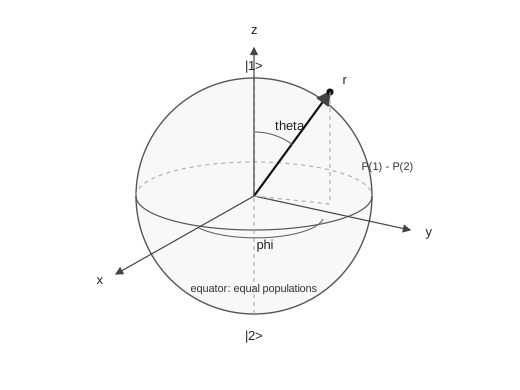
Bloch-sphere representation of a two-level state. Use this visual for state rays and spin- expectation directions, not for literal particle motion. The canonical discussion is Bloch Sphere.
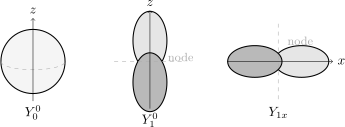
Low-order spherical-harmonic angular shapes. The figure is a recognition aid; calculations should use the complex normalized convention stated in Spherical Harmonics Quick Reference.
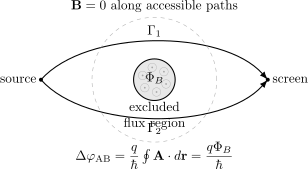
Two paths enclosing excluded magnetic flux acquire a relative Aharonov–Bohm phase. The visual emphasizes holonomy in the accessible region, not a local force along the paths. See Aharonov–Bohm Effect.
| Asset | Source | Status | Canonical page |
|---|---|---|---|
/figures/wave-mechanics/bloch-sphere-two-level.svg | /figures-src/wave-mechanics/bloch-sphere-two-level.tex | committed static SVG; schematic convention figure | Bloch Sphere |
/figures/wave-mechanics/spherical-harmonics-angular-shapes.svg | /figures-src/wave-mechanics/spherical-harmonics-angular-shapes.tex | committed static SVG; shape-recognition figure | Spherical Harmonics |
/figures/wave-mechanics/aharonov-bohm-two-path-phase.svg | /figures-src/wave-mechanics/aharonov-bohm-two-path-phase.tex | committed static SVG; conceptual phase-holonomy figure | Aharonov–Bohm Effect |
Candidate Visualizations
Section titled “Candidate Visualizations”The following candidates should be added only after the source figure or notebook exists and passes the admission checklist.
| Candidate | What it should show | Source expectation | Required warning or validation |
|---|---|---|---|
| Spin rotation trajectories | Bloch vector moving under a stated Hamiltonian | notebook or animation source | norm and Bloch-vector length conservation |
| Angular momentum cones | fixed precession-style schematic | TikZ source | semiclassical picture; not a literal orbit |
| Coupled angular momentum vector model | allowed values from and | TikZ or notebook | vector model is mnemonic; exact content is representation theory |
| Berry phase as solid angle | loop on the parameter sphere and enclosed | TikZ or validated notebook | sign tied to Hamiltonian and eigenstate convention |
| Aharonov–Bohm ring interference | flux-dependent fringe or ring-spectrum shift | notebook source | periodicity under |
| Level splitting under symmetry breaking | degeneracy lifting as a parameter is turned on | notebook source | conserved labels and broken symmetries stated |
| Zeeman multiplet diagram | -dependent shifts in a magnetic field | TikZ or notebook | sign of coupling and factor convention stated |
| Time-reversal action on spinors | spin reversal plus complex conjugation | schematic or exact notebook | antiunitary nature and sign stated |
Admission Checklist
Section titled “Admission Checklist”A visualization belongs here only when it has:
- a stable asset path under
public/figures/; - a source path under
public/figures-src/or a source notebook undernotebooks/; - alt text that states the physical content;
- a caption that names the plotted object and convention;
- a validation statement or explicit schematic label;
- a link to the canonical page where the physics is explained;
- no hidden dependence on a gauge, phase, basis ordering, or sign convention.
For notebook-generated figures, use the status labels from Reproducibility Status. A plot with no validation cell should remain a candidate.
Caption Rules
Section titled “Caption Rules”Captions for this volume should answer:
- Is the figure a state, operator, expectation value, probability density, spectrum, phase, or schematic?
- Which convention is used for basis order, phase, gauge, or orientation?
- Which parameters are fixed?
- What mathematical fact or physical lesson should the reader see?
- What check supports the figure if it is generated from a computation?
For example, a Berry-phase solid-angle plot should state the loop orientation and the convention for the eigenstate. A spherical-harmonic plot should state whether it shows complex , a real linear combination, the sign, or a probability density.
Accessibility and Design
Section titled “Accessibility and Design”Use labels and line styles in addition to color. Do not rely on red/blue signs alone for positive and negative lobes. For dense diagrams, keep mathematical labels short and place detailed interpretation in the caption.
Avoid visual metaphors that overpower the exact statement. Angular momentum cones, coupled-vector cartoons, and spin arrows are useful mnemonics, but the caption must say when the exact object is an operator algebra or Hilbert-space ray.
Common Mistakes
Section titled “Common Mistakes”- Treating the Bloch sphere as physical space.
- Showing real spherical harmonics while citing complex formulas without warning.
- Drawing spin as a tiny rotating ball.
- Plotting a gauge-dependent quantity without naming the gauge.
- Using a vector-model angular momentum diagram as if it were an exact derivation.
- Exporting a notebook-generated figure before convergence or normalization checks.
- Omitting parameter values from a level-splitting or Berry-phase plot.
Cross-Links
Section titled “Cross-Links”- Computational Notebooks
- Bloch Sphere
- Spherical Harmonics Quick Reference
- Angular Momentum Problems
- Berry Phase Problems
- Aharonov–Bohm Effect
- Degeneracy Lifting
- Reproducibility Status
References
Section titled “References”- E. Tufte, The Visual Display of Quantitative Information, 2nd ed., Graphics Press, 2001.
- R. N. Zare, Angular Momentum: Understanding Spatial Aspects in Chemistry and Physics, Wiley, 1988.
- A. Shapere and F. Wilczek, eds., Geometric Phases in Physics, World Scientific, 1989.
- J. J. Sakurai and J. Napolitano, Modern Quantum Mechanics, 3rd ed., Cambridge University Press, 2020.
Exercises
Section titled “Exercises”- A plot shows a spin arrow moving on a sphere but does not say whether it is a Bloch vector or a physical-space trajectory. Why should it remain out of the gallery?
Solution
The interpretation is ambiguous. A Bloch vector represents expectation values or a ray in a two-level Hilbert space; it is not a literal particle trajectory. The caption must state the object being plotted and the Hamiltonian or transformation that generates the motion.
- A spherical-harmonic figure uses real lobes but the nearby text quotes complex formulas. What must the caption explain?
Solution
It must state that the plotted lobes are real linear combinations of complex spherical harmonics, not the complex eigenfunctions themselves. It should also identify the sign, normalization, and whether the surface radius represents amplitude, signed amplitude, or probability density.