Squeezed States: First Encounter
A squeezed state is an oscillator state whose uncertainty is reduced in one quadrature below the ground-state value while the uncertainty in the conjugate quadrature is increased. It is a controlled reshaping of quantum noise, not a violation of the uncertainty principle.
For a first encounter, the essential picture is:
- the vacuum or ground state has equal uncertainty in two conjugate quadratures;
- squeezing narrows one quadrature distribution;
- the conjugate quadrature broadens;
- pure ideal squeezed states can still be minimum-uncertainty states;
- detailed single-mode, two-mode, and experimental squeezing technology belongs in the continuous-variable and quantum-optics pages.
Dimensionless Quadratures
Section titled “Dimensionless Quadratures”For the harmonic oscillator, define dimensionless quadrature operators
They obey
In terms of the physical position and momentum,
The oscillator ground state has
or, in physical units,
The word “quadrature” here means a phase-space component of the oscillator, not a numerical integration rule.
The Basic Squeeze Operator
Section titled “The Basic Squeeze Operator”With one common phase convention, a real squeezing parameter defines
The squeezed vacuum is
For with this convention,
Therefore the squeezed-vacuum variances are
Equivalently,
The product remains
which corresponds to
Thus the squeezed vacuum is still a minimum-uncertainty state in this ideal pure case. It is not a state with less uncertainty in every direction.
Phase-Space Picture
Section titled “Phase-Space Picture”A useful first picture is an uncertainty ellipse in the plane. The ground state is circular in these dimensionless coordinates. Squeezing turns the circle into an ellipse.
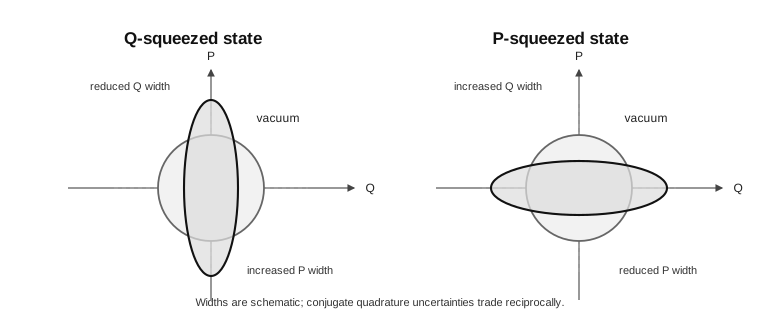
A schematic phase-space picture of single-mode squeezing. For in the convention used here, the width decreases while the width increases. A phase rotation can squeeze a different quadrature.
The ellipse orientation depends on the squeezing phase. A more general squeezed state can have its narrow axis at an angle in phase space. This page keeps the axes aligned with and to make the uncertainty tradeoff visible.
Relation To Coherent States
Section titled “Relation To Coherent States”A coherent state is a displaced ground-state Gaussian:
It has nonzero mean quadratures but ground-state variances:
A squeezed state changes the variances. A displaced squeezed state combines both operations:
Its center can follow classical-like oscillator motion while its noise ellipse is not circular. This distinction is why coherent states and squeezed states should not be used as synonyms. Coherence describes a special displacement and phase relation; squeezing describes anisotropic quadrature uncertainty.
Coherent-State Dynamics shows why rotations and linear drives preserve ordinary coherent states, whereas parametric quadratic terms generally generate squeezed coherent states.
Number-State Content
Section titled “Number-State Content”The squeezed vacuum is not a number state and not a coherent state. In the number basis it contains only even occupation numbers:
The absence of odd number states is a signature of pair structure in this ideal single-mode squeezed vacuum. In quantum-optics language, squeezing is often produced by interactions that create or annihilate excitations in pairs. That more detailed mechanism belongs in the quantum-optics and continuous-variable treatments.
The mean occupation number is
Consequently, the squeezed-vacuum mean energy is
Reducing one quadrature noise below the vacuum value costs energy by increasing excitation content and anti-squeezing the conjugate quadrature.
Minimum Uncertainty, But Not Always
Section titled “Minimum Uncertainty, But Not Always”The ideal squeezed vacuum above satisfies
So do displaced squeezed states of the form . They are Gaussian pure states with a reshaped covariance ellipse.
Realistic or mixed squeezed states need not saturate the bound. Loss, thermal noise, imperfect mode matching, and phase noise can make
The phrase “squeezed below vacuum” therefore requires a specified quadrature, a specified reference vacuum, and a specified measurement convention.
Applications Preview
Section titled “Applications Preview”Squeezed states matter because many measurements are limited by fluctuations in a particular quadrature. If the signal is encoded in that quadrature, reducing its variance can improve sensitivity, provided the anti-squeezed quadrature does not leak back into the measurement.
Common settings include:
- optical and microwave parametric amplifiers;
- homodyne detection of field quadratures;
- gravitational-wave interferometry and precision metrology;
- continuous-variable quantum information;
- generation of two-mode entanglement from pair-correlated modes.
These applications are powerful but conditional. Useful squeezing depends on phase control, loss, detector efficiency, mode matching, and the full noise budget. The first oscillator lesson is the geometry of uncertainty; the engineering of useful squeezed light or squeezed motion is a later subject.
Common Mistakes
Section titled “Common Mistakes”- Saying squeezing beats the uncertainty principle. It redistributes uncertainty between conjugate quadratures.
- Forgetting the anti-squeezed quadrature.
- Confusing a squeezed state with a coherent state.
- Calling a single-mode squeezed state bipartite entangled without specifying a bipartition.
- Quoting a squeezing parameter without stating the quadrature convention or phase.
- Assuming all states with reduced noise are pure minimum-uncertainty states.
- Treating “quadrature” in this context as numerical quadrature.
Where This Is Used
Section titled “Where This Is Used”- Squeezed Light develops nonlinear optical generation, homodyne verification, loss and phase-noise limits, and precision applications.
- Squeezing develops the cross-platform measurement criterion that combines reduced variance with signal response, readout direction, and loss.
- Coherent States gives the displaced, unsqueezed Gaussian comparison.
- Coherent-State Dynamics compares coherence-preserving evolution with parametric squeezing and nonlinear shearing.
- Zero-Point Energy explains the ground-state width that squeezing reshapes.
- Minimum-Uncertainty Wave Packets gives the broader Gaussian equality condition for position and momentum.
- Phase Space supplies the classical geometry behind the quadrature plane.
- Squeezed States as Entangled Modes develops single-mode and two-mode squeezing in the continuous-variable setting.
- Gaussian States Preview gives the covariance-matrix language used for general Gaussian states.
- Sudden Approximation shows why a sudden oscillator-frequency change expresses the old ground state as a squeezed vacuum in the new number basis.
References
Section titled “References”- D. F. Walls and G. J. Milburn, Quantum Optics, 2nd ed., Springer, 2008.
- M. O. Scully and M. S. Zubairy, Quantum Optics, Cambridge University Press, 1997.
- C. C. Gerry and P. L. Knight, Introductory Quantum Optics, Cambridge University Press, 2005.
- H. P. Yuen, “Two-photon coherent states of the radiation field,” Physical Review A 13, 2226-2243, 1976.
- C. M. Caves, “Quantum-mechanical noise in an interferometer,” Physical Review D 23, 1693-1708, 1981.
- J. R. Klauder and B.-S. Skagerstam, Coherent States, World Scientific, 1985.
Exercises
Section titled “Exercises”- Show that the ideal squeezed vacuum remains a minimum-uncertainty state.
Solution
For the convention used on this page,
Therefore
In physical units, and , so
- If , what happens to and relative to the ground-state values?
Solution
The ground-state values are
For ,
Thus
One quadrature width is halved, and the conjugate quadrature width is doubled.
- Use to find the mean energy of a squeezed vacuum.
Solution
The oscillator Hamiltonian is
Therefore
- Explain why a squeezed state with smaller than the vacuum does not imply a smaller total quantum uncertainty.
Solution
For the ideal squeezed vacuum,
If , then is smaller than the vacuum value, but is larger by the reciprocal factor. The product remains . Squeezing has redistributed uncertainty between conjugate quadratures rather than removing it.