Hermite Functions
Hermite functions are the normalized shape functions of the one-dimensional quantum harmonic oscillator. They are Hermite polynomials multiplied by a Gaussian and normalized in .
This page is a focused reference for the eigenfunctions. The differential-equation derivation belongs to Differential-Equation Solution, and the polynomial identities belong to Hermite Polynomials.
Dimensionless Functions
Section titled “Dimensionless Functions”In the dimensionless coordinate , define
Here is the physicists’ Hermite polynomial. The first few are
Thus the first Hermite functions are a Gaussian, a Gaussian times a linear function, and a Gaussian times a quadratic function.
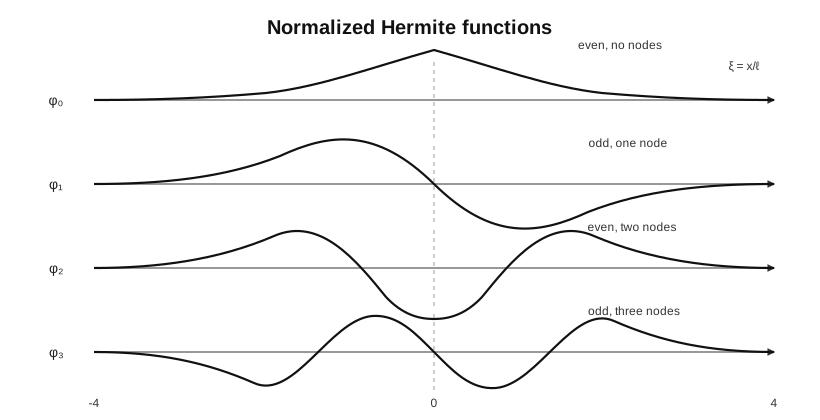
The first four normalized Hermite functions . The parity alternates with , and the number of nodes is exactly .
Oscillator Scaling
Section titled “Oscillator Scaling”For the physical oscillator with mass and angular frequency , the oscillator length is
The dimensionless coordinate is
The normalized position-space energy eigenfunctions are scaled Hermite functions:
Equivalently,
The factor is required because . Without it, the physical wavefunction would have the wrong units and the wrong normalization.
Orthonormality
Section titled “Orthonormality”The dimensionless Hermite functions obey
Therefore the physical oscillator wavefunctions obey
The normalization follows from the weighted Hermite-polynomial identity
The Gaussian weight is essential. The polynomials are not orthogonal with respect to the ordinary unweighted integral on the real line.
Parity and Nodes
Section titled “Parity and Nodes”Hermite polynomials satisfy
Because the Gaussian envelope is even,
and hence
Even gives even functions, and odd gives odd functions. The th Hermite function has exactly real nodes. This agrees with the general one-dimensional bound-state rule that higher energy states have more nodes.
Energy Labels
Section titled “Energy Labels”The Hermite function label is also the oscillator energy label:
The wavefunction is the coordinate representation of the number state :
Number-state notation and ladder actions are collected in Number States. This page focuses on the functions themselves.
Recurrence and Matrix Elements
Section titled “Recurrence and Matrix Elements”The dimensionless Hermite functions satisfy useful ladder identities:
and
After restoring , the position operator has matrix elements
These formulas are often faster than doing integrals directly. They are the wavefunction version of the ladder-operator algebra.
Fourier-Transform Property
Section titled “Fourier-Transform Property”With the unitary dimensionless Fourier convention
the Hermite functions are Fourier-transform eigenfunctions:
This property is one reason Hermite functions are useful in spectral methods and phase-space calculations. The phase depends on the Fourier convention; the eigenfunction structure does not.
Completeness
Section titled “Completeness”The set
is a complete orthonormal basis of . A square-integrable function can be expanded as
with coefficients
Completeness is a Hilbert-space statement about convergence in norm. It does not mean every function is well approximated pointwise by a short Hermite expansion.
Common Mistakes
Section titled “Common Mistakes”- Confusing the Hermite polynomial with the normalized Hermite function .
- Dropping the factor when converting to .
- Writing the Gaussian envelope as instead of .
- Forgetting that starts at .
- Mixing physicists’ Hermite polynomials with probabilists’ .
- Treating Fourier-transform phases of Hermite functions as convention-independent.
- Assuming a short Hermite-function expansion is automatically good for discontinuous or sharply localized functions.
Where This Is Used
Section titled “Where This Is Used”- Quantum Harmonic Oscillator summarizes the oscillator spectrum and scales.
- Differential-Equation Solution derives why Hermite functions appear.
- Hermite Polynomials gives the special-function identities used here.
- Ladder-Operator Solution: First Encounter gives the operator origin of the recurrence relations.
- Number States interprets as .
- Harmonic Oscillator Spectrum gives a quick formula reference.
- Fourier Transform supplies the convention-sensitive transform background.
- Harmonic-Oscillator Propagator Notebook tests stable Hermite recurrences, spectral completeness, and kernel convergence numerically.
References
Section titled “References”- D. J. Griffiths and D. F. Schroeter, Introduction to Quantum Mechanics, 3rd ed., Cambridge University Press, 2018.
- R. Shankar, Principles of Quantum Mechanics, 2nd ed., Springer, 1994.
- C. Cohen-Tannoudji, B. Diu, and F. Laloë, Quantum Mechanics, Wiley, 1977.
- F. W. J. Olver, D. W. Lozier, R. F. Boisvert, and C. W. Clark, eds., NIST Handbook of Mathematical Functions, Cambridge University Press, 2010.
- G. B. Arfken, H. J. Weber, and F. E. Harris, Mathematical Methods for Physicists, 7th ed., Academic Press, 2013.
Exercises
Section titled “Exercises”- Show that is normalized if is normalized.
Solution
Compute
Set , so . Then
- Use the parity of to prove the parity of .
Solution
The Gaussian factor is even:
The Hermite polynomial satisfies
Therefore
- Derive from the recurrence relation for .
Solution
Since ,
Use
Orthonormality gives
- Why are Hermite polynomials alone not acceptable oscillator wavefunctions?
Solution
The polynomial grows like at large . It is not square-integrable on the real line. The Gaussian factor supplies the decay needed for normalizability. The normalized Hermite function is the product of the polynomial, the Gaussian envelope, and the normalization constant.