Effective Radial Potential
The effective radial potential is the simplest way to read the qualitative physics of a fixed angular-momentum sector in a central potential. It combines the actual potential with the centrifugal term that appears after angular separation. The result is not a new interaction in the Hamiltonian; it is a plotting and reasoning device for the reduced radial equation.
The canonical derivation of the half-line radial equation is in Radial Schrödinger Equation. This page uses that equation to explain centrifugal barriers, turning points, qualitative bound states, and radial nodes.
Definition
Section titled “Definition”For a particle of mass in a central potential, the reduced radial wavefunction
satisfies, for ,
The effective radial potential is
The second term is the centrifugal term. Its coefficient is , not , because it comes from the eigenvalue of :
This effective-potential picture should always be read with two qualifications. First, it applies after fixing ; different angular-momentum sectors have different radial equations. Second, the radial coordinate lives on the half-line , with regularity at inherited from the original three-dimensional problem.
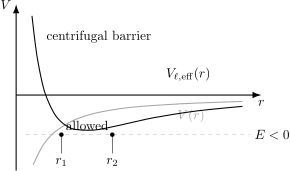
For an attractive central potential, the centrifugal term raises the effective radial potential near the origin when . A bound-state energy can have radial turning points and in the qualitative semiclassical picture.
Centrifugal Barrier
Section titled “Centrifugal Barrier”For , the centrifugal term vanishes:
For , the term
is positive and grows as . For nonsingular potentials, and also for the attractive Coulomb potential, this growth dominates close enough to the origin. The radial wavefunction is therefore suppressed at small radius in higher angular-momentum sectors.
This is the quantum version of the classical centrifugal barrier: nonzero angular momentum makes it difficult to reach the center. The quantum statement is not that the particle follows an orbit and bounces off a wall. It is that the radial differential equation contains a positive short-distance term that changes the allowed wavefunction shape.
Increasing usually pushes probability density outward, raises low-lying radial energies, and reduces the number of bound states supported by a fixed attractive well. The magnetic quantum number does not affect this barrier in a rotationally invariant problem.
Turning Points
Section titled “Turning Points”In a qualitative radial plot, turning points are radii where
Regions with
are classically allowed in the radial sense, while regions with
are classically forbidden. In the exact quantum problem, the wavefunction is smooth through a turning point. The allowed-forbidden language is a semiclassical guide, not a boundary condition imposed by hand.
The origin deserves separate care. The point is a boundary of the radial half-line, not simply another ordinary turning point. Physical regularity near the origin is part of the radial domain; see Boundary Conditions for Radial Wavefunctions for the checklist. For standard nonsingular or Coulomb-like central potentials, the regular behavior is
Detailed semiclassical matching near ordinary turning points belongs to Turning Points and Connection Formulas.
Qualitative Bound States
Section titled “Qualitative Bound States”Suppose as . Then negative-energy square-normalizable states, if they exist, are bound states, while positive energies belong to the continuum. For a fixed , the effective potential tells us whether the radial equation contains a well deep and wide enough to support bound levels.
Several qualitative rules are useful:
- a deeper attractive well can support more radial bound states;
- a wider attractive region can support more radial bound states;
- increasing raises the centrifugal barrier and can remove weakly bound states;
- bound states with more radial nodes usually occur at higher energy within the same sector.
These are not substitutes for solving the radial equation, but they are reliable first checks. If a claimed high- bound state is localized at very small in a nonsingular well, the centrifugal barrier should make the reader suspicious. If a claimed spectrum is independent of for an arbitrary central potential, the result is probably importing a special property of the Coulomb or oscillator problem.
Radial Nodes
Section titled “Radial Nodes”For standard regular central-potential bound states, each fixed sector behaves like a one-dimensional Sturm–Liouville problem on the half-line. The bound states can be ordered by the number of zeros of in :
Here is the radial node number. It counts radial nodes, not angular nodes. Angular nodal structure comes from the spherical harmonic .
For a generic central potential, the bound-state energies have the form
Hydrogen is special. In the ideal Coulomb problem,
and the bound-state energy depends only on . That special degeneracy is explained in Degeneracy of the Hydrogen Atom; it should not be assumed for a general central potential.
Coulomb Example
Section titled “Coulomb Example”For an attractive Coulomb potential
the effective radial potential is
For , it rises to near the origin, approaches from below at infinity, and has a minimum. Setting the derivative to zero gives
so
At this radius,
This minimum is a qualitative clue to where higher- Coulomb radial probability tends to live. It does not by itself quantize the hydrogen spectrum; the exact quantization comes from solving the radial equation with normalizability and regularity.
Scattering Interpretation
Section titled “Scattering Interpretation”For short-range central potentials, the same centrifugal barrier helps explain low-energy partial-wave scattering. If the incident wave number is small, high- sectors face a large centrifugal barrier before reaching the interaction region. Their phase shifts are then often suppressed compared with low- sectors.
This is why low-energy scattering is frequently dominated by the wave, , with higher partial waves entering as the energy increases or as the range of the interaction becomes large. The full scattering expansion belongs to Partial-Wave Expansion.
Common Mistakes
Section titled “Common Mistakes”- Treating as a new external potential independent of angular momentum.
- Using where the angular eigenvalue requires .
- Forgetting that the sector has no centrifugal barrier.
- Treating turning points as hard walls where the quantum wavefunction must vanish.
- Ignoring the origin as a boundary point of the radial half-line.
- Confusing radial nodes with angular nodes.
- Expecting hydrogen’s degeneracy in every central potential.
Where This Is Used
Section titled “Where This Is Used”- Radial Schrödinger Equation derives the equation whose fixed- potential is interpreted here.
- Boundary Conditions for Radial Wavefunctions states the origin, infinity, and singular-potential conditions behind the qualitative picture.
- Coulomb Potential sets the signs and natural scales for the Coulomb example used here.
- Hydrogen Atom specializes this picture to the Coulomb potential.
- Degeneracy of the Hydrogen Atom explains why Coulomb levels have more degeneracy than the effective-potential picture alone would suggest.
- Angular and Radial Separation shows how the centrifugal term arises from angular eigenvalues.
- Partial-Wave Expansion uses the centrifugal barrier to organize scattering by angular momentum.
References
Section titled “References”- D. J. Griffiths and D. F. Schroeter, Introduction to Quantum Mechanics, 3rd ed., Cambridge University Press, 2018.
- R. Shankar, Principles of Quantum Mechanics, 2nd ed., Springer, 1994.
- C. Cohen-Tannoudji, B. Diu, and F. Laloë, Quantum Mechanics, Wiley, 1977.
- L. D. Landau and E. M. Lifshitz, Quantum Mechanics: Non-Relativistic Theory, 3rd ed., Pergamon, 1977.
- J. R. Taylor, Scattering Theory: The Quantum Theory of Nonrelativistic Collisions, Dover, 2006.
Exercises
Section titled “Exercises”- What is the effective radial potential in the sector, and what physical effect is absent there?
Solution
For ,
Therefore
There is no centrifugal barrier. The radial state can have nonzero amplitude at the origin if the potential and boundary condition allow it.
- For with , find the minimum of for .
Solution
The effective potential is
Differentiate:
Setting this to zero gives
Substitution gives
- Explain why high- partial waves are often suppressed in low-energy scattering from a short-range potential.
Solution
For , the effective radial potential includes the positive centrifugal term
At low energy this term can prevent the radial wave from significantly entering the short-range interaction region. Since the wave samples the potential weakly, the corresponding phase shift is small. The channel has no centrifugal barrier, so it often dominates low-energy scattering.