Concept Map
Relativistic kinematics, wave equations, particle states and quantum fields are connected by different kinds of argument. Some connections are constraints, some require a chosen mathematical construction, and others add physical input or make a controlled approximation. Reading all these connections as one inevitable historical chain obscures their assumptions.
Kinematics, modes and field structure
Section titled “Kinematics, modes and field structure”The diagram groups the main relationships. A solid arrow marks a constraint, a dotted arrow marks added quantum structure, and dashed arrows mark controlled reduction or matching. The detailed choices appear in the table below.
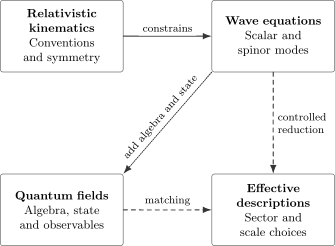
The arrows have different meanings. Symmetry alone does not select a unique wave equation; a mode equation alone does not supply a quantum algebra, interaction or observable. Effective descriptions require stated sectors and scales. TikZ source.
The map is not a prerequisite graph. It also does not identify an exact change of representation with an approximation that discards terms or sectors.
| Input and choice | Connection and destination |
|---|---|
| Relativistic momentum and a time orientation | Constrain the mass shell and select the positive-energy invariant measure |
| Mass shell plus a scalar amplitude | Construct the Klein–Gordon equation |
| Mass shell plus a first-order Clifford/spinor construction | Construct the Dirac equation; scalar factorization relates the equations but does not make their state descriptions identical |
| Poincaré symmetry and a representation space | Organize spinor components or unitary particle states, with different transformation laws |
| Wave equations plus prescribed gauge potentials | Define external-field coupling and gauge covariance |
| A wave operator plus a source and boundary prescription | Define a Green-function inverse |
| Numerical modes plus oscillator algebra and a state | Construct free quantum fields and their correlations |
| Matter plus dynamical electromagnetic degrees of freedom and an interaction | Enter the gauge-theory and QED bridges |
| A retained particle sector and controlled low momenta and fields | Obtain Pauli dynamics and FW corrections |
The limitations of a fixed-particle model can motivate a larger state space. They do not themselves construct its algebra, vacuum or dynamics. Where Quantum Field Theory Begins identifies those additions.
Representation changes and approximations are different operations
Section titled “Representation changes and approximations are different operations”The exact free FW transformation unitarily changes the representation of the state and its observables. It retains both free energy blocks. Choosing one block is an additional sector restriction.
The static FW expansion is instead a low-energy asymptotic calculation with stated field and momentum counting. Truncating it is not an exact identity over all states. Antiparticle Decoupling asks a further dynamical question: when does evolution preserve the chosen sector approximately?
NRQED matching adds another relationship. It determines effective coefficients by reproducing specified amplitudes or observables of an underlying quantum-field model. It can include effects not present in a classical external-field Dirac equation. “Low energy” therefore does not mean that all routes to an effective Hamiltonian contain the same physical information.
Related objects that should not be identified
Section titled “Related objects that should not be identified”A current and a probability density. A conserved KG charge need not be a positive local Born density. The Dirac density is positive, but that does not remove the negative-energy sector of its full one-particle Hamiltonian. Use the current comparison.
Spinor components and particle states. A finite-dimensional spinor boost need not be unitary in the Euclidean component norm. The complete particle state includes its momentum measure and transformation law. Use the Wigner construction.
Negative-frequency modes and negative particle probabilities. In a quantum field expansion, the mode and its operator coefficient have separate roles. The antiparticle assignment does not introduce a negative Hilbert probability. Use Spinors to Fermion Fields.
A propagator and an observable. A source inverse, Wightman function, time-ordered correlation and scattering amplitude require different definitions. Use the Propagator Table and the linked derivation owners.
Charge and total particle number. A pair can change total number while preserving charge. A fixed-charge space can contain many number sectors. Use Why Fock Space Is Necessary.
Use the map to select a route
Section titled “Use the map to select a route”For an ordered learning path, use the Bridge Roadmap and each page’s required background. For a calculation already in progress, follow the table to the missing assumption or construction. The scope guide states which outputs are treated, and Problems and Projects test whether the distinctions survive in a new example.
References
Section titled “References”- Foldy, Leslie L., and Siegfried A. Wouthuysen. “On the Dirac Theory of Spin 1/2 Particles and Its Non-Relativistic Limit.” Physical Review 78, 29–36 (1950). doi:10.1103/PhysRev.78.29. Representation change and low-energy expansion.
- Thaller, Bernd. The Dirac Equation. Springer, 1992. doi:10.1007/978-3-662-02753-0. Operators, spectra and sector choices.
- Weinberg, Steven. The Quantum Theory of Fields, Volume I: Foundations. Cambridge University Press, 1995. doi:10.1017/CBO9781139644167. Representations, particle states and field constructions.