Energy–Momentum Relation
The free relativistic dispersion relation is the invariant statement
or, in energy and three-momentum,
It defines the mass shell. Its quadratic form leads directly to the Klein–Gordon equation; trying to construct a first-order time-evolution law whose square gives the same shell leads to the Clifford algebra and the Dirac equation. The two algebraic roots must be handled carefully: a future-directed classical particle has , while relativistic wave equations contain both positive- and negative-frequency modes. Calling the negative root an antiparticle before quantization skips the essential field-theory step.
Required background. Metric and Units fixes signs and dimensions; Four-Vectors supplies four-velocity, four-momentum, and invariant contractions.
Deriving the mass shell
Section titled “Deriving the mass shell”For a massive free particle,
Taking the invariant norm gives
Using ,
and multiplying by yields
The invariant mass can therefore be recovered from any inertial frame:
For one future-directed particle of mass , and , so is positive and the positive sheet is selected. The Lorentz-invariant equation itself contains two sheets,
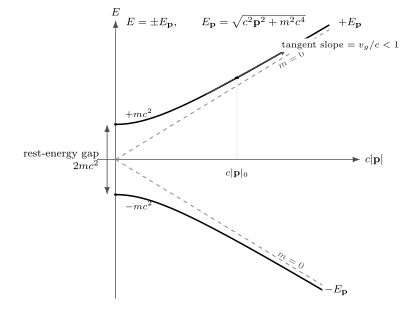
The massive dispersion relation has positive- and negative-frequency sheets separated by at zero momentum. The dashed lines are the massless limits . Because the horizontal axis is , the dimensionless tangent slope is .
The plot uses on the horizontal axis so both axes have energy units. It is a dispersion diagram, not a spacetime light cone.
Massive, massless, and composite systems
Section titled “Massive, massless, and composite systems”For , the shell becomes null:
A physical future-directed photon uses the positive branch. It has no rest frame, but its four-momentum and null invariant are well defined.
For noninteracting particles, or for asymptotic particles in a scattering state, the total four-momentum is
For an interacting or bound system, must instead be the complete conserved four-momentum, including field and interaction contributions rather than only a sum of constituent mechanical momenta. For future-directed non-spacelike total momentum, the system’s invariant mass is defined by
For timelike , a center-of-momentum frame exists and , so . A null total momentum instead has and no center-of-momentum frame. When the complete conserved four-momentum is used, invariant mass includes internal kinetic and interaction energy; it is generally not the sum of the constituent rest masses.
The word on shell means that a four-momentum satisfies the relevant free dispersion relation. In scattering calculations, momentum transfers and internal propagator variables need not obey it; those are called off shell. Off-shell quantities are integration or bookkeeping variables, not additional observable particle species.
Low-momentum expansion
Section titled “Low-momentum expansion”For , the positive branch can be expanded with :
The leading term is the rest energy. Removing the common phase leaves the nonrelativistic kinetic energy ; the next term is the leading free relativistic correction. The expansion parameter is , equivalently at leading order. It is not controlled merely by subtracting a large constant.
The negative branch expands as the negative of the same series. A one- component Schrödinger theory cannot consistently turn the two sheets into two independent probabilities. Their proper interpretation depends on whether the wave equation is scalar or spinorial and, ultimately, on quantized fields.
Ultrarelativistic expansion
Section titled “Ultrarelativistic expansion”When on the positive branch,
The leading behavior is massless, but the correction remains measurable in time of flight, oscillation phases, threshold kinematics, and precision dispersion analyses. “Ultrarelativistic” means a controlled hierarchy, not that the mass has ceased to exist.
Phase and group velocity
Section titled “Phase and group velocity”For the positive-frequency plane wave
the angular frequency and wavevector are and . A narrow free wave packet has group velocity
For a massive positive-energy particle, inserting and gives
Its magnitude is less than . In the massless limit it approaches . The phase velocity along is for a massive mode and can exceed ; it does not carry a localized signal and is not the particle velocity.
From the shell to wave equations
Section titled “From the shell to wave equations”With the plane-wave convention on the metric page,
Applying the quadratic shell to a scalar amplitude gives
the free Klein–Gordon equation. Its second time derivative preserves both frequency branches and requires two pieces of initial data.
Dirac instead sought an equation first order in time and space. Factoring the quadratic invariant requires matrix coefficients whose anticommutators cancel the cross terms. That demand, rather than a choice of convenient notation, produces the gamma-matrix Clifford algebra.
Common pitfalls
Section titled “Common pitfalls”Identifying the negative root with an antiparticle immediately. The root first labels a negative-frequency sector of a classical wave equation. Antiparticle creation and annihilation acquire a stable interpretation after field quantization.
Dropping the rest energy before expanding. First identify the positive branch and the small ratio ; then remove the common rest- energy phase. Subtraction alone does not establish a nonrelativistic regime.
Applying the free shell to every four-momentum. External asymptotic particles are on shell. Internal or exchanged momenta in QFT generally are not.
Confusing the dispersion plot with a light cone. The axes are energy and momentum, not time and position. The massless asymptotes have a related slope because both encode the same invariant speed.
Exercises
Section titled “Exercises”1. Nonrelativistic correction
Section titled “1. Nonrelativistic correction”Expand through order and state when the correction is small relative to the Newtonian kinetic energy.
Solution
The binomial series gives
The ratio of the correction magnitude to is , so it is small when .
2. Group velocity
Section titled “2. Group velocity”Differentiate the positive branch and prove for .
Solution
Differentiation gives
Therefore
when .
3. Two-photon invariant mass
Section titled “3. Two-photon invariant mass”Two photons have equal energy and opposite momenta. Find the invariant mass of the pair. Compare it with two parallel photons of the same energy.
Solution
For opposite momenta, the total four-momentum is , so
For parallel photons, and , so the system invariant mass is zero. Invariant mass depends on the total energy- momentum configuration, not the individual rest masses alone.
4. Both frequency branches
Section titled “4. Both frequency branches”Insert into the differential equation above and show that both signs of solve it.
Solution
The derivatives give and . The equation reduces to
which depends only on . Hence both solve it.
References
Section titled “References”- J. D. Bjorken and S. D. Drell, Relativistic Quantum Mechanics, McGraw–Hill, 1964.
- W. Greiner, Relativistic Quantum Mechanics: Wave Equations, 3rd ed., Springer, 2000, doi:10.1007/978-3-662-04275-5.
- S. Navas et al. (Particle Data Group), “Kinematics,” in Review of Particle Physics, Physical Review D 110, 030001, 2024, doi:10.1103/PhysRevD.110.030001.
- M. D. Schwartz, Quantum Field Theory and the Standard Model, Cambridge University Press, 2014, doi:10.1017/9781139540940.