Causality and Light Cones
A light cone separates events that can be connected by causal propagation from events with no invariant time order. Relativistic quantum theory must respect that geometry in its response to local interventions. It need not make every wavefunction tail or every correlation vanish outside a light cone. Keeping geometry, evolution, and measurement distinct prevents several common misconceptions about relativistic wave equations.
Required background. Lorentz Transformations supplies boosts and their action on event separations.
Helpful background. The Klein–Gordon Equation introduces the two Cauchy data of a hyperbolic wave equation.
Timelike, null, and spacelike separation
Section titled “Timelike, null, and spacelike separation”For two events define . Their squared interval is
The sign of is Lorentz invariant. If , the separation is timelike: an inertial frame exists in which the events occur at the same spatial point. If and the events are distinct, the separation is null. If , it is spacelike: a frame exists in which they are simultaneous.
The future causal cone of an event contains separations satisfying ; its boundary is null and its interior timelike. A massive material object follows a timelike worldline. Light in vacuum follows null trajectories in the geometric-optics limit. These statements concern causal propagation, not the magnitude of a phase velocity.
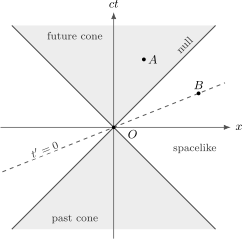
Equal scales on and make null rays diagonal. Every proper orthochronous observer places after . The spacelike event is simultaneous with in the frame with , whose slice is dashed; a larger boost reverses their time order.
Which time order is invariant?
Section titled “Which time order is invariant?”Choose the spatial axis along the separation. Under a passive boost,
For a future timelike or null separation, and . Every finite boost with therefore gives . Proper orthochronous observers agree on the order of such events, though not on the elapsed coordinate time.
For a spacelike separation with , the boost gives , and a slightly larger subluminal boost gives . For example,
are simultaneous at . At the transformed time separation is negative. An influence that connected these events would have to travel faster than light in the original frame. Merely changing coordinates does not create such an influence.
Domains of dependence of wave equations
Section titled “Domains of dependence of wave equations”The principal derivative part of the free Klein–Gordon equation is . Its characteristic surfaces are null. For sufficiently regular Cauchy data, the solution at with depends only on initial data inside the ball at . In particular, changing compactly supported initial data cannot change the solution outside the causal future of the changed region.
The mass term changes evolution within the cone, including dispersive tails; it does not move the characteristic cone. The same causal propagation applies to the full free Dirac initial-value problem. This is a statement about the local differential equations with their complete initial data.
Selecting positive-frequency modes is an additional, spatially nonlocal restriction. For a free scalar it imposes at
The square-root operator ties one Cauchy datum nonlocally to the other. One cannot independently prescribe both as compactly supported arbitrary functions and also demand positive frequency. Apparent instantaneous tails after such a projection do not contradict the finite domain of dependence of the unprojected local equation.
Correlation functions are not signal kernels
Section titled “Correlation functions are not signal kernels”In a relativistic quantum field theory, spacelike separated local observables commute. For observables smeared in spacelike separated regions and , this means
If a local unitary intervention in is generated by , , it leaves unchanged: . Consequently no choice of this local operation changes the statistics of . This is an elementary operational consequence of microcausality, not a proof of the full field-theory framework.
Commutativity does not imply absence of correlations. The connected correlator can be nonzero even when the commutator vanishes. For the same reason a Feynman two-point function may be nonzero at spacelike separation. A retarded response kernel, whose support records where a local perturbation can affect an observable, is the appropriate signal diagnostic.
For fermionic fields, spacelike anticommutation replaces commutation at the field level; physical even local observables still commute. The one-particle Dirac equation by itself does not supply this operator algebra. Tong’s discussion of free-field causality illustrates how the additional field structure enforces it.
Common pitfalls
Section titled “Common pitfalls”Reading a superluminal phase velocity as a signal. A massive free mode has , while its group velocity is . A signal front is controlled by the differential equation’s characteristics, not by a single constant-phase surface.
Equating spacelike separation with statistical independence. Quantum states can correlate measurements in commuting local algebras. Such correlations do not provide a controllable communication channel.
Exercises
Section titled “Exercises”- Events have and . Find the frame velocity that makes their spatial separation vanish and compute the time separation there.
Solution
gives . Then , with positive time order. This is the proper-time separation along the inertial connecting worldline.
- Two qubits in the Bell state have commuting observables and . Compute their connected correlation and explain why it does not refute the no-signaling statement.
Solution
Both individual expectations vanish and , so the connected correlation is one. A unitary on the first qubit leaves the second reduced density matrix unchanged. The example illustrates the algebraic distinction; it is not itself a model of relativistic localization.
- Compactly supported KG initial data vanish outside a ball of radius . State the largest possible support radius at a later time . Does positive frequency follow from this support condition?
Solution
The full solution vanishes outside radius . This requires both initial data to have the stated support. It does not imply positive frequency; positive frequency instead imposes the nonlocal relation displayed above.
References
Section titled “References”- R. Haag, Local Quantum Physics: Fields, Particles, Algebras, 2nd ed., Springer, 1996 — local observables and causal structure.
- W. Rindler, Introduction to Special Relativity, 2nd ed., Oxford University Press, 1991 — causal ordering and light cones.
- D. Tong, Lectures on Quantum Field Theory, University of Cambridge, 2006, section 2.6.1 — free-field commutators and spacelike correlations.