Potential Step
The potential step is the simplest scattering problem. A particle approaches a sudden change in potential energy,
Even this elementary setup shows a key quantum effect: a wave can reflect from a potential discontinuity even when the particle energy is above the step.
The value assigned exactly at has no effect on the solutions. This page assumes a constant mass and no delta-function interaction at the interface, so both and are continuous there. A common time factor is suppressed throughout.
Consider a particle incident from the left with energy . In the region ,
and the wavefunction is written as incident plus reflected waves:
The coefficient is the reflection amplitude. The incident amplitude has been set to one.
This ansatz is a scattering boundary condition, not merely the most general local solution. It specifies one incoming wave from the left and permits an outgoing reflected wave. On the right, only an outgoing or decaying solution is retained; there is no wave incident from . A different experiment with incidence from the right would require a different ansatz.
The behavior in depends on whether is above or below .
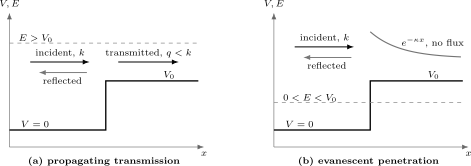
The two scattering regimes for a left-incident state. For , the right-hand wave propagates with and carries transmitted current. For , the right-hand solution decays and carries no current. Arrows and the exponential are schematic rather than amplitude plots on the energy axis.
Above The Step
Section titled “Above The Step”If , define
The transmitted wave in is
Continuity of and at gives
and
Solving,
The reflection coefficient is
The transmission coefficient is a current ratio, not merely :
One checks that
Writing
the probabilities take the dimensionless form
The raw amplitude exceeds one for an upward step because . This does not violate probability conservation: the transmitted wave moves more slowly. In a unit-flux basis the transmission amplitude is
and directly.
The factor is essential because the transmitted wave has a different velocity.
Below The Step
Section titled “Below The Step”If , define
The solution for that remains finite as is evanescent:
Matching at gives
Solving gives
The reflection amplitude has unit modulus but a nontrivial phase:
That phase shifts the nodes of the standing interference pattern on the incident side. A reflected wave packet can therefore acquire a spatial or temporal shift even though its asymptotic reflection probability is one.
The wave penetrates into the classically forbidden region over a length scale
However, the evanescent wave carries no transmitted current into . For a semi-infinite step with ,
This is not the same as finite-barrier tunneling. A finite barrier has a second boundary where the evanescent wave can match back onto a propagating transmitted wave.
The zero current follows directly:
The tail stores stationary probability density near the interface but does not transport probability to .
Exactly At Threshold
Section titled “Exactly At Threshold”At , the right-region equation is . Its general solution is . Boundedness as sets , and matching gives
The constant right-hand solution carries no current, so and . It is a generalized threshold solution, not a normalizable state. The result agrees continuously with both from above and from below; the amplitude again is not a transmission probability.
Results at a Glance
Section titled “Results at a Glance”For a positive upward step and left incidence:
| Regime | Right-hand solution | Probabilities | ||
|---|---|---|---|---|
| , | ||||
| constant | , | |||
| , |
Here , , and in their respective regimes.
Probability Current
Section titled “Probability Current”For a one-dimensional plane wave , the probability current is
For , the current is negative:
Thus reflection and transmission coefficients are defined by
This current-based definition generalizes correctly when wave numbers differ.
For the full left-region superposition,
so the density contains interference fringes. In the current, however, the cross terms cancel:
For ,
Continuity of and makes , which is exactly . Probability conservation is therefore encoded locally in the interface matching, not imposed as an unrelated algebraic check.
Limiting Cases
Section titled “Limiting Cases”The amplitudes pass several useful checks:
- No step: As , , so , , , and .
- Threshold from above: As , , so , , and .
- Threshold from below: As , , producing the same and .
- Infinite upward step: At fixed and , and . The interface value tends to zero, recovering the hard-wall Dirichlet condition.
- High energy: If , then
so reflection from a fixed abrupt step becomes small, though not identically zero.
The change of reflection phase from near threshold to in the hard-wall limit records the changing effective boundary condition seen by the incident wave.
A Downward Step
Section titled “A Downward Step”The same above-step formulas apply when . Then : the particle speeds up after crossing, but an abrupt wavelength mismatch still produces reflection,
The negative sign is a phase reversal. Classically there is no reflection from a downward step, whereas quantum reflection depends on spatial variation of the wave number, not only on whether the potential rises or falls.
Wave-Packet Interpretation
Section titled “Wave-Packet Interpretation”The stationary scattering states are delta-normalized ideals extending over both half-lines. A physical experiment launches a normalizable packet with momentum amplitude concentrated near . If and vary little across its bandwidth, the late-time reflected and transmitted packet probabilities are approximately and .
If the coefficients vary appreciably, the outgoing packets are filtered and distorted. Their phases also affect positions and arrival times. For , a packet temporarily builds an evanescent density near the interface and then returns entirely to the left; there is no asymptotic transmitted packet for a semi-infinite step.
The discontinuous step is itself an idealization. Replacing it by a smooth change over a distance large compared with the local wavelength can strongly suppress above-step reflection, as described by semiclassical methods.
Classical Comparison
Section titled “Classical Comparison”Classically, a particle with always crosses the step, slowing down as its kinetic energy decreases. Quantum mechanically, part of the wave is reflected whenever the wave number changes abruptly. This is above-step reflection.
For , both classical and quantum particles fail to propagate indefinitely into the region. Quantum mechanically, the wavefunction still penetrates a finite distance into the forbidden region.
The comparison should not turn the evanescent density into a classical residence trajectory. It is part of one stationary wave solution and carries no rightward flux. Conversely, above-step and downward-step reflection have no point-particle classical analogue; they arise from matching a wave and its derivative across a wavelength change.
Common Mistakes
Section titled “Common Mistakes”- Computing as when .
- Rejecting as unphysical instead of comparing probability currents.
- Calling the evanescent tail for a transmitted flux.
- Keeping the growing exponential for a semi-infinite right region.
- Forgetting the reflected wave when .
- Applying infinite-wall boundary conditions at a finite step.
- Forgetting derivative continuity for a constant-mass finite step.
- Treating as automatic without checking currents.
- Adding incident and reflected current magnitudes while ignoring their opposite signs.
- Treating the threshold amplitude as a probability of four.
- Assuming only an upward step can reflect a quantum wave.
- Applying single-energy and to a broad wave packet without accounting for spectral variation.
- Confusing a semi-infinite step with a finite barrier.
Where This Is Used
Section titled “Where This Is Used”- Free Particle gives the plane-wave current.
- Boundary Conditions explains continuity at finite jumps.
- Probability Current derives the current and continuity equation used in the flux ratios.
- Normalization Conventions explains flux normalization.
- Reflection and Transmission Coefficients develops channel and current conventions beyond this first example.
- Finite Potential Barrier adds a second interface and shows both tunneling and above-barrier reflection.
- Rectangular Barrier Tunneling focuses on the tunneling regime of a finite barrier.
- Finite Square Well uses related matching conditions for bound states.
- Wave Packets and Scattering turns stationary amplitudes into asymptotic packet probabilities.
References
Section titled “References”- D. J. Griffiths and D. F. Schroeter, Introduction to Quantum Mechanics, 3rd ed., Cambridge University Press, 2018.
- R. Shankar, Principles of Quantum Mechanics, 2nd ed., Springer, 1994.
- C. Cohen-Tannoudji, B. Diu, and F. Laloë, Quantum Mechanics, Wiley, 1977.
- J. R. Taylor, Scattering Theory: The Quantum Theory of Nonrelativistic Collisions, Dover, 2006.
- R. G. Newton, Scattering Theory of Waves and Particles, 2nd ed., Dover, 2002.
Exercises
Section titled “Exercises”- Derive and for .
Solution
Matching gives
Substitute into the second equation:
Then
so . Therefore
- Show that for .
Solution
Use
Then
- For , derive
and show directly that the reflection probability is one.
Solution
The matching equations are
Substituting into the derivative equation gives
Thus
and . Since numerator and denominator of are complex conjugates,
- Derive the high-energy result for an upward step.
Solution
Let . Then
Therefore
and
- Track the below-step reflection amplitude as and as . What boundary behavior does each phase limit resemble?
Solution
The amplitude is
At threshold, , so . Incident and reflected waves then add at the interface, giving , while their derivatives cancel. This resembles a zero-slope or Neumann-type reflection at the threshold interface.
For an infinitely high step, , so . The waves cancel at the interface,
which is the Dirichlet hard-wall condition. Both limits have unit reflection probability, but their reflection phases differ by .