Why Postulates Matter
A postulate package specifies how a physical theory turns preparations, transformations, composite systems, and measurements into quantitative predictions. It identifies the theory’s primitive objects and the rules that connect them.
Postulates are not ceremonial preliminaries. Without them, symbols such as , , , and have no agreed physical role. Yet a postulate list is not a complete model of an experiment, a derivation from data alone, or an answer to every interpretive question.
This page explains the job and logical status of postulates. The canonical compact list is Minimal Postulates; the remaining pages translate that package into finite-dimensional, wave-mechanical, and density-operator forms.
What Counts as a Postulate
Section titled “What Counts as a Postulate”A postulate is a rule adopted as part of a theory’s starting structure. Within that package it is not proved from earlier rules. It constrains what mathematical objects represent physical situations and how those objects generate predictions.
Several neighboring kinds of statement should not be conflated with postulates:
- A theorem follows logically from the postulates plus stated mathematical assumptions.
- A model assumption selects a particular system, Hamiltonian, state preparation, detector, boundary condition, or approximation.
- A convention fixes notation or coordinates without changing predictions.
- An empirical regularity summarizes observed behavior that motivates, tests, or constrains the theory.
- An interpretive claim assigns ontology or explanatory meaning beyond the shared predictive rules.
For example, assigning the Hilbert space to an ideal spin- degree of freedom uses the state-space framework but also models the relevant system as two dimensional. Choosing
is a model assumption, not a universal postulate of quantum mechanics. Choosing whether is diagonal with the entry first is a convention. Deriving the transition probability under that is a calculation.
The boundary between “postulate” and “theorem” depends on the chosen primitives. A rule stated independently in one presentation may be derived inside a broader framework in another. Logical role is package relative.
A Compact Theory Specification
Section titled “A Compact Theory Specification”A laboratory prediction involves four layers:
- physical procedures and modeling assumptions;
- mathematical representatives;
- a probability rule;
- comparison with experimental data.
In a modern finite-dimensional notation, a single trial may be summarized by
The predicted outcome probabilities are
For a closed system, . For a pure state and projective measurement,
and the trace rule becomes
The postulates specify which assignments and transformations are allowed and how this probability is computed. The physical model specifies which , , and describe the apparatus at hand.
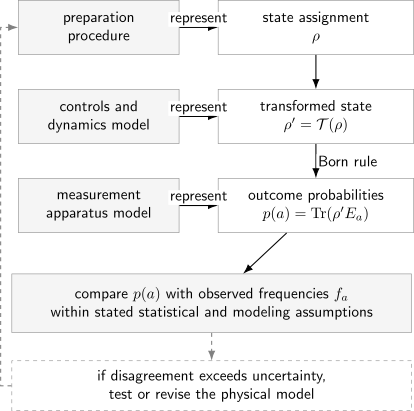
Postulates organize the formal arrows and probability rule. Experimental agreement tests the entire physical modeling package, including preparation, dynamics, measurement, and statistical assumptions.
Why Compactness Matters
Section titled “Why Compactness Matters”A compact postulate package serves several purposes at once.
Consistency. The same state and measurement rules must be used across atomic, optical, condensed-matter, and information-theoretic applications. This prevents local calculational habits from silently becoming incompatible theories.
Economy. Many consequences follow from a small structural core. Once composite systems use tensor products, entangled states are available without an extra “entanglement postulate.” Once probabilities are assigned by positive normalized effects, convex mixtures and coarse-grained outcomes acquire a common treatment.
Portability. Abstract rules separate theory structure from representation. A ket, wavefunction, spinor, matrix-product state, or density matrix can encode the same prediction in different computational languages.
Error diagnosis. A calculation can fail because of an invalid state, nonunitary closed-system evolution, incomplete measurement effects, a wrong Hamiltonian, a bad approximation, or an arithmetic mistake. The postulate structure helps identify which layer is responsible.
Scope control. A precise package exposes assumptions that need revision when moving to open systems, identical particles, quantum field theory, relativistic locality, or operationally restricted subsystems.
Compactness does not imply infallibility or metaphysical finality. It makes the theory’s commitments visible enough to test, compare, and generalize.
Not Arbitrary Decorations
Section titled “Not Arbitrary Decorations”The standard rules are abstract, but they are not empty notational choices.
The statement that pure states are rays says that
represents one physical state. The equivalence is reflected in all density operators and transition probabilities:
By contrast, changing a relative phase inside
can change interference probabilities. The distinction between a redundant global phase and an observable relative phase is physical, not typographical.
Similarly, the Born rule is not the convention that probabilities happen to be written with squared moduli. It is the empirical bridge from complex state structure to outcome statistics. The tensor-product rule is not mere bookkeeping: it enlarges composite state space beyond products and permits entanglement.
These commitments are supported by the theory’s broad empirical success, but no finite list of experiments logically forces one unique wording of the postulates. Different primitive languages may encode the same tested structure.
Different Equivalent Packages
Section titled “Different Equivalent Packages”There is no single sacred textbook list. Common packages include:
- an abstract Hilbert-space presentation using rays, self-adjoint operators, the Born rule, unitary evolution, and tensor products;
- a wave-mechanics presentation using , differential operators, normalization, and the Schrödinger equation;
- a density-operator presentation using positive trace-one operators, measurement effects, channels, and partial traces;
- a finite-dimensional quantum-information presentation using matrices, qubits, instruments, and tensor-product registers.
These packages are equivalent only when a translation preserves the relevant operational predictions within a stated domain. For a pure state,
preserves every probability:
Likewise,
is the position representation of an abstract state vector, not a new physical theory.
Apparent equivalence can fail when domains, boundary conditions, superselection sectors, or infinite-dimensional operator issues are suppressed. Equivalent Formulations gives the canonical comparison.
Logical Economy and Redundancy
Section titled “Logical Economy and Redundancy”Calling a postulate set “minimal” always means minimal relative to chosen primitives and desired scope.
If pure state vectors and projective measurements are primitive, the ideal selective update rule is often stated separately. If quantum instruments are primitive, outcome probabilities and conditional updates are two parts of one operation. If density operators are primitive, classical mixing is already built into the convex state space. If only pure states are primitive, mixed states require an additional construction.
Redundancy is not always a defect. A textbook may state a consequence explicitly because it is operationally central or pedagogically clarifying. Conversely, compressing every rule into the most abstract framework can hide the physical questions that motivated it.
A useful postulate package should balance:
- logical independence;
- empirical transparency;
- mathematical precision;
- ease of application;
- an explicit domain of validity.
Two lists with different lengths can describe the same theory because they choose different primitive concepts or leave different results to be proved.
Empirical, Mathematical, and Conventional Content
Section titled “Empirical, Mathematical, and Conventional Content”A careful formulation separates three layers.
Empirical or physical content includes the probability assignments, interference structure, reversible closed-system dynamics, and composition rules that are confronted with experiment.
Mathematical representation includes complex Hilbert spaces, positive operators, tensor products, and operator algebras. These structures encode the physical content in a form that supports calculation and theorem proving.
Convention includes basis ordering, coordinate labels, Fourier-transform signs, units such as , and active versus passive transformation language.
The categories interact but are not interchangeable. A basis change can alter matrix entries without altering predictions. A new Hamiltonian changes the physical model without changing quantum theory’s postulates. A modified probability rule would change the theory itself.
The same caution applies to idealization. Treating a system as isolated or a detector as projective is usually a modeling approximation made within the postulate framework, not a universal statement that every real apparatus is perfectly isolated or projective.
Textbook Postulates and Reconstruction Programs
Section titled “Textbook Postulates and Reconstruction Programs”Textbook postulates usually begin with the mature Hilbert-space formalism and state how to use it. A reconstruction asks whether that mathematical formalism can be derived from more operational or information-theoretic principles.
Examples of reconstruction programs use assumptions about distinguishability, composition, reversible transformations, purification, causality, or information capacity. They clarify which structural features separate quantum theory from nearby probabilistic theories.
These programs do not produce one universally accepted unique derivation. Different reconstructions:
- choose different primitive operational notions;
- address finite-dimensional or other restricted domains;
- assume different continuity, composition, or causality conditions;
- optimize for different explanatory goals.
Their value is diagnostic: they expose which physical principles do work in deriving the familiar formalism. They do not make empirical input unnecessary, because the reconstruction principles themselves must be motivated, interpreted, and tested.
The standard calculation pages use the established Hilbert-space theory. Reconstruction results are references for understanding why alternative postulate packages can be informative rather than arbitrary.
Postulates and Interpretations
Section titled “Postulates and Interpretations”The shared predictive postulates do not by themselves decide what the quantum state ultimately represents, whether a state update is ontic or epistemic, or why an individual run yields one definite recorded outcome.
For an ideal projective measurement,
predicts the outcome distribution. A selective update rule then predicts conditional probabilities for later measurements. Those rules are sufficient for repeatability checks and sequential-measurement calculations.
They do not uniquely answer:
- whether the state is a physical field, information, a relation, or part of another ontology;
- whether all branches persist;
- whether collapse is fundamental, effective, or inferential;
- why this particular outcome occurred in one trial.
Interpretations may add claims about these questions while retaining the same ordinary laboratory probabilities. Such additions should be labeled as interpretive rather than smuggled into the shared formalism. See What the Postulates Do Not Say.
Background Assumptions and Scope
Section titled “Background Assumptions and Scope”Compact lists often hide assumptions in their nouns.
Saying “system” presumes that a subsystem or effective degree of freedom has been identified. Saying “time evolution” presumes an external time parameter in ordinary nonrelativistic mechanics. Saying “observable” presumes a domain on which an operator and its spectral structure are meaningful. Saying “composite” presumes an appropriate composition rule and, often, a tensor-factor description.
Other common background assumptions include:
- repeated trials are modeled as sufficiently comparable preparations;
- probabilities can be connected to observed frequencies through a statistical model;
- closed-system unitary evolution is an idealization over a specified interval;
- the Hamiltonian is self-adjoint on a suitable domain;
- particle type, superselection rules, and symmetrization constraints have been specified;
- nonrelativistic quantum mechanics is adequate for the energies, velocities, and processes under study.
In finite dimensions many analytic subtleties disappear. In infinite dimensions, unbounded operators, domains, continuous spectra, and convergence matter. In relativistic quantum field theory, fixed-particle Hilbert spaces and simple subsystem tensor factors may be inadequate.
The detailed boundary audit belongs to Assumptions and Scope.
What Postulates Cannot Do Alone
Section titled “What Postulates Cannot Do Alone”A postulate package does not supply the physical model for a particular problem. It does not determine:
- the Hamiltonian of an atom or molecule;
- masses, charges, coupling constants, or external fields;
- a wavefunction’s boundary conditions;
- which detector observable or POVM models an apparatus;
- which degrees of freedom may be neglected;
- the accuracy of an approximation;
- the preparation history or experimental noise model.
For example, the Schrödinger equation specifies how a chosen Hamiltonian generates evolution:
It does not tell us whether should describe a Coulomb potential, harmonic trap, spin coupling, lattice model, or effective open-system interaction. That information comes from physics beyond the abstract postulate.
Experiment tests predictions made by the postulates and all these modeling choices. A discrepancy does not identify which ingredient failed without further analysis.
How This Chapter States the Theory
Section titled “How This Chapter States the Theory”This chapter uses a layered presentation:
- Minimal Postulates gives the concise standard nonrelativistic package.
- Finite-Dimensional Postulates makes matrix assumptions explicit.
- Wave-Mechanics Postulates translates the same structure into position space.
- Density-Matrix Formulation treats general states, effects, channels, and reductions.
- Equivalent Formulations identifies the translation maps and limits.
- Assumptions and Scope exposes background conditions.
- What the Postulates Do Not Say separates predictive rules from open foundational questions.
The goal is neither to canonize one textbook’s numbering nor to blur real differences. Equivalent notation should be translated; different assumptions should be named.
Worked Example: One Prediction in Two Packages
Section titled “Worked Example: One Prediction in Two Packages”Prepare a two-level system in
and measure in the basis . The state-vector package uses
and predicts
The density-operator package represents the preparation by
Its prediction is
The symbols differ, but the state and measurement translations preserve the probability. This is operational equivalence in a simple pure-state setting.
Worked Example: Composition Adds New States
Section titled “Worked Example: Composition Adds New States”Suppose and are qubits. The composition rule assigns
Product preparations give vectors such as
The tensor-product space also contains
which cannot be written as . Entanglement is not appended by a separate empirical formula after composition; it follows from the state-space structure assigned to composites.
The local states are
even though the joint state is pure. The example shows why a compact structural rule can have far-reaching consequences and why changing a composition postulate changes the theory’s possible correlations.
Diagnostic Questions
Section titled “Diagnostic Questions”When reading any proposed postulate set, ask:
- What are the primitive physical procedures?
- What mathematical objects represent them?
- Which statements are postulates and which are derived?
- How are probabilities assigned?
- How are systems composed?
- What transformations are allowed?
- How are conditional outcomes represented?
- Which assumptions are merely conventional?
- What domain and idealizations are being used?
- What would count as an empirical failure of the package?
These questions make differently numbered textbook lists comparable.
Common Mistakes
Section titled “Common Mistakes”- Treating postulates as a list to memorize without identifying their predictive role.
- Calling a model-specific Hamiltonian a universal postulate.
- Confusing a theorem with an independent assumption.
- Treating basis choices, global phases, or Fourier signs as different physics.
- Assuming the shortest-looking postulate list is logically or pedagogically best.
- Declaring two formulations equivalent without giving a prediction-preserving translation.
- Omitting domains and other infinite-dimensional assumptions.
- Treating ideal closed systems or projective measurements as exact descriptions of every apparatus.
- Smuggling one interpretation of measurement into the shared predictive package.
- Claiming reconstruction programs remove the need for empirically motivated assumptions.
- Forgetting that a successful theory prediction tests postulates together with the physical model and approximation scheme.
- Applying ordinary nonrelativistic postulates where quantum field theory is required.
Cross-Links
Section titled “Cross-Links”- Postulates and Equivalent Presentations
- Minimal Postulates
- Finite-Dimensional Postulates
- Wave-Mechanics Postulates
- Density-Matrix Formulation
- Equivalent Formulations
- Assumptions and Scope
- What the Postulates Do Not Say
- Quantum States
- Observables
- Born Rule
- Unitary Time Evolution
- Tensor Products
- Density Operators
References
Section titled “References”- P. A. M. Dirac, The Principles of Quantum Mechanics, 4th edition, Oxford University Press, 1958.
- J. von Neumann, Mathematical Foundations of Quantum Mechanics, English translation, Princeton University Press, 1955.
- A. Peres, Quantum Theory: Concepts and Methods, Kluwer Academic Publishers, 1995. Springer DOI.
- J. J. Sakurai and J. Napolitano, Modern Quantum Mechanics, 3rd edition, Cambridge University Press, 2020.
- M. A. Nielsen and I. L. Chuang, Quantum Computation and Quantum Information, 10th anniversary edition, Cambridge University Press, 2010. Cambridge DOI.
- L. Hardy, “Quantum theory from five reasonable axioms” (2001). arXiv:quant-ph/0101012.
- G. Chiribella, G. M. D’Ariano, and P. Perinotti, “Informational derivation of quantum theory,” Physical Review A 84, 012311 (2011). DOI: 10.1103/PhysRevA.84.012311.
- L. Masanes and M. P. Müller, “A derivation of quantum theory from physical requirements,” New Journal of Physics 13, 063001 (2011). DOI: 10.1088/1367-2630/13/6/063001.
Exercises
Section titled “Exercises”- Classify each statement as a postulate-level rule, theorem, model assumption, or convention:
- pure states are represented by rays;
- for a particular spin apparatus;
- unitary evolution preserves inner products;
- the ordered basis is rather than .
Solution
Within the standard package, representing pure states by rays is a postulate-level rule. Choosing the specific Hamiltonian is a model assumption. Preservation of inner products is a theorem following from unitarity:
The ordering of the basis is a convention. Changing it consistently changes matrix positions but not predictions.
- A source prepares , a spin evolves under a known Hamiltonian , and an apparatus measures . Identify the preparation, transformation, measurement, and probability rule.
Solution
The preparation is represented by
For a closed interval of duration , the transformation is
when is time independent. The measurement has projectors
The outcome probabilities are
- Explain why a global phase is representational redundancy while a relative phase can affect predictions.
Solution
Replacing by leaves the density operator unchanged:
Every Born-rule probability is therefore unchanged. A relative phase in
changes off-diagonal density-matrix elements and can change measurements in a basis that recombines and .
- Prove that the ket and density-operator packages give the same probability for a pure state and measurement effect .
Solution
Set . Then cyclicity of the trace gives
Thus the translation preserves every single-outcome probability. For full equivalence one must also translate transformations, composites, and conditional operations.
- Which structural rule makes entangled states possible? Show that the Bell state cannot be a product.
Solution
The composition rule assigns the tensor product
Suppose
Matching coefficients would require
The nonzero first and last equations require , contradicting . Therefore the state is not a product.
- Why is choosing the Coulomb Hamiltonian for hydrogen not itself a universal quantum postulate?
Solution
The postulate-level dynamics rule says how a self-adjoint Hamiltonian generates evolution. The Coulomb Hamiltonian identifies masses, charges, coordinates, and an interaction appropriate to one physical model:
Its form comes from modeling the hydrogen atom and the electromagnetic interaction, together with approximations such as nonrelativistic motion and a suitable treatment of the nucleus. Other systems use different Hamiltonians without changing the general quantum postulates.
- Give one measurement question answered by the standard postulates and one not answered by them alone.
Solution
Given a state and a measurement, the postulates answer the probability of each outcome and, with an instrument or update rule, the conditional probabilities for later measurements.
They do not by themselves decide the ultimate ontology of the state, whether a selective update is a physical collapse or an information update, or why one individual trial yields one particular outcome. Those are interpretive or foundational questions beyond the shared probability algorithm.
- Two authors give postulate lists of different lengths. What must be checked before concluding that they describe different theories?
Solution
One must compare primitives, scope, and predictions. A rule stated independently in one list may be derived from a broader primitive in the other. For example, a separate projective update rule may be included inside a general instrument formalism.
Construct translation maps between states, transformations, measurements, and composites, then check whether
is preserved for every procedure in the shared domain. Also compare background assumptions such as dimension, continuity, superselection, and allowed measurements. Different numbering or length alone is not evidence of different physics.