Classical Mixtures vs Quantum Superpositions
A coherent superposition and a statistical mixture can give identical probabilities in one measurement basis while representing different quantum states. The distinction appears when another measurement recombines the alternatives and becomes sensitive to relative phase.
For a two-level system, compare the normalized pure state
with the matched mixture
The superposition assigns complex amplitudes to two basis alternatives. The mixture assigns classical probabilities to preparation procedures and discards the preparation label. Their common diagonal probabilities do not make the states equal.
The comparison is always relative to a stated basis. Pure versus mixed is basis independent; coherence versus incoherence is not.
Two Different Preparation Rules
Section titled “Two Different Preparation Rules”The density operator of the superposition is
The matched mixture is
Both have trace one and the same diagonal entries. Their basis-independent purities differ:
whereas
If both amplitudes are nonzero, then
so the matched mixture is genuinely mixed. The two states coincide only in the trivial cases or , when there is just one populated alternative.
The terminology can mislead. A superposition is not a classical list of simultaneous properties. It is one pure state whose amplitudes determine probabilities and interference. A mixture is not one unknown member of a uniquely determined list: the same density operator may have many ensemble decompositions.
Coherence Terms in a Chosen Basis
Section titled “Coherence Terms in a Chosen Basis”A general qubit density matrix in the computational basis can be written
The off-diagonal entry is a coherence term relative to the basis . Positivity requires
or equivalently
This inequality gives a useful continuum:
- is completely incoherent in the chosen basis;
- is partially coherent and mixed;
- saturates positivity and gives a pure state.
Off-diagonal entries are therefore neither a synonym for purity nor a basis-independent mark of “quantumness.” A mixed state can have off-diagonal entries in a non-eigenbasis, and every density operator is diagonal in an eigenbasis.
Same Statistics in One Basis
Section titled “Same Statistics in One Basis”The computational-basis projectors are
For both and the matched mixture,
These measurements see only the diagonal entries in their own basis. They do not test the off-diagonal phase information.
The equal-weight example is especially clear:
while
Both give , yet they are operationally distinguishable.
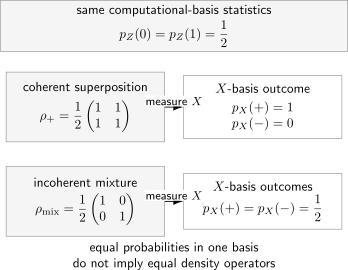
The computational-basis probabilities agree, but the -basis distributions do not. A single basis generally does not determine a quantum state.
Phase-Sensitive Measurements
Section titled “Phase-Sensitive Measurements”To probe coherence, use a basis that recombines and . Define
For
the Born rule gives
The diagonal population drops out because this equatorial measurement weights both computational-basis alternatives equally. The outcome imbalance is
which directly probes one quadrature of the coherence.
For the pure phase state
the off-diagonal element is , so
Choosing gives a definite plus outcome. For the equal incoherent mixture, and both outcomes remain for every .
Where the Interference Term Comes From
Section titled “Where the Interference Term Comes From”Let a detector outcome correspond to a vector . Set
For the pure superposition, the amplitude is
and its probability is
The last line is the interference term. It depends on relative phases among the preparation amplitudes and the measurement overlaps.
For the matched mixture,
There is no cross term because the preparation probabilities are averaged after separate alternatives are prepared. In a coherent state, amplitudes add before the modulus is squared; in an incoherent mixture, probabilities are averaged.
Relative Phase, Not Global Phase
Section titled “Relative Phase, Not Global Phase”Multiplying the whole vector by a global phase changes no density operator:
Changing only the relative phase does change the state. For the equal superposition,
All values of give equal -basis probabilities, but they point in different equatorial directions on the Bloch sphere and are distinguished by suitable values of . Relative phase is physical because it changes interference; global phase is not.
The canonical state-vector treatment is Superposition and Relative Phase.
Basis Dependence Without Contradiction
Section titled “Basis Dependence Without Contradiction”The plus state is coherent in the computational basis but diagonal in the basis:
This does not turn it into a mixed state. Its eigenvalues remain and its purity remains one.
Conversely, the unequal mixture
is diagonal in the basis but generally has off-diagonal entries in the basis. It remains mixed because basis changes do not alter its eigenvalues.
Three statements must be kept separate:
- Pure or mixed is a basis-independent property of the spectrum.
- Coherent or incoherent is relative to a chosen basis or preferred set of states.
- Prepared by classical randomization concerns a procedure and any associated side information.
A physical problem supplies the reference basis through paths, energy levels, spin components, a control Hamiltonian, a measurement apparatus, or an environmental pointer basis. Modern resource theories of coherence likewise fix a preferred basis or algebra before defining incoherent states and operations.
Partial Coherence and Dephasing
Section titled “Partial Coherence and Dephasing”The distinction is not all-or-nothing in realistic experiments. Starting from
a phase-damping process may produce
The populations remain fixed while the coherence magnitude is reduced by . A phase-sensitive outcome becomes
The fully dephasing channel in the computational basis is
This unconditioned channel removes off-diagonal terms without selecting one measurement outcome. It should not be confused with a conditioned projective update, which produces a state associated with a recorded result.
What the Density Operator Does Not Reveal
Section titled “What the Density Operator Does Not Reveal”The same mixed density operator can arise in physically different ways. The maximally mixed qubit state
may result from:
- randomly preparing or and losing the classical label;
- randomly preparing or and losing that label;
- tracing one qubit out of a Bell state;
- noise or uncontrolled interaction with an environment.
No measurement on the qubit alone distinguishes these histories, because all local probabilities are determined by the same . The differences reside in external records and correlations. Access to a preparation label, entangled partner, or environment can distinguish joint descriptions that share the same local density operator.
The older terms proper mixture and improper mixture are sometimes used for classical randomization and reduced states, respectively. The terminology can obscure the operational point: locally, equal density operators are indistinguishable; globally, their extensions may differ. Ensembles and Preparation Procedures and Purification Overview develop these two sides.
Decoherence Moves Coherence into Correlations
Section titled “Decoherence Moves Coherence into Correlations”Suppose a system initially in
interacts with an environment initially in . A unitary interaction may produce
Tracing out the environment gives
The environmental overlap
acts as the dephasing factor. If the two environmental records become nearly orthogonal, , then local interference becomes small. Yet the global state may remain pure. Coherence has become inaccessible to system-only measurements because it is encoded in system–environment correlations.
Decoherence explains the suppression of interference in a selected basis; by itself it is not a unique interpretation of measurement outcomes and does not convert the global unitary state into a classical ensemble. See Decoherence Preview.
Tomography and Coherence Witnesses
Section titled “Tomography and Coherence Witnesses”For
the Pauli expectation values are
Together they reconstruct the state:
A measurement alone determines only and cannot decide whether vanishes. An measurement probes the real part of , and a measurement probes its imaginary part. Full qubit tomography requires enough incompatible measurement settings to determine all three Bloch components.
One nonzero phase-sensitive expectation value witnesses coherence in the chosen basis, but a zero value of alone does not prove incoherence: the coherence may be purely imaginary and visible in .
Plus State vs Equal Mixture
Section titled “Plus State vs Equal Mixture”For the plus state,
while for the equal mixture,
Their basis-independent diagnostics also differ:
On the Bloch Sphere, lies on the surface at , while lies at the center. The two states agree only in their -basis outcome distribution.
Practical Workflow
Section titled “Practical Workflow”When comparing a proposed superposition with a mixture:
- State the reference basis.
- Convert every preparation to a density operator.
- Compare the full operators, not only their diagonals.
- Check purity or eigenvalues for the basis-independent pure–mixed distinction.
- Identify the off-diagonal terms in the chosen basis.
- Choose a measurement whose projectors contain the relevant superpositions.
- Calculate probabilities with the Born rule.
- Ask whether external labels or correlations are accessible.
- If decoherence is involved, identify the environmental overlap or channel that suppresses coherence.
If two preparations yield the same density operator, no system-only experiment can distinguish them. If the operators differ, some measurement distinguishes them in principle, even if a convenient measurement must be found.
Common Mistakes
Section titled “Common Mistakes”- Calling any linear combination a statistical mixture.
- Saying a superposition means the system possesses two incompatible classical properties simultaneously.
- Comparing only diagonal probabilities in one basis.
- Treating off-diagonal entries as basis-independent.
- Assuming every state with off-diagonal entries is pure.
- Assuming every diagonal matrix reveals a unique classical preparation.
- Forgetting that a purely imaginary coherence is invisible to an measurement but visible to .
- Adding probabilities where coherent amplitudes should be added.
- Treating dephasing as a conditioned measurement outcome.
- Inferring a unique physical history from a reduced density operator.
- Claiming decoherence destroys global coherence rather than redistributing it into correlations.
- Confusing a global phase with a relative phase.
Cross-Links
Section titled “Cross-Links”- Superposition and Relative Phase
- Density Operators
- Pure vs Mixed States
- Ensembles and Preparation Procedures
- Trace Rule for Expectation Values
- Bloch Sphere
- Reduced Density Matrices
- Purification Overview
- Entropy Overview
- Born Rule
- Expectation Values
- Decoherence Preview
- Classical Correlation vs Entanglement
References
Section titled “References”- P. A. M. Dirac, The Principles of Quantum Mechanics, 4th edition, Oxford University Press, 1958, Chapters 1–2.
- L. E. Ballentine, Quantum Mechanics: A Modern Development, 2nd edition, World Scientific, 2014, Chapters 2–3.
- A. Peres, Quantum Theory: Concepts and Methods, Kluwer Academic Publishers, 1995, Chapters 3–4. Springer DOI.
- M. A. Nielsen and I. L. Chuang, Quantum Computation and Quantum Information, 10th anniversary edition, Cambridge University Press, 2010, Chapter 2. Cambridge DOI.
- T. Baumgratz, M. Cramer, and M. B. Plenio, “Quantifying coherence,” Physical Review Letters 113, 140401 (2014). DOI: 10.1103/PhysRevLett.113.140401.
- M. Schlosshauer, “Decoherence, the measurement problem, and interpretations of quantum mechanics,” Reviews of Modern Physics 76, 1267–1305 (2005). DOI: 10.1103/RevModPhys.76.1267.
Exercises
Section titled “Exercises”- For
find the density matrix and the expectation values of , , and .
Solution
The projector is
Here and . Therefore
The state is the eigenstate of . Its coherence is purely imaginary in the computational basis, so an measurement alone would miss it.
- Derive the probabilities and for a general qubit state with off-diagonal entry .
Solution
Using
one obtains
The orthogonal outcome has the opposite sign:
Their sum is one, and their difference probes a phase-selected quadrature of .
- Prove the positivity bound for
When is the bound saturated?
Solution
A Hermitian matrix with nonnegative diagonal entries is positive semidefinite exactly when its determinant is nonnegative. Here
Thus positivity requires
The determinant vanishes when equality holds. Since , a zero determinant gives eigenvalues and , so the state is pure. A strict inequality gives two positive eigenvalues and a mixed state.
- Show explicitly why the pure superposition and its matched mixture differ by an interference term for an arbitrary detector outcome .
Solution
Set
For ,
For the matched mixture,
The difference is exactly the cross term. It vanishes for measurements that do not recombine the alternatives or for states with no coherence between them.
- Write and in the basis. What does the result show about basis dependence?
Solution
In the ordered basis ,
The maximally mixed state is invariant under every basis change:
The plus state has no off-diagonal entries in its eigenbasis, but it remains pure. It has off-diagonal coherence in the basis. The maximally mixed state is incoherent in every basis. Matrix diagonality is basis relative, while purity is not.
- Verify that
is trace preserving and removes computational-basis coherence.
Solution
The Kraus operators are and . They satisfy
so the map is trace preserving. For
direct multiplication gives
The channel preserves populations and discards the off-diagonal terms. It is an unconditioned dephasing operation, not the selection of either outcome.
- Derive the reduced system state after the interaction
What happens when ?
Solution
Expanding the joint projector and tracing the environment yields
If , the environmental records are orthogonal and the reduced state becomes
Local interference is absent. The joint state can nevertheless remain a pure entangled superposition, so the coherence survives in correlations unavailable to system-only measurements.
- A laboratory produces either by randomly preparing or , or by giving you one qubit of a Bell pair. Can any qubit-only measurement distinguish the methods? What additional access could distinguish them?
Solution
No. Every qubit-only POVM element has probability
for both methods. Equal reduced density operators imply equal statistics for every local measurement.
The extensions differ. In the random-preparation method, a retained classical record may reveal whether or was sent. In the Bell-pair method, access to the partner qubit reveals entanglement and nonclassical joint correlations. The local state alone does not determine which extension is present.