Wigner’s Theorem
Wigner’s theorem turns a symmetry statement about physical pure states into an operator statement on Hilbert space:
Let be a complex Hilbert space with . If
is a bijection satisfying
for every pair of rays, then there is either a unitary operator or an antiunitary operator such that
The implementing operator is unique up to multiplication by one scalar phase. No continuity hypothesis is required for this standard full-preserver formulation. The theorem is kinematic: it classifies pure-state ray symmetries, not Hamiltonians, dynamics, or measurement instruments.
Required background. Physical States as Rays defines projective state space; Transition-Probability Preserving Maps separates the exact hypothesis from nearby preserver theorems.
Helpful background. Transition Probabilities supplies the operational interpretation of squared overlaps.
The theorem’s hypotheses
Section titled “The theorem’s hypotheses”Every clause does work.
| Clause | Why it matters |
|---|---|
| complex Hilbert space | the conclusion distinguishes linear from conjugate-linear lifts |
| dimension at least two | excludes the one-ray triviality of a one-dimensional space |
| entire projective space | the map acts on all pure-state rays under consideration |
| bijection | rules out proper isometric embeddings such as the unilateral shift |
| all transition probabilities preserved | retains the full projective metric, not only orthogonality |
The preserved quantity is
Because it is phase independent, it is defined on rays. Asking instead that the complex inner product itself be preserved would already choose phases and would state a stronger, vector-level condition.
Surjectivity cannot simply be omitted from the standard conclusion. In infinite dimensions, the unilateral shift is a nonsurjective linear isometry and induces a full transition-probability preserving ray embedding, but it is not unitary. There are Wigner-type embedding theorems, but their conclusion must be stated in that language.
Unitary and antiunitary implementations
Section titled “Unitary and antiunitary implementations”A unitary is complex-linear and preserves inner products:
An antiunitary is conjugate-linear and satisfies
Either relation preserves norms and overlap magnitudes, so either operator induces a valid ray symmetry. In a chosen orthonormal basis, every antiunitary can be written as
where is unitary and is componentwise complex conjugation. This factorization depends on the chosen conjugation ; conjugate-linearity does not.
For example, on ,
is antiunitary. It maps to its complex conjugate while leaving the transition probability unchanged.
Uniqueness up to one phase
Section titled “Uniqueness up to one phase”Suppose two unitary operators and induce the same ray map. Then maps every ray to itself:
for each nonzero . Choose linearly independent and . Linearity gives
but preservation of the ray of requires the right side to be a scalar multiple of . Independence forces . Connecting arbitrary vectors through such pairs shows
Hence . The same argument applies to two antiunitary implementations after composing one inverse with the other, which produces a linear unitary. In dimension at least two, one ray transformation cannot have both a unitary and an antiunitary implementation: their relative composition would be a conjugate-linear map fixing every ray, which is incompatible with the rays of for varying complex .
The phase is global for the implementing operator. The theorem does not grant an independently chosen phase for each input ray after the lift is fixed.
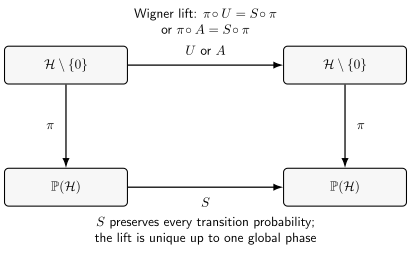
Wigner’s theorem lifts a bijective transition-probability preserver from projective Hilbert space to a unitary or antiunitary map upstairs. The square commutes after projectivization, and any two lifts of the same type differ by one global phase.
Finite-dimensional proof skeleton
Section titled “Finite-dimensional proof skeleton”A transparent proof architecture begins with an orthonormal basis . Because transition probability zero is preserved, the image rays are mutually orthogonal. Choose normalized representatives of those image rays.
For a normalized vector
choose a normalized representative
of . Probabilities with the basis rays give
These equations fix magnitudes but not relative phases. Compare additionally with rays represented by
Their transition probabilities recover the real and imaginary parts of . Consistency across triples of basis directions leaves exactly two global possibilities:
or
The first case is induced by the linear map ; the second by the conjugate-linear map with the same basis action. Norm preservation makes the lift unitary or antiunitary.
This is a proof skeleton, not a complete proof: a full treatment must make the phase choices consistent, handle zero coefficients and dimension two, and show that the linear-versus-conjugate-linear alternative cannot vary between subspaces.
Infinite-dimensional extension boundary
Section titled “Infinite-dimensional extension boundary”In an infinite-dimensional Hilbert space, one applies the finite-dimensional argument coherently on finite-dimensional subspaces generated by basis vectors, then uses completeness to extend the resulting isometry. Surjectivity of the ray map ensures the lift has full range rather than a proper closed isometric image.
Alternative proofs use the fundamental theorem of projective geometry, semilinear maps, or rank-one projector preservers. Each approach must control the allowed field automorphism. Preservation of transition probabilities and the Hilbert topology reduce the alternatives to the identity or complex conjugation, yielding linear or conjugate-linear isometries.
The details are nontrivial enough that an informal statement such as “preserving angles obviously implies unitary” is not a proof, especially in infinite dimensions.
Wigner versus Uhlhorn
Section titled “Wigner versus Uhlhorn”Wigner’s theorem here preserves every transition probability. Uhlhorn’s theorem assumes only orthogonality preservation in both directions, together with bijectivity and normally , and reaches the same unitary-or-antiunitary conclusion.
The dimension-three condition belongs to the orthogonality-only theorem. It should not be imported into the full-preserver Wigner statement. In dimension two, preserving antipodal Bloch-sphere pairs is much weaker than preserving all Bloch-sphere angles.
From a transformation to a symmetry group
Section titled “From a transformation to a symmetry group”For each in a symmetry group , Wigner’s theorem produces a lift defined only up to phase. Even when all lifts are unitary,
may hold with a nontrivial phase multiplier . Associativity forces a cocycle condition, but Wigner’s theorem alone does not show that phases can be chosen to set .
Thus a ray representation generally lifts first to a projective unitary representation. Central extensions and group cohomology determine whether it can be replaced by an ordinary representation. Spin representations of rotations are a central example of this distinction.
If is a continuous group, continuity is additional structure on the map . The identity component admits unitary rather than antiunitary lifts; antiunitary implementations can occur in disconnected components, as with time reversal. Obtaining self-adjoint generators then requires a strongly continuous unitary lift before Stone’s theorem applies.
The kinematic boundary
Section titled “The kinematic boundary”Wigner’s theorem says how a probability-preserving pure-state symmetry is implemented. It does not say that the implementation commutes with a chosen Hamiltonian. A dynamical symmetry additionally requires, for example,
or the appropriate covariance relation when external parameters transform.
It also does not classify affine maps of mixed states, completely positive channels, POVM symmetries, or nonlinear state-update rules. Those objects have their own preserver and covariance theorems.
Superselection introduces another qualification. If the physical pure-state space is a union of sectorwise projective spaces rather than all of , the theorem applies to the declared ray domain only after one specifies whether symmetries preserve or permute sectors.
What the theorem does not establish
Section titled “What the theorem does not establish”- It does not prove that every injective preserver is unitary; surjectivity matters.
- It does not make antiunitary maps complex-linear.
- It does not automatically produce an ordinary group representation.
- It does not imply Hamiltonian invariance or conservation laws.
- It does not apply unchanged to mixed-state channels or measurement instruments.
- It does not replace a sector analysis when superselection is present.
Common pitfalls
Section titled “Common pitfalls”Adding continuity as though it were essential to the isolated theorem. The standard bijective full-preserver formulation needs no continuity hypothesis. Group continuity is a separate later question.
Forgetting the antiunitary branch. Complex conjugation preserves overlap magnitudes and cannot be represented by a complex-linear unitary.
Omitting surjectivity. A proper isometric embedding preserves transition probabilities but need not be unitary.
Confusing projective and ordinary representations. Choosing Wigner lifts for each group element can leave a phase cocycle.
Concluding dynamical symmetry. Probability preservation is kinematic; commutation or covariance with is additional.
Exercises
Section titled “Exercises”1. Verify both implementation types
Section titled “1. Verify both implementation types”Show directly that a unitary and an antiunitary operator each induce a transition-probability preserving ray map.
Solution
For a unitary, the inner product itself and both norms are preserved. For an antiunitary, the inner product is complex conjugated and the norms are preserved. In either case the squared magnitude divided by the norm product is unchanged.
2. Phase uniqueness
Section titled “2. Phase uniqueness”Let a unitary fix every ray. Prove .
Solution
For each nonzero , write . For linearly independent , linearity and invariance of the ray of require
so all three scalars agree. This connects every pair of nonzero vectors. Unitarity gives .
3. The qubit form
Section titled “3. The qubit form”For qubit rays, use to explain why a Wigner symmetry induces an orthogonal transformation of the Bloch sphere.
Solution
Preservation of every transition probability is preservation of every dot product. A bijection of the unit sphere preserving dot products extends to an orthogonal linear map of . Determinant transformations lift unitarily; determinant transformations require an antiunitary factor.
4. Kinematic is not dynamical
Section titled “4. Kinematic is not dynamical”Give a unitary transition-probability preserver that is not a symmetry of on .
Solution
The Pauli matrix is unitary and therefore preserves all transition probabilities. But
It is a Wigner transformation but not a dynamical symmetry of this fixed Hamiltonian.
5. Why one-dimensional space is trivial
Section titled “5. Why one-dimensional space is trivial”Explain why the theorem excludes from its nontrivial statement.
Solution
A one-dimensional Hilbert space has exactly one ray, so its projective space has only the identity map and every transition probability equals one. The ray data cannot distinguish linear from conjugate-linear implementation; the classification has no substantive content.
References
Section titled “References”- V. Bargmann, “Note on Wigner’s theorem on symmetry operations,” Journal of Mathematical Physics 5, 862–868, 1964, doi:10.1063/1.1704188.
- N. P. Landsman, Foundations of Quantum Theory: From Classical Concepts to Operator Algebras, Springer, 2017.
- M. Pankov, Wigner-Type Theorems for Hilbert Grassmannians, Cambridge University Press, 2020.
- E. P. Wigner, Group Theory and Its Application to the Quantum Mechanics of Atomic Spectra, Academic Press, 1959.