Weyl Form of the Canonical Commutation Relations
The formal canonical commutator
involves unbounded operators, so its two products may not even share a common domain. The Weyl form of the canonical commutation relations replaces and by their bounded unitary exponentials. With the conventions
the Weyl relation is
The phase is central, dimensionless, and fixed by the sign convention above. The relation is an identity between bounded operators on all of . Recovering and from it still requires strong continuity and Stone’s theorem.
Required background. Self-Adjoint Operators, Strongly Continuous Unitary Groups, and the Unbounded Spectral Theorem supply the analytic prerequisites. Fourier translations and modulations are assumed at an introductory level.
Helpful background. State Vectors supplies the Hilbert-space setting for the unitary operators used below.
Exponentiating a canonical pair
Section titled “Exponentiating a canonical pair”If and are self-adjoint, spectral calculus defines and as unitary operators for every real parameter. Both families obey additive group laws:
They are strongly continuous. The Weyl phase says that the two group actions fail to commute by a scalar:
Because the defect is a multiple of the identity, it commutes with every operator. This central phase is the exponentiated remnant of the canonical commutator.
The dimensions also audit the formula. Here has units of position and has units of momentum, so is dimensionless. If dimensionless group parameters are preferred, they must be introduced consistently rather than silently deleting .
Translation and modulation fix the sign
Section titled “Translation and modulation fix the sign”On , take
Then
This direct calculation is the convention anchor for the entire CCR spine. Changing the definition of , the sign of , or the order of the two unitaries changes the displayed phase. Such forms are equivalent only after their conventions are translated.
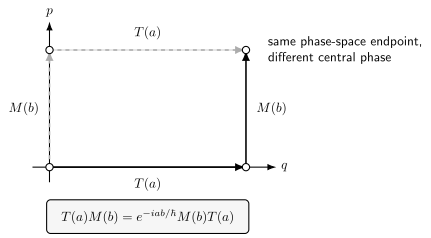
Translation and modulation reach the same phase-space endpoint in either order, but the two operator products differ by the central phase . The oriented rectangle records the sign convention used on this page.
The next page develops this realization as the Schrödinger Representation, including domains, regularity, and irreducibility. The calculation here fixes the abstract relation rather than serving as another coordinate-representation tutorial.
Regular Weyl systems
Section titled “Regular Weyl systems”A Weyl pair is a pair of unitary representations and satisfying the displayed relation. It is regular when the maps
are strongly continuous. Regularity is a topological hypothesis, not a consequence of the algebraic Weyl relation alone.
For a regular pair, Stone’s theorem gives unique self-adjoint generators and through
Their domains are the vectors on which the corresponding strong derivatives exist. A nonregular representation can satisfy algebraic exponentiated relations while one or both one-parameter families fail to have self-adjoint infinitesimal generators.
Regularity must also be kept separate from irreducibility. A Weyl system is irreducible when the only closed subspaces invariant under every and are and . Equivalently, its bounded commutant contains only scalar multiples of . Direct sums of regular Weyl systems are still regular but are reducible.
Symmetric phase-space notation
Section titled “Symmetric phase-space notation”For canonical pairs, write and define
With
the Weyl multiplication law becomes
The antisymmetric bilinear form is the canonical symplectic form in the sign convention explicitly declared above. Swapping the definition of changes the sign of the phase; it does not change the represented central extension.
The scalar factor is a multiplier, so is a projective unitary representation of the additive phase-space group. Adding a central coordinate turns it into an ordinary unitary representation of the Heisenberg group. The nonzero central character is fixed by .
Recovering the infinitesimal commutator
Section titled “Recovering the infinitesimal commutator”Suppose a dense subspace is invariant under the relevant operators and lies in the domains of and . Differentiating the Weyl relation first in and then in at the identity yields
The domain statement is part of the conclusion. The expression is meaningful only when . Schwartz space is the standard common invariant core in the Schrödinger representation.
The reverse implication is not automatic. An identity on some dense domain need not imply that and are self-adjoint there, that the domain contains analytic vectors, or that the infinitesimal relation integrates to the global Weyl relation. Extra hypotheses are required.
Why the bounded form is stronger and safer
Section titled “Why the bounded form is stronger and safer”The Weyl relations avoid three immediate defects of the raw commutator:
- every and is bounded and everywhere defined;
- their products have no domain ambiguity;
- global group composition and the central phase are stated exactly.
But “safer” does not mean assumption free. One must still ask whether the families are strongly continuous, whether the representation is irreducible, how many canonical pairs are present, and which central character is fixed. These are precisely the hypotheses used by the Stone–von Neumann theorem.
The Weyl form also exposes two impossibility results. In finite-dimensional Hilbert space,
for matrices, whereas . Thus exact nonzero canonical commutation relations cannot be represented by finite matrices. More generally, bounded operators cannot satisfy in a unital Banach algebra; this is Wintner’s obstruction. Canonical generators are necessarily unbounded in regular representations.
Representations outside the uniqueness theorem
Section titled “Representations outside the uniqueness theorem”The Weyl relations themselves admit cases beyond ordinary Schrödinger quantum mechanics.
Nonregular representations. Strong continuity can fail, so position or momentum may not exist as a self-adjoint generator. Such representations are not covered by Stone–von Neumann uniqueness.
Reducible representations. A direct sum of Schrödinger representations satisfies the same Weyl relation and is regular, but it has nontrivial invariant sectors. Its multiplicity is not removed until irreducibility is imposed.
Infinitely many degrees of freedom. For fields and thermodynamic limits, regular irreducible representations can be unitarily inequivalent. The finite-dimensional phase-space hypothesis is essential.
Zero central character. If the phase is trivial, the two subgroups commute and the representation is not the nonzero- canonical quantum system.
Compact configuration spaces. Angle-like variables require their own global group and topology; one cannot transplant the Euclidean Weyl system without modification.
Scope relative to other CCR pages
Section titled “Scope relative to other CCR pages”This page is self-contained for the bounded Weyl system, regularity, central character, and the precise bridge back to unbounded generators. Use Canonical Commutation Relations for physical calculations, the formula card for rapid convention lookup, and Heisenberg Group for geometry and representation language.
Common pitfalls
Section titled “Common pitfalls”Quoting a phase without definitions. The sign follows from the declared , , and operator order. Audit those definitions before comparing two sources.
Calling a representation regular because it is irreducible. Regularity is strong continuity; irreducibility is the absence of invariant subspaces. Neither condition implies the other.
Differentiating bounded identities without a common domain. Stone gives generators individually. The commutator additionally needs vectors in .
Assuming the raw commutator exponentiates. A formal dense-domain identity does not by itself establish the global Weyl relation.
Applying finite-degree uniqueness to a field. Infinite systems can have unitarily inequivalent regular representations.
Exercises
Section titled “Exercises”1. Verify the convention anchor
Section titled “1. Verify the convention anchor”Using the displayed translation and modulation formulas on , verify the Weyl relation and its adjoint form.
Solution
Direct substitution gives
Taking adjoints reverses the order and conjugates the phase:
which is the original relation with replaced by and reordered.
2. The finite-dimensional trace obstruction
Section titled “2. The finite-dimensional trace obstruction”Show that no finite matrices and can satisfy when .
Solution
Cyclicity gives
But
The assumed identity is therefore impossible.
3. Derive the symplectic multiplier
Section titled “3. Derive the symplectic multiplier”Starting from the one-dimensional Weyl relation, compute for the symmetric definition on this page.
Solution
Move through using . Combining this phase with the two half-phases in the definitions yields
The vector formula follows by replacing products with dot products.
4. Differentiate on a common core
Section titled “4. Differentiate on a common core”Assume is a common analytic vector for and . Differentiate the Weyl relation to recover the sign of .
Solution
Differentiate with respect to at :
Multiply by and then differentiate with respect to at zero, using . The result is
5. Regular but reducible
Section titled “5. Regular but reducible”Let be a regular irreducible Weyl system on . Show that is regular and satisfies the same Weyl relation but is reducible.
Solution
The relation and strong continuity hold componentwise. The proper closed subspace is invariant under every , so the direct-sum representation is reducible.
References
Section titled “References”- G. B. Folland, Harmonic Analysis in Phase Space, Princeton University Press, 1989.
- B. C. Hall, Quantum Theory for Mathematicians, Springer, 2013.
- H. Weyl, “Quantenmechanik und Gruppentheorie,” Zeitschrift für Physik 46, 1–46, 1927, doi:10.1007/BF02055756.
- A. Wintner, “The unboundedness of quantum-mechanical matrices,” Physical Review 71, 738, 1947, doi:10.1103/PhysRev.71.738.2.