von Neumann Measurement Model
The von Neumann measurement model shows how the formal update rules of ideal measurement can arise from ordinary unitary dynamics on a larger system: the quantum system plus an apparatus pointer. The essential step is not a mysterious interruption of Schrödinger evolution. It is the creation of correlations between system alternatives and macroscopically distinguishable pointer states.
The model is idealized, but it is the standard reference point for understanding projective measurement, backaction, pointer states, decoherence, and the distinction between selective and nonselective updates.
Discrete Correlation Model
Section titled “Discrete Correlation Model”Let be orthonormal eigenstates of the system observable being measured, and let be the ready state of the apparatus pointer. An ideal premeasurement unitary satisfies
where the pointer states are distinguishable apparatus states associated with different outcomes.
By linearity, an input superposition evolves as
The result is not a product state. It is an entangled system-apparatus state, unless only one coefficient is nonzero.
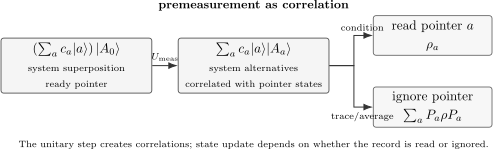
The von Neumann premeasurement step correlates system alternatives with pointer states . Reading the pointer gives a selective state; ignoring or tracing over the pointer gives the nonselective measurement channel.
Recovering Outcome Probabilities
Section titled “Recovering Outcome Probabilities”If the pointer states are orthonormal or effectively distinguishable,
then measuring the pointer in the basis gives outcome with probability
For a general density operator , the same ideal measurement is represented by projectors
and the probability is
The apparatus model therefore reproduces the projective Born rule when the pointer states faithfully distinguish the system alternatives.
Selective Update from Reading the Pointer
Section titled “Selective Update from Reading the Pointer”Suppose the pointer is read and outcome is obtained. Conditioning the joint state on the pointer result gives the system state
This is the selective projective update. In the premeasurement picture, it is not applied before the apparatus interaction. It is the state assignment after the pointer record is known.
The sequence is:
system interacts with pointer -> pointer outcome becomes available -> condition on the observed pointer outcome -> use the corresponding selective stateThis ordering matters. State update is tied to a physical record and to the information used for later predictions.
Nonselective Update from Ignoring the Pointer
Section titled “Nonselective Update from Ignoring the Pointer”If the pointer outcome is not read or not retained, the system state is obtained by tracing over the pointer. Starting from a pure input
the reduced system state is
If the pointer states are orthogonal, this becomes
For a general density operator, the unread ideal measurement channel is
Thus the nonselective update is reduced dynamics: the total system-apparatus state may evolve unitarily, while the system alone loses coherence in the measured basis.
Imperfect Pointers and Unsharp Measurements
Section titled “Imperfect Pointers and Unsharp Measurements”The ideal projective limit requires pointer states that are reliably distinguishable. If the pointer states have nonzero overlaps,
then the reduced state retains some coherence between and :
The measurement is then not fully projective. It may be better described as an unsharp measurement or a POVM, depending on how the pointer is read out. This is the operational meaning of finite resolution: if the apparatus cannot reliably separate alternatives, it cannot implement a sharp PVM.
Continuous Pointer Model
Section titled “Continuous Pointer Model”The textbook von Neumann model often uses a continuous pointer coordinate with conjugate momentum satisfying
Let the measured system observable be
During a short measurement interval, the interaction Hamiltonian is idealized as
If
then the interaction unitary is
For an eigenstate and pointer wavefunction , this unitary shifts the pointer packet:
A superposition of eigenstates becomes a superposition of differently shifted pointer packets. If those packets are well separated compared with their widths, the measurement is approximately projective. If they strongly overlap, the measurement is weak or unsharp.
Decoherence of Pointer States
Section titled “Decoherence of Pointer States”Macroscopic pointers are not isolated. They interact with many environmental degrees of freedom. A more realistic correlation chain is
After tracing over the environment, interference between different pointer alternatives is multiplied by environmental overlaps:
For macroscopic records, these overlaps are often extremely small on practical time scales. Decoherence therefore explains why pointer alternatives behave as stable classical records for local observers.
This does not, by itself, settle every interpretation question about definite outcomes. It explains the suppression of interference in reduced descriptions and the robustness of pointer records.
What the Model Explains
Section titled “What the Model Explains”The von Neumann model explains several structural facts:
- why apparatus degrees of freedom belong in a measurement model;
- how outcome probabilities can be read from pointer correlations;
- why conditioning on a pointer record gives a selective update;
- why ignoring the pointer gives a nonselective channel;
- why measurement can disturb the system even when the total dynamics is unitary;
- why finite pointer resolution leads naturally toward POVMs;
- why decoherence is relevant to the classical appearance of measurement records.
It also marks boundaries. The model is not a complete detector engineering theory, not a universal proof that all measurements are projective, and not by itself a resolution of the measurement problem.
Example: Stern–Gerlach as a Pointer Model
Section titled “Example: Stern–Gerlach as a Pointer Model”In a Stern–Gerlach measurement of spin along , the spin degree of freedom becomes correlated with spatial wavepackets. Schematically,
The spatial packet is the pointer. If and are well separated at the detection screen, reading the spot position approximately measures . If the packets overlap substantially, the measurement is not an ideal sharp spin measurement.
Common Mistakes
Section titled “Common Mistakes”- Thinking the model says collapse occurs before the apparatus interaction.
- Forgetting that the premeasurement state is generally entangled, not one selected branch.
- Treating pointer states as perfectly distinguishable without checking their overlap.
- Ignoring the nonselective state when the pointer record is unavailable.
- Treating decoherence as identical to selecting a single outcome.
- Calling every system-apparatus coupling a projective measurement.
- Forgetting that real detectors may be destructive, inefficient, noisy, or coarse grained.
Cross-Links
Section titled “Cross-Links”- Projective Measurements
- Selective and Nonselective Measurements
- State Update Rules
- Common Misconceptions
- Closed vs Open Quantum Systems
- Decoherence Preview
- Partial Trace
- What the Postulates Do Not Say
References
Section titled “References”- J. von Neumann, Mathematical Foundations of Quantum Mechanics, Princeton University Press, 1955.
- E. P. Wigner, “The Problem of Measurement,” American Journal of Physics 31, 6–15, 1963.
- A. Peres, Quantum Theory: Concepts and Methods, Kluwer, 1995.
- P. Busch, P. J. Lahti, and P. Mittelstaedt, The Quantum Theory of Measurement, Springer, 1996.
- W. H. Zurek, “Decoherence, einselection, and the quantum origins of the classical,” Reviews of Modern Physics 75, 715–775, 2003.
- M. Schlosshauer, Decoherence and the Quantum-to-Classical Transition, Springer, 2007.
- H. M. Wiseman and G. J. Milburn, Quantum Measurement and Control, Cambridge University Press, 2010.
Exercises
Section titled “Exercises”- Suppose
and the apparatus unitary maps to and to . Write the final system-apparatus state.
Solution
By linearity,
Unless one coefficient vanishes or the pointer states are identical, this is an entangled state of system and apparatus.
- For the state in Exercise 1, compute the reduced system density matrix when .
Solution
The reduced state is
If , the system is fully dephased in the basis. If , tracing over the apparatus has not reduced the system coherence.
- In the continuous pointer model, why does large separation between pointer packets make the measurement closer to projective?
Solution
Large separation makes the shifted pointer wavefunctions nearly orthogonal. Orthogonal pointer states can be reliably distinguished and suppress off-diagonal reduced-system terms after the pointer is ignored. Overlapping pointer states give ambiguous readout and leave residual coherence, so the measurement is weaker or unsharp.
- Does the unitary premeasurement step by itself produce a selected outcome?
Solution
No. The premeasurement unitary produces a correlated superposition . A selective state is assigned only after conditioning on a pointer record. If the pointer is ignored, the system is described by a nonselective reduced state. Interpreting how a single definite outcome is selected is a foundations question beyond the unitary correlation step alone.