Spinor Algebra
A calculation can satisfy the Clifford algebra and still use an incorrect charge-conjugation matrix or negative-frequency momentum label. This executable notebook tests those additional contracts in the Dirac, chiral, and a genuinely complex unitary basis. It exports individual residuals, includes deliberately wrong constructions, and supplies selected exact rational-complex fixtures alongside floating-point checks. The general algebra is developed at Gamma Matrices; this page concerns its numerical verification.
Required background. Gamma Matrices supplies the identities; Gamma-Matrix Conventions fixes their signs; Free Dirac Spinors supplies the on-shell normalization and labels. Helpful background. Bilinear Covariants explains the polarization checks, and Symmetry Conventions explains the discrete maps.
Run the investigation. The program and retained results below support the stated experiment. Follow Running an Experiment for environment and output-directory guidance. The recorded evidence applies to its stated parameters and environment.
Clifford matrices and on-shell test columns
Section titled “Clifford matrices and on-shell test columns”Use , , and . The program constructs
The adjoint is in each transformed basis. Massive columns have , , and Hilbert norms . The independent checks include
Both labels are future directed, but the waves are and . Consequently the latter has canonical momentum . At a fixed momentum of the Hamiltonian, the orthogonality test is . Replacing the second label by tests a different statement, which generally fails.
The program also checks energy and chirality projectors, traces, all sixteen bilinear components, polarized outer products, the on-shell Ward identity, and the massive Gordon identity. Selected massless nonzero-momentum fixtures test identities that remain defined; they skip the rest-spin polarization and Gordon formulas containing . The zero-energy massless apex is rejected.
Similarity and congruence are different tests
Section titled “Similarity and congruence are different tests”For a constant unitary component change , linear matrices transform by similarity:
An antilinear map contains component conjugation . Applying it to instead gives
The initial Dirac-basis choices are and . Their squares as antilinear maps involve and , rather than and . These phases agree with the linked symmetry ledger. Coordinate reflections must still accompany the component maps.
A real change between Dirac and chiral bases does not adequately expose the distinction between and . The additional complex basis makes the wrong rule fail. In the retained default run, both and a blind reconstruction differ from the correctly transformed by a maximum-entry gap of approximately . The Clifford tests alone would not detect either error.
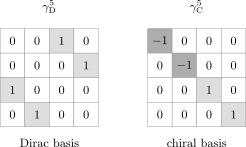
The two familiar representations of , read from the retained matrix CSV. Displayed entries are rounded to integers; their numerical deviations are below . The complex third basis is included in the download and verification, but is not represented by this real-entry diagram.
These are constant unitary component changes. Lorentz boosts of Dirac components are a different, generally nonunitary representation. Likewise, the checked classical product with spacetime inversion is a linear map of commuting solution columns in the chosen phase convention. It neither proves the quantum-field CPT theorem nor computes its antiunitary operator square. Commuting arrays also do not supply the fermionic reordering signs of field bilinears.
Run and inspect the identity ledger
Section titled “Run and inspect the identity ledger”Download the standalone Python program. The retained run used Python 3.12.14 and NumPy 2.3.5; no plotting package is required. From a directory containing the program, run:
python -m pip install numpy==2.3.5python spinor-algebra.py --output-dir spinor-resultsChoose a new output directory: existing outputs are protected from replacement. The default massive fixture has , twelve seeded samples in addition to fixed cases, seed 20261002, and a largest designated momentum-to-mass ratio of 1000. The complete report records the actual parameters, environment, tolerances, and hashes. To probe cancellation more strongly:
python spinor-algebra.py --max-ratio 1000000 --output-dir spinor-large-ratioThe default run passes 7,050 checks, including 32 selected exact assertions implemented with rational complex arithmetic. This is finite evidence for the implementation, not a proof for all momenta or representations.
| Download | What to inspect |
|---|---|
| Matrices CSV | Real and imaginary entries, with basis, matrix, row, and column labels |
| Spinors CSV | On-shell columns and their kinematic labels |
| Bilinears CSV | Covariants for the declared spin and basis fixtures |
| Checks CSV | Every absolute error, comparison scale, scaled error, tolerance, and verdict |
| JSON report | Parameters, per-identity maxima, negative controls, limitations, and file hashes |
The public JSON replaces local output locations with download paths; numerical results and CSV bytes retain the executed run’s values. For the figure, put the matrices CSV beside the TikZ source, then use a TeX installation with PGFPlots 1.18:
latex notebook-spinor-bases.texdvisvgm --no-fonts notebook-spinor-bases.dviThe source selects the default Dirac and chiral records. If modifying the CSV layout, update that selection before reproducing the diagram.
Absolute errors and small invariants
Section titled “Absolute errors and small invariants”Each floating check exports an error and an explicitly chosen scale. A small scaled error means small error relative to that scale. It does not necessarily mean small relative error in the final invariant. For example, can subtract terms of size when . The normalization check uses a scale , which makes the loss of digits in something the reader must inspect separately.
In the default ledger, the largest absolute Gordon-identity error is approximately , with a comparison scale and scaled error . These three numbers describe the same row. Reporting just the first as an unexplained failure, or just the last as sixteen-digit accuracy in every small quantity, would both be misleading.
The exact fixtures avoid floating cancellation for selected rational inputs and use a separate arithmetic implementation. The floating suite then explores directions, spin states, bases, and larger momentum ratios. Neither substitutes for an algebraic derivation, and increasing the sample count cannot repair a wrong convention.
Exercises
Section titled “Exercises”A Clifford-preserving mistake. Keep the correct but transform by similarity. Explain which checks can still pass and why the complex-basis control is useful.
Solution
Similarity of the gamma matrices preserves their anticommutator identically, independently of the separately supplied . An antilinear map, however, must conjugate the inverse component transformation. This produces on the right of . For real it equals , masking the mistake; a generic complex unitary separates the two constructions.
Negative-frequency labels. Explain why the program’s nonzero control does not contradict orthogonality of a Hermitian free Hamiltonian’s positive- and negative-energy eigenspaces.
Solution
The columns as labeled belong to Hamiltonians with opposite canonical momenta: belongs to , whereas belongs to with eigenvalue . The eigenspace orthogonality statement at fixed compares with .
Cancellation audit. For the
u covariant normalization rows, compute
both the exported scaled residual and the
absolute error divided by . Explain
their ratio and why a massless run would
need a different question.
Solution
The two denominators are and , so the latter relative error is times the exported scaled error. At the expected covariant norm vanishes: relative error with denominator is undefined. Absolute residuals and a nonzero scale such as remain meaningful away from the excluded apex.
References
Section titled “References”- Bjorken, James D., and Sidney D. Drell. Relativistic Quantum Mechanics. McGraw–Hill, 1964.
- Dreiner, Herbi K., Howard E. Haber, and Stephen P. Martin. “Two-component spinor techniques and Feynman rules for quantum field theory and supersymmetry.” Physics Reports 494, 1–196 (2010). doi:10.1016/j.physrep.2010.05.002. See also the corrected arXiv version, especially the four-component convention comparisons.