Dirac Wave Packets
A free Dirac packet can contain positive- and negative-energy components even when only one fixed spinor component is initially populated. This calculation separates those notions with spectral projectors, then compares a coherent packet with the statistical mixture obtained by removing coherence between its energy sectors. It measures current oscillations, packet dephasing, and the limits of position moments in a periodic box. The operator derivation remains at Zitterbewegung.
Required background. Zitterbewegung supplies the independent velocity/displacement benchmark; The Dirac Hamiltonian supplies energy projectors; Dirac Current fixes density and flux. Helpful background. Negative-Energy Solutions explains the distinction from field-theoretic antiparticle counting.
Run the investigation. Download the complete package, extract it, and run python run.py --output-dir results in the environment described by Running an Experiment. The package verification report records the tested source, actual execution date, environment and scientific checks.
Exact evolution in a fixed-spin Dirac sector
Section titled “Exact evolution in a fixed-spin Dirac sector”Use , mass , and free motion along . In the Dirac basis, the two-component column used by the program embeds as
This is an invariant spin-up sector for one-dimensional free motion. It is not an arbitrary three-dimensional Dirac spinor. Its matrices and dispersion are
On each retained Fourier mode,
The unitary FFT acts on the spatial index, leaving the two spinor components intact. With spacing , the norm is . Evolution is exact for the retained modes; there is no time-integration step.
The density and longitudinal current are
Both energy sectors have positive Hilbert norm. Their populations are conserved by this free Hamiltonian. A negative-sector weight is not a pair-production probability.
Compare components, sectors, and mixtures
Section titled “Compare components, sectors, and mixtures”Download dirac-wave-packets.py. It is a standalone, import-safe NumPy program with no network access or repository-helper dependency. The retained environment is Python 3.12.14 and NumPy 2.3.5. In a Python 3.12 virtual environment:
python -m pip install "numpy==2.3.5"python dirac-wave-packets.py --output-dir dirac-runChoose a new directory; existing outputs
are refused. The default execution reports
"passed": true and 157 scientific
checks. Use --help for profile parameters
and destination overrides.
The default grid has , , and . The unprojected Gaussian has center , intensity width , and carrier momentum . Each preparation is normalized to unit total norm:
| Preparation | Construction | Default negative-sector norm |
|---|---|---|
positive_only | Apply and normalize | , numerical zero |
negative_only | Apply and normalize | |
upper_component_only | Populate the upper fixed component | |
coherent_mixed | Prepare a coherent spinor with both energy sectors |
The upper-component example directly shows why deleting the lower component is not the same as projecting onto positive energy. The projectors depend on momentum.
For any normalized preparation, let . The comparison mixture is
Its trace is one because the original sector weights are retained. Independently normalizing each sector and adding the two projectors would generally change the mixture. A density matrix is also not a new spinor formed by adding probabilities.
Spectral interference and packet dephasing
Section titled “Spectral interference and packet dephasing”Write the initial Fourier sectors as and . For the normalized packet, define
The mean current is
The dephased mixture has the constant first term. A pure energy sector has . A coherent packet has a range of frequencies , so its oscillatory contribution can decrease through phase dispersion without loss of total norm or transfer between the sectors.
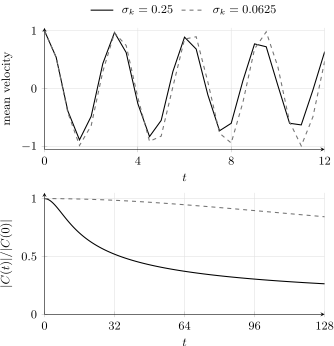
A separate near-rest fixture uses , zero mean momentum, and momentum widths and . Above: the coherent mean current, with lines joining exact samples separated by in time. Below: , computed from the complex spectral sum rather than estimated from sampled oscillation peaks. At the envelopes are and , respectively. This fixed fixture is distinct from the default moving profile packet.
The coordinate observable being studied matters. A consistent unitary change of representation transforms both states and observables and leaves their expectation values unchanged. The oscillation is not a literal microscopic trajectory of an electron and does not imply radiation or particle creation in this free calculation. The canonical interpretation explains the role of transformed observables. Phase dispersion in this finite-mode calculation is reversible and can recur; it is not irreversible loss of coherence to an environment.
Outputs and figure reproduction
Section titled “Outputs and figure reproduction”| Download | Contents |
|---|---|
| Summary and checks | Conventions, environment, program/CSV hashes, and all fixed checks |
| Profiles | Complex components, density/current, dephased profiles, and local interference |
| Diagnostics | Sector/component populations, velocity, energy, and qualified position moments |
| Refinements | Independent cutoff/box studies and numerical derivative residuals |
| Dephasing study | The two fixed near-rest packets at 257 times each |
Published report paths are normalized to download locations; numerical results and CSV bytes are unchanged. Custom command-line profile parameters do not replace the fixed verification or dephasing fixtures. Check the custom profile’s own diagnostics.
Place the TikZ/PGFPlots source
beside dephasing.csv and run:
latex notebook-dirac-coherence.texdvisvgm --no-fonts notebook-dirac-coherence.dviThe source also finds the retained CSV from the repository root. Its two row blocks are documented in the source. The five default profile times are too sparse to infer the oscillation frequency; the figure uses the separate, more densely sampled dephasing table.
A periodic-box centroid needs a separate check
Section titled “A periodic-box centroid needs a separate check”Multiplication by the coordinate on a periodic grid has a discontinuity at the box boundary. Its raw mean is not automatically a particle’s mean position on the infinite line. A packet crossing that boundary can appear to jump.
The program retains raw box moments,
but supplies line_position_if_diagnostics_pass
only when three checks agree: a conservative
travel-distance margin, a small edge
probability, and agreement with the
independent Heisenberg displacement from
Zitterbewegung.
The operator ordering in that displacement
is preserved; it is not obtained by
reusing the spatial centroid routine.
For the mixed packet at , the centroid differs from the Heisenberg prediction by about . At , agreement on the central refinement window is excellent, yet the global centroid discrepancy is and the line-position test still fails. At the default , the corresponding diagnostics pass. The returned blank position value in a failed case is therefore useful evidence, not a missing number to fill by hand.
These guards are numerical controls. They are not a compact-support theorem for Gaussian or nonlocally projected packets.
Independent verification and useful limits
Section titled “Independent verification and useful limits”The 157 checks include six exact rational assertions, independent eigensolver projectors, unitarity, local continuity, fixed sector populations, the pointwise current bound, and agreement with the ordered Heisenberg velocity and displacement. The retained continuity residual is at most .
At fixed , the coarse grid gives packet errors of about for positive-only data and for mixed data. Finer grids agree with the fine reference at roughly . The separate box test holds spacing fixed and compares a fixed central window. Neither study is replaced by checking norm conservation alone.
The diagnostic time derivative has a second-order residual, decreasing from at to at . It differentiates exact evolved data; it is not a time-stepping error.
The command-line experiment requires for its gap and inverse-Hamiltonian benchmarks. The evolution kernel has a well-defined at the massless zero-energy point, but do not. The code does not invent a sector assignment at that point.
Modification exercises
Section titled “Modification exercises”Delete a component or project a sector? At , apply to the column . Explain the upper-only result in the table.
Solution
The projection is , which is nonzero for . A localized upper-only packet samples such momenta and therefore generally contains both energy sectors. The component label is not a spectral-energy label.
Remove coherence without changing populations. Compare the coherent and dephased currents while retaining the same . Which quantity changes, and which do not?
Solution
The interference term is removed. The positive/negative sector populations, total norm, and free energy expectation are unchanged. Local density and current can change because their coherent cross terms need not vanish pointwise.
Trust a norm but reject a position.
Shrink --length while holding the
spatial spacing approximately fixed.
Why can the norm still pass while the
line-position diagnostic fails?
Solution
Finite-mode evolution remains unitary on the periodic box. It conserves the box norm even after periodic images or a boundary crossing affect coordinate moments. A line-position claim requires the additional edge, travel, and Heisenberg checks.
References
Section titled “References”- Bjorken, James D., and Sidney D. Drell. Relativistic Quantum Mechanics. McGraw–Hill (1964). Free Dirac dynamics and current.
- Thaller, Bernd. The Dirac Equation. Springer (1992). doi:10.1007/978-3-662-02753-0. Spectral sectors, localization, and the interpretation of free Dirac motion.